

Asia Pulp and Paper’s big REDD scam on the Kampar peninsula

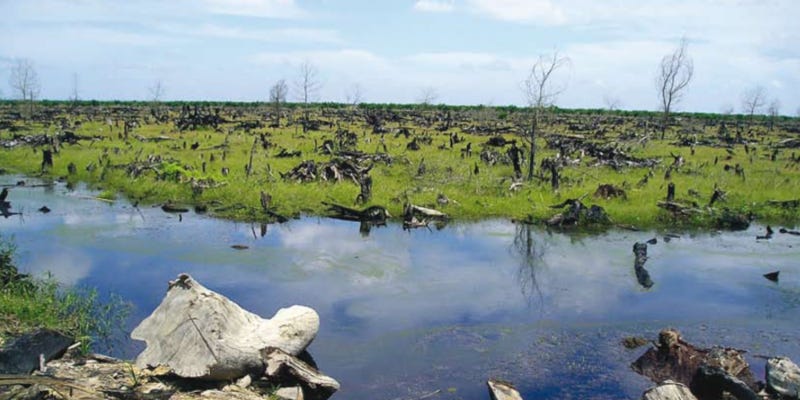
How can a company use the fact that it is one of largest forest destroyers in Indonesia to benefit from REDD? Easy. The very fact that the company is so destructive means that any forest in the company’s concessions is automatically threatened. So any patch of forest left standing must, by definition, be avoided deforestation.
That’s the trick that Asia Pulp and Paper is hoping to pull, with more than a little help from Indonesia’s Ministry of Forestry. In the process, APP is attempting to use REDD to re-brand itself. “One of the most destructive companies on the planet”, as George Monbiot described APP, now wants us to believe that it is protecting the forests and the climate.
A new report from Greenomics Indonesia exposes how two of APP’s “carbon reserves” are in fact set aside for commercial reasons and not because of a new-found interest in biodiversity or reducing deforestation. The report is titled, “Reasons Behind Asia Pulp and Paper’s Taman Raja & Kampar Carbon Reserves.” Greenomics Indonesia uses company reports to reveal that one of these areas of forest is in fact too steep to log and the other is of “low timber potential” and is “very difficult to access”.
APP claims that it is setting aside part of its concessions to protect biodiversity and to reduce emissions from deforestation. The company calls one of these areas the Kampar Carbon Reserve and it is working with Dorjee Sun’s company, Carbon Conservation, to establish a REDD project there. The forest area covers 15,000 hectares on deep peat and is part of a pulpwood plantation concession of PT Putra Riau Perkasa (PT PRP).
Aida Greenbury is Managing Director of Sustainability & Stakeholder Relations at Asia Pulp & Paper. In a press release at the launch of the project a year ago she said, “The Kampar Carbon Reserve is a gift from Indonesia to the world.” It would have been accurate to describe the project as a gift from the Indonesian Ministry of Forestry to APP.
Jago Wadley, a senior forest campaigner at the Environmental Investigation Agency, pointed out (in a comment on REDD-Monitor) that Ministry of Forestry Decree No. 101, 2004 (SK. 101/Menhut-II/2004) stated that “pulp and paper companies would not be permitted to harvest raw materials from natural forests after December 2009.”
Had this decree remained in place, it would now be illegal for APP to use the timber from the Kampar peninsula for its pulp and paper operations. But in January 2009, M.S. Kaban, then-Minster of Forestry, revoked the decree and allowed pulp and paper companies to continue trashing forests until 2015. In revoking the decree, Kaban created a threat to the forests of the Kampar peninsula and thus created the possibility of APP cashing in on REDD by leaving the forest standing.
In its new report, Greenomics Indonesia reveals that the Kampar Carbon Reserve may not be threatened after all. Greenomics quotes from a 2008 report produced by the concession holder, PT Putra Riau Perkasa:
Although this area [the PT PRP concession] was previously designated as a selective logging concession (HPH), having regard to the stunted nature of the forest with low timber potential, there would only be a very slim possibility that it could be exploited by a HPH company. At this time, there is no illegal logging taking place on the ground. Besides its lack of potential, this area is also very difficult to access, as it is far removed from the nearest roads or drains. Most of the rivers in the area are small, and many are clogged by vegetation. The only access into the area is on foot, with the journey taking between 1 and 3 days, that is, along the corridor of PT RAPP [a subsidiary of pulp and paper company APRIL] or Selat Panjang.
Greenomics Indonesia explains that the deep peatlands in PT PRP’s concession were not set aside as a result of APP’s “commitment to biodiversity conservation”, but because they were too difficult to get to. Further, the PT PRP report concluded that the concession could not be developed as a pulpwood plantation and that the entire concession was a high conservation value forest.
Since 2008, APP’s timber supplier PT Putra Riau Perkasa had no intention of clearing the forest in the Kampar Carbon Reserve. The forest is inaccessible and unless the laws are changed (again), it will be illegal to clear the forest in three years’ time. APP hopes to create carbon credits from this non-additional project which will allow pollution elsewhere to continue. And it is using this token project to greenwash the rest of its destructive operations.
Comments following the original post on REDD-Monitor.org are archived here: https://archive.ph/DBofC#selection-811.0-811.10