

Carvier Limited: “3 million units available!!” from Brazil – the ethical alternative to carbon credits?

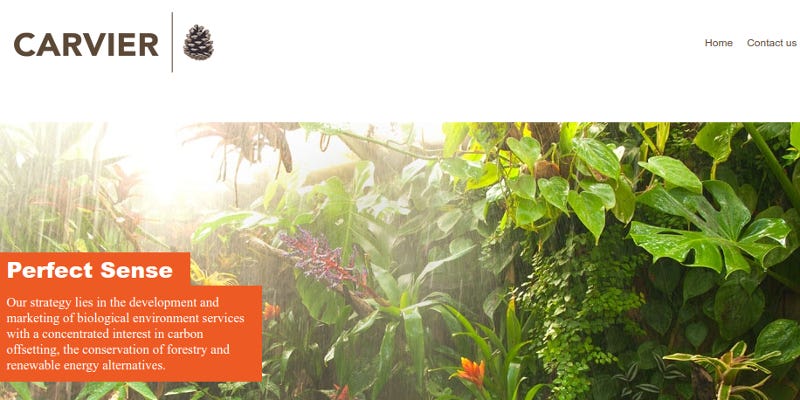
A company called Carvier Limited is advertising 3 million “Sustainability Credit Units” from an area of forest in Brazil. Predictably enough, REDD-Monitor had a few questions for Carvier Limited. And, perhaps just as predictably, Carvier Limited has so far not responded.
Here’s what we know so far about Carvier Limited and its “Sustainable Credit Units” from Brazil. Carvier Limited was incorporated in the UK in September 2011. The company describes itself as a “Carbon Reduction and Management Services Provider”. Barinua Nwikpo is the company director. Nwikpo is also director of another company called Tamar (London) Ltd.
On 30 March 2012, Tamar (London) Ltd was one of four companies that were “ordered into provisional liquidation by the High Court on public interest grounds” pending a court hearing on 29 June 2012. Courts appoint a provisional liquidator to avoid the risk that companies’ assets disappear before legal insolvency proceedings are completed.
The other three companies ordered into provisional liquidation were Johnnystone Limited, Brad Baker Limited and Tullett Brown. The director of Johnnystone Limited is John Nwikpo. The director of Brad Baker Limited is Bradley Ferry, who is also a director of Tullett Brown. Barinua, John and Daniel Nwikpo own a total of 74% shares in Tullett Brown.
Tullett Brown was a commodity trader, specialising in precious metals (gold and silver) and carbon trading. In March 2012, World Finance named Tullett Brown “Commodities Broker of the Year in Western Europe”. Simon Greenspan, a broker with Tullett Brown, accepted the award on behalf of Tullett Brown. Here’s what Greenspan had to say about carbon trading:
“It’s an area of the market that Tullett Brown, not only are we very excited about, we are very passionate about it. At Tullett Brown we’ve only ever invested in areas of the market that have truly stood the test of time, such as gold and silver and property. When our analysts were looking for the next great area of growth it was fairly obvious to them. It was the planet, it was the environment. The preservation of the planet allows us at Tullett Brown to give our clients what they truly seek, which is sustainable returns for many years to come.”
On 23 May 2012, I wrote to Carvier Limited. Chantel Koorts at Carvier Limited replied the same day explaining that,
“I forwarded this on to my Director for your response, he will be able to answer any question and provide any reports and documentation requested. However he is not due back till next Thursday.”
REDD-Monitor looks forward to his response. Meanwhile Koorts continues to post exciting looking offers, such as the following, on 29 May 2012, on LinkedIn:
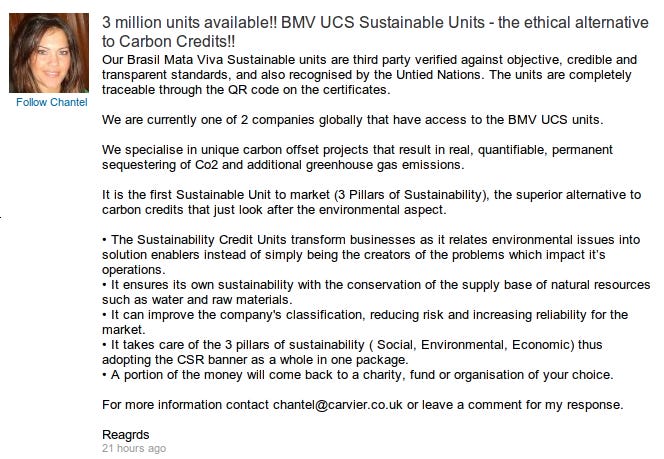
Apart from the obvious question about the United Nations not yet “recognising” any REDD credits, because there is not yet an agreement at the UNFCCC about REDD, this raises more questions about Brasil Mata Viva and its Sustainability Credit Units.
Brasil Mata Viva describes itself as,
a Brazilian standard dedicated to valuing the rural landowner, so as to achieve its principal objective of harmonizing human activity by promoting the conservation of biodiversity, and incentivizing the rational use of natural resources, thus benefitting the citizens of today as well as future generations.
The company has produced a video, in which it describes the way that Brasil Mata Viva works as follows:
[F]irst, identifying the remaining forests in the selected areas, when the Carbon Level Storage is estimated in each property. This credit is turned into financial incentive for new technology used in manufactured products by the community in order to improve life’s conditions, to achieve the desired sustainability. There are two situations: the farmer is payed [sic] to take care of the native forest and its carbon storage, becoming its depositary just after receiving the fund. And the other situation is that the farmer get payed to recover the vegetation, producing new levels of carbon storage.
Which doesn’t make much sense to me either. The Brazil Mata Viva website includes a list of projects, but it’s difficult to work out what the standard actually is, how it is validated, who does the validation, what total area the projects cover and so on. REDD-Monitor looks forward to hearing more about this from Carvier, from Brasil Mata Viva and from anyone who can provide further information.
From: Chris Lang
Date: 23 May 2012 21:02
Subject: Some questions about the Brasil Mata Viva Program
To: Chantel Koorts, Carvier LimitedDear Chantel,
Greetings from Jakarta! My name is Chris Lang and I work on a website called REDD-Monitor.
I recently came across the Carvier website and would be grateful if you could answer a few questions about the forestry project in Brazil.
1. How many people does Carvier Limited employ?
2. Could you please describe the Brasil Mata Viva Program. What area is covered by the project(s)? Has a project design document been produced for any of the project areas? Is the document publicly available?
3. Could you please send me a copy of the “BMV Standard” referred to on your website (http://bit.ly/Kok07Y). What area of forest has been certified as complying to this standard? How many Sustainability Credit Units (UCS) have been generated so far? How many do you anticipate generating?
4. How much are selling each UCS for? How many have you sold so far?
5. Do you see a future in this sort of offsetting, given the fact that the price of carbon on the European Trading Scheme has crashed? If so, what future do you see?
6. Recently, the Financial Services Authority issued a warning about the dangers involved in buying carbon credits (http://bit.ly/mPQfNS). How does the public in the UK know that the carbon offsets (or UCS) that Carvier is selling are genuine?
7. On the Carvier webpage “UCS Generation” (http://bit.ly/Jn3t5v) it states that all UCS sustainability units are validated by UNESP, the University of Paulista, in Sao Paulo. Could you please provide more details about the validation process and provide a contact at UNESP that I could ask further about this.
8. The same page on Carvier’s website states that “TUV Reinland [sic] will verify all findings from previous studies undertaken on the project area”. Please provide more details about this verification process and a contact at TÜV Rheinland who could answer further questions about this.
Thank you for your time and I look forward to hearing from you. Please consider your response to be on the record.
Regards, Chris Lang
Comments following the original post on REDD-Monitor.org are archived here: https://archive.ph/OoQ8D#selection-907.6-907.17