


“R”, a commenter on REDD-Monitor, recently told his story about buying voluntary carbon credits from a company called City Asset Partnership. He paid a total of £1,525 for 250 credits, a price of £6.10 per credit. Unfortunately, the company seems to have all the hallmarks of a boiler room scam.
City Asset Partnership told “R” that he would make a profit and that he could sell the credits at any time. The credits have not been sold and now when he phones the company he doesn’t get past the receptionist.
On the home page of its website City Asset Partnership advertises investments in a range of commodities: rubber, oil, diamonds and property. There’s no mention of carbon credits. But a quick search reveals that the company has lots of news stories about carbon markets and a page dedicated to carbon credits. (A search for the word “carbon” on City Asset Partnership’s website gave about 202 results.)
And City Asset Partnership has another website dedicated to the sale of carbon credits, either to companies looking to offset their emissions or to individuals “looking to trade”. And here we find a selection of the usual misleading statements about voluntary carbon credits:
Fortune: “JPMorgan isn’t alone. All the big global investment banks including Barclay’s Citigroup, Goldman Sachs and Merrill Lynch are hurrying into carbon finance.”
Chris Leeds, Head of Emissions Trading, Merrill Lynch: “Carbon could become one of the fastest growing markets ever.”
Louis Redshaw, Barclays Capital: “Carbon will be the world’s biggest commodity market and it could become the World’s biggest market overall.”
UBS: “Carbon prices may triple by 2013.”
The most important thing to note about all these impressive sounding quotations is that there are no dates on any of them. They may have been true a few years ago, but today the reality is dramatically different. Carbon markets are in crisis. Last week, Louis Redshaw resigned from his position as head of carbon, coal and iron ore trading at Barclay’s. In February 2013, his colleague Trevor Sikorski, head of carbon, natural gas and coal research, also left Barclays. “We’re seeing a lot of talent move on from the carbon market,” Dirk Forrister, president of the International Emissions Trading Association, told Bloomberg.
On its website, under the headline, “Potential for Growth”, City Asset Partnership explains that,
The prices of the credits themselves vary and can be volatile, creating the potential for large gains as demand grows. The head of the International Energy Agency has said that the price of carbon credits is still too low, and must rise to $175 a metric ton in order to halve global emissions by 2050. Most analysts see a strong future ahead for carbon credit investment.
This statement is part true, but is nevertheless misleading. In November 2010, Bloomberg did report Nobuo Tanaka, the head of the International Energy Agency, as saying that the price of EU allowances, traded on the EU Emissions Trading System, “must rise to $175 a metric ton in order to halve global emissions by 2050”. So far so good.
But since then, the price of EUAs has fallen steadily. The current price is €2.97.

Far from seeing a strong future ahead, most analysts despair about the current state of the carbon market. Here’s Marcus Ferdinand, an analyst at Thomson Reuters Point Carbon, explaining what is likely to happen to the price of EUAs between now and 2020:
“In the meantime carbon prices will bump along the bottom, waiting for further signals from Brussels to strengthen the market framework.”
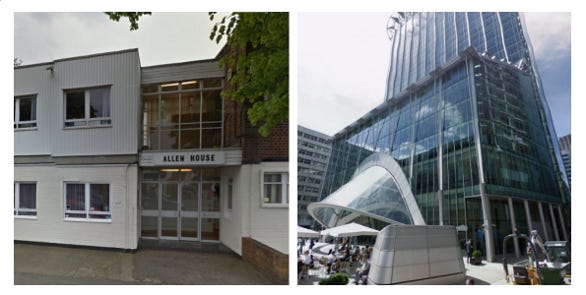
City Asset Partnership was established in November 2011. Its sole director is William Edward Strutt, who is a civil engineer. The front page of the company’s carbon credits website shows the entrance to the Citypoint office building in London. That’s the address the company gives on its website. But the company’s registered and trading address is in Sutton, Surrey. The postcode in Sutton is shared with 555 other companies – given the size of the building, it’s almost certainly a mail forwarding service address. Citypoint, on the other hand, is a huge building. Needless to say, City Asset Partnership does not give a room number or a floor number in the contact address on their website.
Here are the two offices on Google streetview. I’ll leave it to you to decide which is which:
On the website of a publication called The European, is an article titled, “Carbon investments: Would you credit it?” It’s the same headline and same article that MH Carbon’s Richard Clark somehow managed to get published on the Financial Times website. But now it features City Asset Partnership’s logo at the top of the article, a photograph of Citypoint and at the end of the article, contact details are given as City Asset Partnership.
As usual with this type of company’s website, the most (or only?) honest statement is the disclaimer:
Any carbon credit price shown is indicative only and based on current exchange rates. The price of Carbon Credits can go down as well as up. It may be difficult to ascertain a market value for VERs as many are transacted “over the counter” and, as such, prices may vary from reseller to reseller.
Currently VER’s are illiquid in comparison to the credits traded on the Compliance EUA Credit Market. There may also be a big difference between the buying and selling prices of carbon credits. Trading in carbon credits involves risk. You may get back less than your total outlay and there is a risk that you will make no recovery. However you may also benefit from any possible increase in the value of the carbon credits. Any growth shown or suggested is a projection only and cannot be guaranteed.
UPDATE – 2 May 2013: City Asset Partnership is advising people to invest their self-invested personal pension (SIPP) in voluntary carbon credits. And they are doing so by making misleading claims about the potential profits available. These screenshots are from a City Asset Partnership brochure titled, “Guide to SIPPS”:
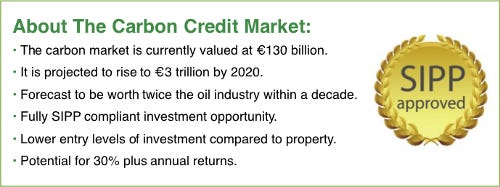
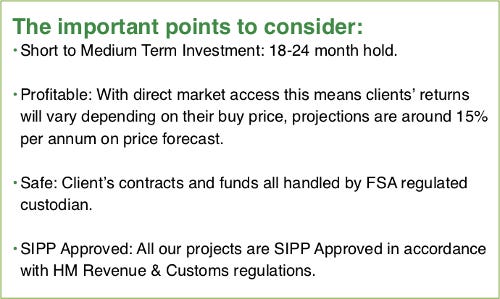
Apart from the misleading claims about potential profits, in January 2013, the FSA put out a warning about companies that are advising people to invest their pensions in unregulated products through a SIPP.
City Asset Partnership’s claim that “Client’s contracts and funds [are] all handled by [an] FSA regulation custodian” is also misleading. The company was listed on Carbon Neutral Investments’ list of clearing members. In March 2013, the Financial Conduct Authority put out a warning about Carbon Neutral Investments explaining that voluntary carbon credits are not regulated and that “you will not have access to the Financial Ombudsman Service (FOS) or Financial Services Compensation Scheme (FSCS) if things go wrong,” regardless of whether the company handling the money is registered by the FCA.
Carbon Neutral Investments has now changed its name to Gemmax Solutions (which is not on the FCA registered list of companies). City Asset Partnership is listed as “Dormant” on Gemmax Solutions’ website (and the web address is given as cityap.net, instead of cityap.co.uk – or puffin-test.com/CAP, which is City Asset Partnership’s carbon credits website).
Comments following the original post on REDD-Monitor.org are archived here: https://archive.is/N26m6#selection-1319.4-1319.15