

Confusion and alarm over ASC Impact’s carbon plantations in Gambella, Ethiopia
“The trees make us very worried.”

A Swiss company called ASC Impact GmbH is developing a tree planting project in the Gambella region in the west of Ethiopia. The Sustainable Forestry in Gambella project is in the Gog district and covers a total area of 27,500 hectares. About 20,000 hectares will be planted largely with eucalyptus and acacia trees, and the rest is split between a “bio reserve” and community-based agriculture.
While ASC Impact markets itself as investing in “sustainable” projects, villagers in the Gambella region are concerned. “The trees make us very worried,” Ob Omot tells Jennifer Steiner and Anina Ritscher, journalists writing in the Swiss newspaper WOZ.
ASC Impact is a private equity firm that invests in agriculture and forestry project. It was founded in 2021 by Christian Winkler, a former banker at Credit Suisse and venture capitalist, Matthias Schulz, a lawyer and entrepreneur, and the Kirchmayer family, which bought up almost 150,000 hectares of forestry operations in Eastern Europe and is now moving into Africa.
“We pay nothing for the land there,” ASC Impact’s CEO Karl Kirchmayer tells WOZ. Project documents state that “The land is legally owned by the project developer and has been procured from the local Government of Gog Woreda in Gambella.”
Plantations in Ethiopia, Republic of Congo, and Angola
ASC Impact is also developing tree plantation projects in the Republic of Congo and Angola, with a target of 150,000 hectares of land. ASC Impact is promising investors in its projects an annual return of 20%, WOZ reports.
An Austrian company called EcoNetix GmbH is also involved in the project in Ethiopia. A December 2023 report states that EcoNetix has signed a deal with investors to market millions of carbon credits in the United Arab Emirates. Mohammed Sulaiman Alfahim, who is a managing director of something called Alfahim Holding in Dubai, and is an advisory board member of EcoNetix and ASC Impact. In 2023, he founded Sustain Now, which aims to market the carbon credits.
A trip to Ethiopia
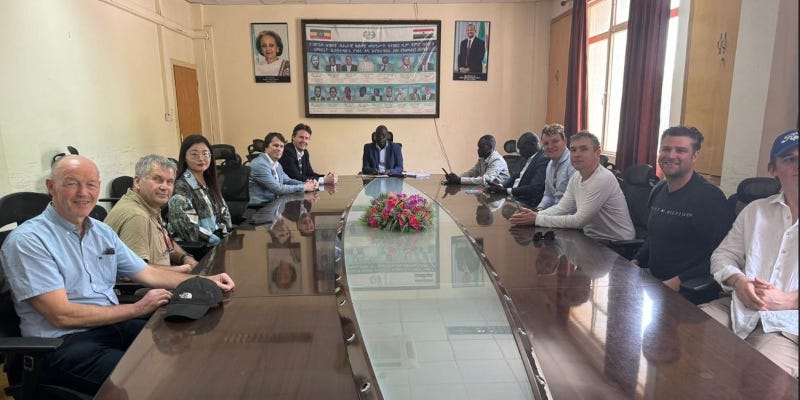
Two years ago Andreas Rickert visited what he calls “our forest project in Ethiopia”. At the time, Rickert was CEO of Nixdorf Kapital, an impact investment firm. A related company, Nixdorf Impact Movement Management GmbH manages ASC Impact Forestry Fund GmbH & Co. KG.
Rickert previously worked at McKinsey and the World Bank, and in 2010, he founded a consulting firm called Phineo. Rickert acknowledges that “what looks good on paper, can still be challenging to implement”.
But he writes that he was not only “convinced” but “enthusiastic!”
According to Rickert, Thomas and Karl Kirchmayer had in recent years developed this large project together with local people in a way that it “has truly become a community project”. The president of Gambella, Omot Ojulu Obup, reaffirmed his support in a meeting and “made an additional 60,000 hectares of land available”.
Rickert writes that,
The team has defined a set of 180 KPIs [Key Performance Indicators] to monitor and ensure that we achieve the greatest possible positive social and environmental impact when we carry out large-scale reforestation.
He promises that the project would “build a bridge, create jobs including local management, drill wells for clean drinking water, and build a school and hire teachers.
Indigenous People’s organisation raises the alarm
In February 2024, the Anywaa Survival Organisation raised the alarm about the signing of the land acquisition contract with ASC Impact. Anywaa Survival Organisation explains that, “The targeted land belongs to the Nyikani sub-clan of the Anywaa indigenous people and has been an important source of livelihoods for generations.”
ASO describes the land as “rich in fish stocks, rare and protected trees and fertile arable land” that people use for “farming, hunting, grazing, and fishing grounds”.
ASO is concerned that the land deal threatens Indigenous People’s livelihoods and culture. They accuse ASC Impact of making promises of investment to hand-picked community leaders to convince them to support the project.
Matthias Schulz, a co-founder of ASC Impact tells WOZ that, “Drone images and satellite images clearly show that neither livestock farming nor farmland exists on this piece of land.”
WOZ reports Ob Omot as saying that the first he new about the project was when he saw images of the contract signing on social media. “We do not know what government and companies have agreed on or what consequences the project will have for us,” another person who wanted to remain anonymous says. He lives in the regional capital and often visits relatives south of the project area. “A lot of people in the villages are confused and therefore reject the project,” he says.
Stakeholder “consultation”?
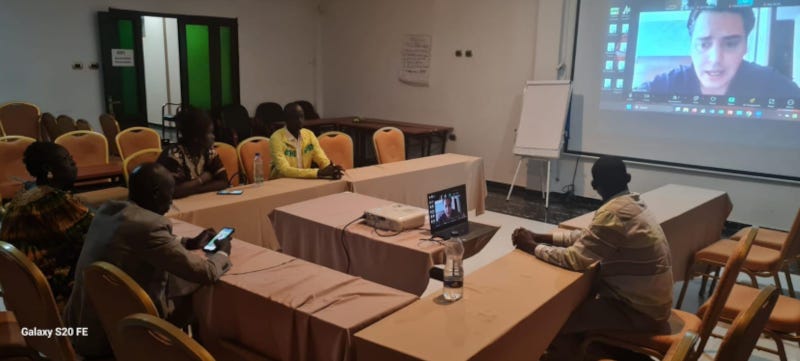
The project is listed on the Gold Standard’s registry, but the project has not been validated. In December 2024, the project uploaded a draft Stakeholder Consultation Report to the Gold Standard project page. The 38-page report is based on a meeting that took place at the Captain Hotel in Gambella on 23 September 2024. About 20 people attended the meeting, only two of whom were women.
The meeting consisted of an online presentation by Joko Zenz, CEO of EcoNetix. He spoke about his company, the project, the Gold Standard registry and “the importance of carbon project, including nature-based solutions”. The presentation was followed by questions and answers. There was also a “stakeholder feedback round” following the meeting.
At least two things are blindingly obvious from this report. First, the people taking part in the meeting knew very little about the impacts of planting such a large area with fast growing trees. Second, this was about as far it’s possible to get from a process of free, prior and informed consent.
Nevertheless, project documents list the project start date as 7 March 2025. A Forward Action Request was raised for the Validation and Verification Body to ensure that the stakeholder consultation process complies with Gold Standard requirements.
WOZ’s journalists, Steiner and Ritscher conclude that,
The basic conflict goes far beyond Gambela: In order to combat a climate catastrophe caused by the north, land is claimed in the south. And profits and carbon credits flow back to where the capital comes from.