


Trying to calculate how much avoided deforestation has been achieved through a REDD project is not an easy matter. In fact it’s impossible without knowing what would have happened in the absence of the REDD project.
“Offsets are an imaginary commodity created by deducting what you hope happens from what you guess would have happened,” as Dan Welch brilliantly put it five years ago.
This is known as a counterfactual, or a description of what did not happen, but what might, could or would happen under different conditions. Without this counterfactual version of events, it’s impossible to know how many tons of carbon were not emitted into the atmosphere and it’s therefore impossible to know how many carbon credits can be issued from a given REDD project (or from a national level REDD programme).
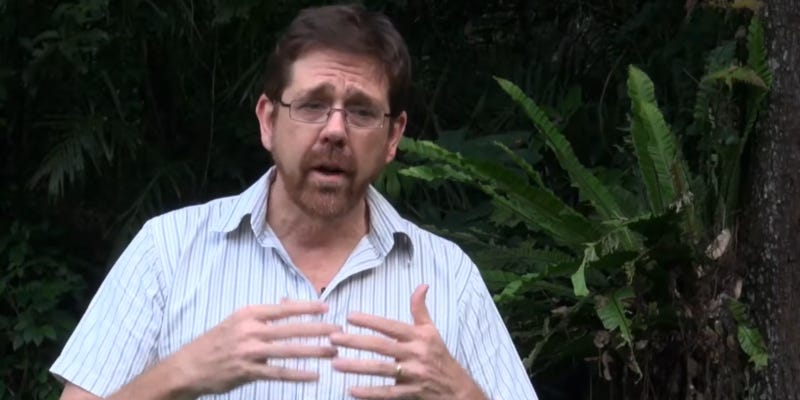
Fortunately, we have experts like Lou Verchot, Director of the Forests and Environment Programme at CIFOR, to explain how REDD is going to work. Here here is talking at Rio+20 in June 2012 (the video is posted below). First, Verchot explains, we need a reference point:
“Reference emission levels are the reference point from which you begin counting how much emissions reductions you may be able to achieve. Reference emissions levels set up a counterfactual of how much emissions levels would have been, would have occurred in the absence of activities to reduce the emissions. So, it’s a little complicated to set up because it is exactly that, it’s the counterfactual, it’s something that did not happen.”
A “little complicated”? That’s some understatement. The REDD that Verchot is discussing is a carbon trading scheme (otherwise why bother going to such extraordinary lengths to measure the carbon not emitted against a counterfactual guess of what would have been emitted?). REDD credits will be sold, allowing emissions from burning fossil fuels to continue somewhere else. The CO₂ thus emitted will remain in the atmosphere for around 100 years. That means we need to know what would have happened, in absence of REDD, for the next 100 years as well, as knowing that the forest will actually remain standing for the next 100 years.
Verchot continues:
“But you also want to set it up in a transparent way that everybody can agree upon, so it has to be, it’s some part negotiation, some part technical determination of what would be a reasonable deforestation level, what would be a reasonable emissions level if you did not have deforestation or if you had business as usual with no reduction in deforestation.”
Verchot explains that the technical side involves looking at historical deforestation rates and the causes of that deforestation. Obviously, agreeing on what did not happen, but might have happened if conditions were different will take quite a lot of negotiation.
“The difficulty is really in this element that it’s counterfactual. It’s something that did not happen. So how do you, you know, under normal circumstances without much variation in the economy you can certainly expect the last five years to be a good predictor of the next five years. But nobody expected the financial crisis, for example. Nobody could predict these big changes, these inflection points. And that’s where things get a bit difficult.
“You know if you go through a financial crisis and the returns to land decrease, you expect a strong reduction in conversion of forest area. If you get a price spike, if food prices go up, you would expect agricultural land to expand. and so predicting some of these flash points, or these points where there are major changes, that cause inflections in your deforestation rate is very difficult.
“And that’s where things get a little complicated.”
There he goes again. A “little complicated”? The interviewer asks Verchot about how this can be addressed. And this is where it gets really scary. Not only do we not know what might happen in the future, we don’t really know enough about what happened in the past either, because, as Verchot points out, many countries, “don’t have good deforestation data”. By now the whole idea of selling carbon credits is looking pretty flaky. If Verchot is fazed, he doesn’t show it:
“We’ve put together a stepwise approach. And the stepwise approach really is data driven. One of the problems is that we are trying to do this in countries that don’t have good deforestation data. They don’t understand how much, they don’t have good data on how much forest they currently have, what had been the deforestation rate. So we lay out some ways to get started. There are datasets out there that everyone has access to, they have problems, everyone knows what the problems is, but at least they are datasets and they are consistent over time.”
Consistent over time? Wrong, but consistently wrong. But when you’re comparing the data to a guess of what might have happened in order to generate an imaginary commodity, that’s the least of your worries.
“You can start with that and set out your reference emissions level. But then what we did is we laid out pathways to prove that. So how could we go about improving the estimates of the area that’s been deforestation. Through satellite imagery, through non-spatially explicit to more spatially explicit types of approaches. How would we go about improving our emissions estimates, because you know it’s not just about the area that’s deforested, it’s about how much carbon is held in the trees on those areas that’s deforested. And that varies. A forest on top of a mountain, or a forest that’s at sea level, a tropical rainforest or a dry forest all have different carbon contents. So we set out a pathway of how do you go from very basic information to getting more complete information so that you get better estimates, more accurate estimates and less bias. So you can improve the precision as well as the accuracy.”
There’s another counterfactual to be considered. What would happen if the finance for REDD didn’t appear? Given that the amount of carbon not emitted under a REDD programme is anybody’s guess and that the UN-led carbon market is close to collapse as the Financial Times commented two days ago, things look pretty shaky.
“Right now everything is in the readiness phase, there’s no long term certainty of funding for REDD. That’s one of the things that our research is showing is a major impediment to REDD moving forward. Demonstration projects are being set up but they are not scaling up because they have no certainty of long term funding.
“The problem is of spending the money that’s available right now…. Countries are having problems spending the money that’s available right now. But they are having problems because they are not ready to invest in institution building, in capacity building, in some of these long term things that are required, because the long term certainty of REDD, of REDD financing, is just not there.”
Talking about the stepwise approach, Verchot notes that it has been agreed in the UNFCCC negotiations, at least in brackets.
“This is our suggestion, and something that we’ve actually demonstrated can work through our research. . . . Getting reference emissions levels set is the first step, because now a country can go to another country and say our reference level, we think our emissions levels are this and they are going to be this for the next five years. Let’s talk about what sort of compensation we can get and we can talk about what type of emissions reductions we are ready to commit to. So it sets the benchmark from which the international negotiations can happen. Both on the finance side, but also on the emissions reduction side. It’s the first step.”
Earlier this year, REDD-Monitor interviewed Frances Seymour, then-head of CIFOR. Seymour claimed that CIFOR did not take a position on carbon trading. Yet CIFOR has put forward a suggestion which apparently has been taken up by the UNFCCC for solving a problem that is only relevant to REDD as a carbon trading mechanism. That is taking a position.
Comments following the original post on REDD-Monitor.org are archived here: https://archive.is/9sDYv#selection-1725.4-1725.14