

Crooked Carbon Business: Overview of documentation
Carbon trading has made the climate crisis worse.

Over the past weeks, REDD-Monitor has featured a series of posts under the headline “Crooked Carbon Business”, written by Simon Counsell and Jutta Kill.
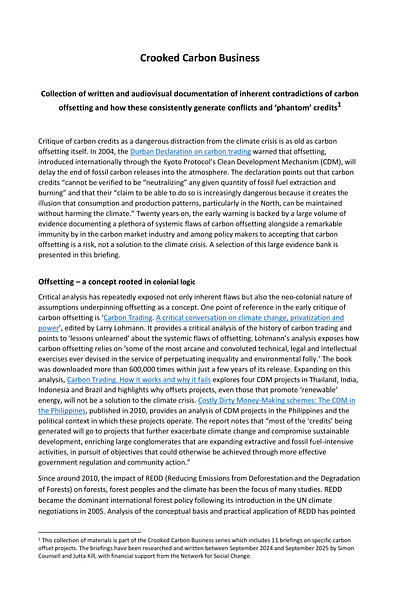
Today’s post is the final one in the series and instead of a case study, it’s an overview of the documentation of “inherent contradictions of carbon offsetting and how these consistently generate conflicts and ‘phantom’ credits”.
The overview can be downloaded here:
I recommend reading the overview in full and clicking through to the many sources of information in the document. There is way too much information to attempt to summarise in a short post here.
Instead, here are some of the NGO reports from the past two decades that have highlighted the fundamental and dangerous flaws that are inevitable in carbon markets. These flaws cannot be resolved by better methodologies, better regulation of carbon markets, or technological fixes.
The purpose of carbon trading is to allow the fossil fuel industry to keep profiting from destroying the climate for as long as possible.
Durban Declaration
The Durban Declaration on Carbon Trading came from a meeting held in Durban, South Africa in 2004. More than 20 years ago, it warned that offsetting will delay the end of fossil fuel extraction:
[T]he internal weaknesses and contradictions of carbon trading are in fact likely to make global warming worse rather than “mitigate” it. CDM projects, for instance, cannot be verified to be “neutralizing” any given quantity of fossil fuel extraction and burning. Their claim to be able to do so is increasingly dangerous because it creates the illusion that consumption and production patterns, particularly in the North, can be maintained without harming the climate.

Carbon Trading
In September 2006, the Dag Hammarskjöld Foundation published “Carbon Trading: A critical conversation on climate change, privatisation and power”. The meeting in Durban was the starting point for the book, which was edited and written by Larry Lohmann of The Corner House.
The book starts by outlining the problem: “climate change is closely tied to the burning of oil, coal and gas”. And the solution: “keeping fossil fuels in the ground”.
A short history of carbon trading focuses on how it was “Made in the USA.” A chapter on “lessons unlearned” looks at the systemic flaws of carbon trading. This is followed by a series of case studies of offsetting projects around the world. The book ends with ways forward, focused on grassroots movements, particularly in the Global South.
CDM in the Philippines
In June 2010, Focus on the Global South published a report titled “Costly Dirty Money-Making schemes”. Written by Herbert Docena, the report investigates the Clean Development Mechanism in the Philippines.
Docema writes that,
Most of the “credits” being generated will go to project that further exacerbate climate change and compromise sustainable development, enriching large conglomerates that are expanding extractive and fossil fuel-intensive activities, in pursuit of objectives that could otherwise be achieved through more effective government regulation and community action. Rather than allowing governments and communities to embark on a just transition towards a more sustainable path, the CDM is rewarding government ineptitude and supporting the very agents that contribute to climate change — while allowing rich countries to continue avoiding the reductions necessary to mitigate climate change.
Carbon trading (again)
In November 2009, the Dag Hammarskjöld Foundation published a report written by Tamra Gilbertson and Oscar Reyes both then working with Carbon Trade Watch. The report, titled “Carbon Trading: How it works and why it fails”, was an updated, shorter analysis of themes covered in Larry Lohmann’s 2006 book.
The report introduces carbon trading, explains how it is supposed to work, and looks at some of the actors involved. Gilbertson and Reyes write that,
The report tells the story of how, from its global beginning as part of the Kyoto Protocol in 1997, carbon trading has failed to change the way we acquire and use energy, while short-circuiting demands for the fundamental reforms needed. In the process, it has rewarded polluters for continued pollution while at the same time causing social and environmental injustice.
The report includes a history of carbon trading, how the EU Emissions Trading System overallocated permits, rewarded Big Polluters, and failed to reduce emissions. Four case studies of Clean Development Mechanism projects in Thailand, India, Indonesia, and Brazil expose how the CDM increased emissions rather than decreasing them. “If every project were designed and implemented perfectly,” Gilbertson and Reyes write, “the net result would be the to move emissions from one place to another with no net reduction.” In fact, the CDM is “riddled with inadequacies” with many projects not representing any emissions savings.
15 years of REDD
In April 2022, World Rainforest Movement published “15 years of REDD: A mechanism rotten at the core”. In the Foreword, the WRM International Secretariat writes that,
The experience of the past 15 years has shown an overwhelming record of REDD’s catastrophic failure to address deforestation and forest degradation – and worse: it has also intensified the climate crisis and left the causes of deforestation untouched. REDD, in fact, has become an underlying cause of deforestation and climate change itself.
The report starts with a critique of REDD by Jutta Kill, an explanation of the difference between fossil carbon and biotic carbon by Joanna Cabello, and a chapter titled “Ending colonialism mean ending REDD+” by Larry Lohmann.
The report also includes detailed case studies of REDD+ in Acre, Brazil, REDD+ in Colombia, the Katingan REDD+ project in Indonesia, the Nhambita carbon project in Mozambique, the PIREDD/Plateux REDD+ project in the Democratic Republic of Congo, and nature-based solutions in Gabon.
And it ends with a chapter that I wrote about the links between Big Polluters and the carbon trading industry:

Carbon offsets unmasked
In 2024, the Dutch NGO Centre for Research on Multinational Corporations (SOMO) wrote a series of articles debunking the corporate myths about carbon offsets: “Facing the fact: carbon offsets unmasked”. The series summarises the evidence showing that carbon offsetting does not work.
“On the contrary,” SOMO writes, “offsetting fundamentally undermines emissions reduction, forest protection, and human rights.”
Several of SOMO’s myth-busting articles have appeared in REDD-Monitor’s series “REDD myths”.
The first of SOMO’s series of articles looks at colonialism, fossil fuels, and carbon trading. It traces the links between fossil fuels and colonialism, neocolonialism, and neoliberalism.
From the 1990s, corporations have effectively captured the international negotiations on climate change. From the 1992 Earth Summit in Rio, where corporations sponsored the summit and had a major lobbying presence, Big Polluters have been able to shape the international climate agenda to their liking.
This, of course, includes carbon trading. “The offset industry reinforces colonial relations between North and South,” SOMO writes, “and is increasingly described in terms of ‘green colonialism’ or ‘carbon colonialism’.
Docena's Philippines CDM research really nails how offsets reward ineptitude while enriching the exact actors driving climate breakdown. The two-decade documentary trail here shows structural problems thatcan't be fixed with better methodologies because relocating emissions geographically was never gonna solve anything. When finance mechanisms become substitutes for actually reducing extraction, the neocolonial dynamics SOMO describes aren't bugs but features. dunno why this keeps surprising people.