

Dams and logging in Sarawak: Can REDD stop the destruction?

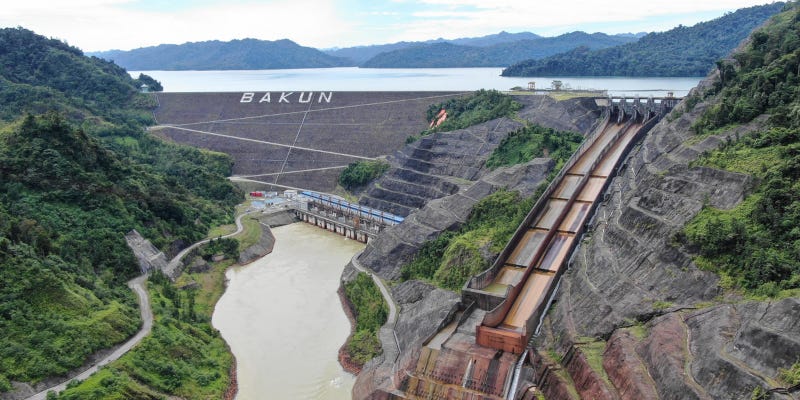
In 2011, the 2,400 MW Bakun dam started operations in Sarawak, Malaysia. Transparency International described the US$2.2 billion project as a “monument to corruption”. The reservoir behind the dam flooded 70,000 hectares of forest. About 10,000 Indigenous People were forced into new houses that they had to pay for themselves.
The Sarawak government plans to build 12 more dams by 2020. The impact on the people, forests and rivers of Sarawak will inevitably be severe. However, others are firmly in favour of more dams, among them Sarawak’s Chief Minister, Abdul Taib Mahmud. Taib has been in power for more than three decades and during that period he has become a multi-billionaire.
Last year, Sarawak Report spoke to one of Taib’s key business partners, who described Taib’s Ten Income Streams. The logging and palm oil industries provided many of the income streams. He demands money for issuing timber licences:
Cronies who deal with the Chief Minister are instructed to pay their bribes and kickbacks into foreign bank accounts outside of Sarawak, often in Hong Kong or Singapore in the early days.
Another source of income is through Federal Government and State contracts. Nearly all government projects in Sarawak are constructed by Taib family companies. The Malaysian Anti Corruption Commission is currently investigating Taib and his fortune.
Hamed Sepawi is the Chairman of Sarawak Energy Berhad, Sarawak’s dam-crazed electricity utility, is Taib’s cousin and business crony. In addition to the Bakun Dam, Sarawak Energy is looking forward to profiting from the hydropower boom in Sarawak. Hamed Sepawi also just happens to be chairman and owner of Ta Ann, one of the largest logging companies in Sarawak. The company has logging concessions covering a total area of 362,439 hectares and plantation licences covering 313,078 hectares.
Both Sarawak Energy and Ta Ann have Australian connections. Hydro Tasmania, owned by the Government of Tasmania, is involved in the Bakun dam and other dams in Sarawak, through its consulting arm, Entura. In 2008, Ta Ann signed a deal with Tasmania to log large areas of Tasmania’s forests, including areas that were supposed to be protected. Ta Ann’s logging operations are notorious in both Sarawak and Tasmania.
This week, Dateline, an Australian current affairs TV programme, broadcast an investigation into the impacts of the Bakun Dam and Ta Ann’s logging.
Later in the week, Roy Adair, the CEO of Hydro Tasmania provoked ridicule on ABC radio by admitting that Hydro Tasmania undertook practically no due diligence before working with Sarawak Energy Berhad, the company leading Sarawak’s dam building charge. In fact, the only check that Hydro Tasmania appears to have undertaken was to check “that SEB is a member of the International Hydropower Association and following the International Hydropower Association protocol on sustainable development.”
Only two problems there. First, membership of the International Hydropower Association is available to anyone who hands over £1,000. Second, Entura started working with Sarawak Energy in 2008, but Sarawak Energy only joined the IHA in 2010.
Most proponents of REDD would probably agree that forest destruction, abuse of indigenous peoples’ rights and corruption are serious problems. All are currently rampant in Sarawak. REDD-Monitor has a question for REDD proponents: What part of the REDD mechanism can possibly address the problems underlying the destruction of Sarawak’s forests?
This is not to suggest that business as usual is an acceptable option. Or that the NGOs and journalists who have been documenting and exposing what’s happening in Sarawak can miraculously stop the destruction. Or that the indigenous peoples who have blockaded roads against loggers and who continue to protest against dam construction will suddenly gain the right to say no to the “development” that profits others but demolishes their livelihoods and culture.
A search for the word “development” on the Chief Minister of Sarawak’s website, which includes Taib’s speeches and press releases, returns 100 hundred results. The word “deforestation” is not mentioned once. Neither is “REDD”.
Comments following the original post on REDD-Monitor.org are archived here: https://archive.is/lPYi1#selection-1339.4-1339.14