

Deforestation in Indonesia continues, despite the moratorium

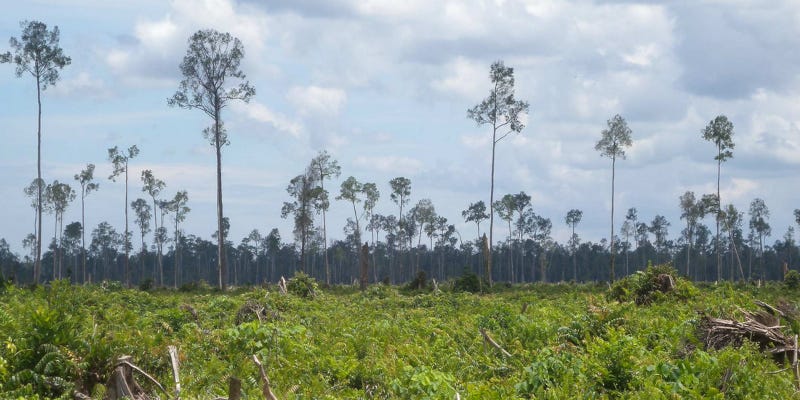
Five million hectares of forest has been removed from Indonesia’s moratorium in the 12 months since the President announced a two year moratorium on new forest concessions, according to Greenpeace.
The Jakarta Globe reports that at a press conference yesterday, Kiki Taufik, a geographical information specialist with Greenpeace Indonesia, said that the five million hectares were not included in the moratorium maps. 1.9 million hectares of forest was removed from Kalimantan and 1.7 million hectares in Papua.
Kiki explained that the areas of forest were not protected because their status was not clear. Deforestation continues in Indonesia. The Jakarta Globe quoted Kiki as saying that,
“In Kalimantan, most of the destroyed forest was in regions where coal concessions were already granted. In Papua, the forest was cut down under pre-existing logging concessions.”
There are many problems with the moratorium, which have been pointed out in previous posts on REDD-Monitor. It doesn’t apply to existing concessions. It doesn’t apply to secondary forest. It’s not legally binding. There are a series of loopholes. It is limited to two years (rather than being performance based). But the worst thing about the moratorium is that it is not reducing deforestation.
The inadequacy of the moratorium was illustrated earlier this week when the Jakarta Post reported that 115 companies have carried out illegal mining operations on an area of almost 500,000 hectares, according to a Supreme Audit Agency (BPK) report dated January 2012.
Greenomics Indonesia points out that BPK also found illegal operations in the palm oil sector. The Norwegian Government Pension Fund Global even owns shares the Malaysia-based KLK Group that owns one of the companies found to be operating illegally. Investigators from the Environmental Investigation Agency and Telapak caught the company, PT Menteng Jaya Sawit Perdana, bulldozing forest on the same day that President Susilo Bambang Yudhoyono signed the Presidential Decree bringing the moratorium into force. (Greenomics Indonesia’s press release is below.)
In an interview with REDD-Monitor in March 2012, Bustar Maitar of Greenpeace said that,
“[T]he Government of Norway is not really “pushing” the Indonesian government to follow what it already agreed in the LoI [Letter of Intent]. The Government of Norway is playing wait and see, but I believe that they realise there is a risk if they do not say something, because the Norwegian Government is playing a key role to address the deforestation issue and to support the REDD initiative, not only in Indonesia but around the globe. If the Government of Norway is not really standing up on this issue in Indonesia, then they will risk their credibility.
Norway is not only failing to push the Indonesian government it is investing in a company that is illegally destroying Indonesia’s forests. Any credibility that Norway may once have had is surely long since gone.
Greenomics Indonesia Press Release:
Moratorium Promoter Norway holds shares in company suspected of serious forestry law violations
PT Menteng Jaya Sawit Perdana’s illegal land-clearing operations have inflicted losses of USD2.67 million
(Jakarta, 27 April 2007) – In mid June 2011, the London-based Environmental Investigation Agency (EIA) and Indonesian NGO Telapak revealed violations of the moratorium involving the granting of licenses covering natural forest and peatland to PT Menteng Jaya Sawit Perdana (MJSP). The parent company of MJSP, a palm plantation company operating in Central Kalimantan Province, is owned by Malaysia-based Kuala Lumpur Kepong Berhad (KLK Group).
Central Kalimantan Province is host to the first pilot project under the LoI between Indonesia and Norway for the implementation of REDD+. The government of Norway itself, through the Government Pension Fund Global (GPFG) has shares in the KLK Group.
In this regard, Greenomics Indonesia feels it necessary to highlight the latest audit report (dated 13 January 2012) from the Indonesian State Audit Board (BPK-RI), which reveals that MJSP conducted land-clearing operations without a Timber Use License and a license from the Minister of Forestry, considering that the company’s concession is located in an area officially designated as forest area.
The said BPK audit report states is based on the results of an overlay of the MJSP concession area using three forest area maps simultaneously. The three maps are the 1982 Central Kalimantan Forest Area Map (TGHK), the 2003 Central Kalimantan Provincial Spatial Plan Map (RTRWP), and the 2011 Central Kalimantan Provincial Forest Area Map (The Forestry Ministry Map).
The BPK report revealed that 3,826.92 hectares of the MJSP concession are actually designated as forest areas according to the 2003 Central Kalimantan Provincial Spatial Plan Map.
Of the said 3,826.92 hectares, 1,972.65 hectares have already been opened up. This figure excludes the parts of the MJSP concession that are designated as forestland according to the 2011 Central Kalimantan Provincial Forest Area Map, the area of which forest area extends to 7,400 hectares.
The BPK audit report states that MJSP has a Plantation Operating License (IUP) that was issued on 13 February 2007.
According to the BPK report, MJSP’s illegal land-clearing operations have inflicted losses of USD2.67 million.
The BPK report also stated that it had uncovered prima facie evidence of forestry crimes that had inflicted losses upon the state and had to be brought to the attention of the law enforcement agencies.
Greenomics Indonesia would ask the government of Norway to carefully study the BPK report, bearing in mind that law enforcement is one of the principal pillars on which the Indonesia-Norway LoI is predicated.
In addition, the government of Norway should make public what it proposes to do about its investment in the KLK Group, of which MJSP is a member, in the light of the BPK report, bearing in mind that it also states that PT Mulia Agro Permai, another KLK Group company, is guilty of forestry crimes as its concession is located in an areas that is officially designated as forest areas.
Greenomics Indonesia would also ask the Indonesian REDD+ Taskforce to respond in a timely fashion to the BPK audit report in a firm, concrete and transparent manner. This is essential if confidence in the Indonesia-Norway LoI is to be maintained, and for showing that law enforcement is not just one of the main pillars of the LoI on paper, but also on the ground.
UPDATE – 4 May 2012: The first three paragraphs were re-written to clarify that the 5 million hectares were removed from the moratorium maps and not necessarily destroyed (at least not yet).
Comments following the original post on REDD-Monitor.org are archived here: https://archive.ph/9nfHF#selection-1049.4-1049.15