

“Ecological Armageddon:” ABC News documentary about APRIL’s operations in Sumatra

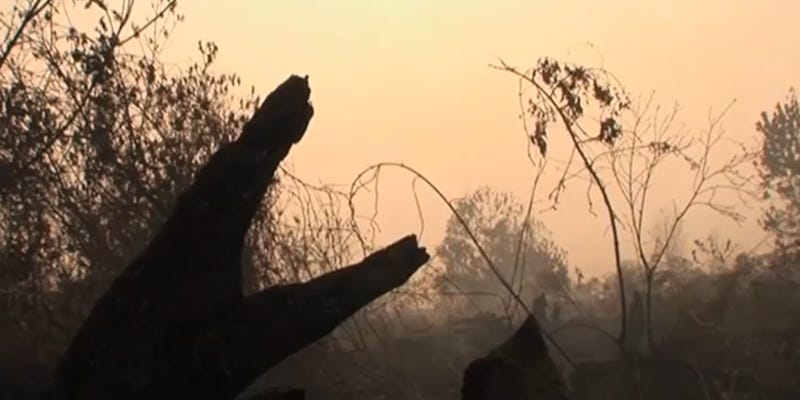
Last week, Australian ABC News’ Foreign Correspondent programme looked into Asia Pacific Resources International Ltd.’s operations on the island of Sumatra, Indonesia. The programme, titled, “Sumatra – Paper/Tiger”, gives a shocking view of the ongoing destruction of Sumatra’s remaining forests.
APRIL runs one of the world’s biggest pulp and paper mills. On its website, the company claims that its vision is “to be one of the largest, best-managed, most profitable and sustainable pulp and paper companies in the world”. But ABC News reporter Matt Brown found a different story.
Watch the ABC News documentary here.
The programme features an interview with Bill Laurance, a forest scientist with James Cook University in Australia. He is extremely critical of APRIL’s operations:
“Some of the worst forest destruction I’ve ever seen anywhere. Some of the fastest and most intense forest loss is happening there.”
“I thought I’d seen you know impressive deforestation in places like the eastern and southern Amazon and parts of Africa and other places, but what’s happening there on just sort of a large industrial scale is pretty daunting.”
“Ideally what you want to be doing is focusing on areas that have already been cleared, but when you’re going in and just mowing down vast expanses of forest and as I understand it, it’s something in the order of about seventy thousand hectares this year, so imagine clearing a hundred and forty thousand footy fields of tropical rainforest just in one year to feed this giant pulp plant. I mean that’s really alarming. That’s just, it’s almost you know an ecological Armageddon.”“Mowing down vast expanses of primary forest and converting it into monocultures of exotic trees which are grown to be four, five years old and then cut down, like you cut the grass and turn into paper pulp, this is not something I define as environmentally sustainable. It’s something different altogether.”
While the programme does not mention REDD, ABC News’ Matt Brown visits the Kampar peninsular, where APRIL has a proposed REDD project. APRIL did not carry out a process of free, prior and informed consent with indigenous communities living on the Kampar Peninsular before starting work on establishing the project. In addition, the company’s logging and plantation operations are having serious impacts for local communities.
As Lafcadio Cortesi of Rainforest Action Network points out in the documentary, there is no guarantee that even the area of forest that APRIL proposes to leave standing will successfully preserve the carbon stored in the peat below the forest:
“The bottom line is that they’re going to be lowering the water levels and how that impacts the whole dome, the whole ecosystem is really anyone’s guess.”
ABC News visited Pulau Padang, an island in the Malacca Strait between Malaysia and Indonesia, where APRIL is currently expanding its destructive operations. ABC News interviewed a local resident whose family has farmed sago on the island for six generations. He is clearly upset at the thought of losing his land to APRIL’s plantations:
“I feel very upset and very sad and I can’t imagine what will happen to my family. I can’t imagine . . . I would be able . . . to continue educating my kids because the only thing that I have – my only hope – is my land.”
But APRIL is already moving in Pulau Padang. Violence has broken out in response. On 13 July 2011, one of the contractors clearing the land for APRIL was stabbed and burned to death. A group of NGOs put out a statement pointing out that there are several overlapping land claims on the island and demanding that APRIL “stops all their operation on the field and withdraws each heavy equipment until the common agreement stated and can be accepted by all parties.”
Bill Laurance gets the last word in ABC News’ documentary:
“When I came back from Sumatra, I almost felt like I had a little bit of post traumatic stress. I mean I just felt at some gut level really disturbed. It’s just the sense that there’s an environmental travesty ongoing here and it’s just alarming to sit here and watch it happening right before your eyes.”
This, then, is the reality of forest destruction in Indonesia – despite the moratorium that president Susilo Bambang Yudhoyono signed into force in May 2011. APRIL’s Director of Operations, David Kerr, even notes in the film that the company has the backing of the Indonesian government:
“We’re doing it in a responsible way in line with what the Indonesian government wants to promote as part of developing forestry and if we don’t do it the way we’re doing it, it can be even worse.”
Comments following the original post on REDD-Monitor.org are archived here: https://archive.ph/cknLg#selection-789.4-789.14