

FAO is whitewashing the call from the UN Special Rapporteur on the rights of Indigenous Peoples for a moratorium on carbon markets
In 2024, the UN Special Rapporteur on the rights of Indigenous Peoples called for a moratorium on carbon markets, not for an FAO seminar in Rome to develop “guiding principles”.

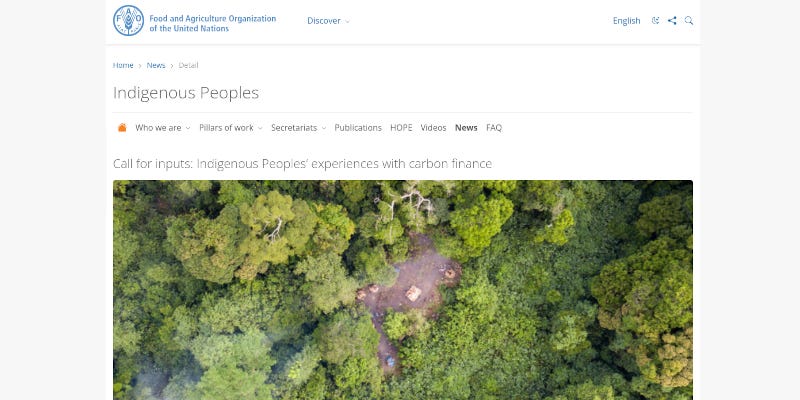
On 10 June 2026, the UN Food and Agriculture Organisation announced a call for inputs from Indigenous Peoples on their experiences with carbon finance in their territories.
Until 30 June 2026, Indigenous Peoples are invited to fill in a survey form. In addition to the ridiculously short period available for inputs (just 20 days), other aspects of this call for inputs are deeply problematic.
FAO states on its website that,
This initiative directly responds to the call made during the 23rd Session of the UN Permanent Forum on Indigenous Issues (UNPFII) by the former Special Rapporteur on the Rights of Indigenous Peoples, who expressly called for a “moratorium” on carbon credits until adequate safeguards are explicitly required to comply with Indigenous Peoples' rights.
The call for a moratorium on carbon markets
REDD-Monitor reported on the call for a moratorium on carbon markets in April 2024.
At a meeting during the 23rd session of the UN Permanent Forum on Indigenous Issues in New York, Francisco Calí Tzay, the UN Special Rapporteur on the rights of Indigenous Peoples called for a moratorium on carbon markets. Tzay said,
“My recommendation on this is very clear. I believe that a permanent moratorium, or at least a moratorium, can be a solution for stopping human rights abuses of Indigenous Peoples’ rights in these carbon markets.”

Five days later, Amnesty International put out a statement in which Chris Chapman, Amnesty International’s Advisor on Indigenous Rights, said,
“The UN Special Rapporteur is right to raise human rights concerns about the workings of carbon markets. Polluters can use them to offset – rather than actually reduce – their greenhouse gas emissions by buying carbon credits for schemes involving Indigenous Peoples’ lands. These schemes do little or nothing to benefit Indigenous Peoples, and in some cases actively harm their rights.”

At a side event at the 2025 UN Permanent Forum on Indigenous Issues, Tom Goldtooth, executive director of the Indigenous Environmental Network, repeated the call for a moratorium on carbon markets and other false solutions. Goldtooth said,
“Carbon markets provide the loophole that the fossil fuel industry needs to continue extraction, combustion, and a fossil extractive economy that is wrecking the harmony of Mother Earth and Father Sky.
“We are long overdue for demanding a permanent moratorium on false solutions being negotiated in Article 6 of the Paris Agreement.”

And the report on the 25th session of the UN Permanent Forum on Indigenous Issues, which took place from 20 April to 1 May 2026 includes the following statement:1
The Permanent Forum is deeply concerned about environmental degradation caused by extractive and emerging market-based mechanisms, including carbon finance and carbon markets, where activities are often undertaken without free, prior and informed consent, contrary to article 32 of the United Nations Declaration on the Rights of Indigenous Peoples. Such developments risk undermining Indigenous Peoples’ rights to lands, territories and resources, and are closely linked to deteriorating physical and mental health conditions and the erosion of traditional livelihoods.
FAO’s call for inputs
FAO claims that its call for inputs “directly responds” to former Special Rapporteur on the Rights of Indigenous Peoples, Francisco Calí Tzay call for a moratorium on carbon markets.
But FAO’s call for inputs comes more than two years after Tzay’s call for a moratorium.
And FAO is not calling for inputs in order to support the call for a moratorium on carbon markets.
Instead, FAO explains that the responses “will serve as the basis for a High-Level Expert Seminar at FAO Headquarters to take stock of Indigenous Peoples’ experiences with carbon finance and their perspectives on its potential implications, benefits, and risks”.
The seminar will take place at FAO’s headquarters in Rome. That’s very convenient for FAO staff, but far less convenient for Indigenous Peoples.
The FAO further explains that the seminar will contribute to “the development of guiding principles to ensure that Indigenous Peoples’ engagement in carbon finance is aligned with a human rights-based approach”.
The seminar is, in other words, all about ensuring that carbon markets continue. Putting in place a moratorium on carbon markets is extremely unlikely to be on the agenda.
We shouldn’t be too surprised. After all, FAO’s theme for this year’s International Day of Forests was “Forests and Economies,” with the tagline “Forests mean business.” Global Forest Coalition responded by pointing out that “Forests mean life, not business”:

Paragraph 10 of the Report on the 25th session of the UN Permanent Forum on Chris ChapmanIndigenous Issues (advanced unedited version).
Let me guess, funded by Canada and Norway?