

Forest cleared for Irrigation Dam 2 construction overlaps proposed Samkos REDD project in Cambodia
A series of dams is under construction or already built inside Wildlife Alliance’s Samkos and Southern Cardamom REDD projects.

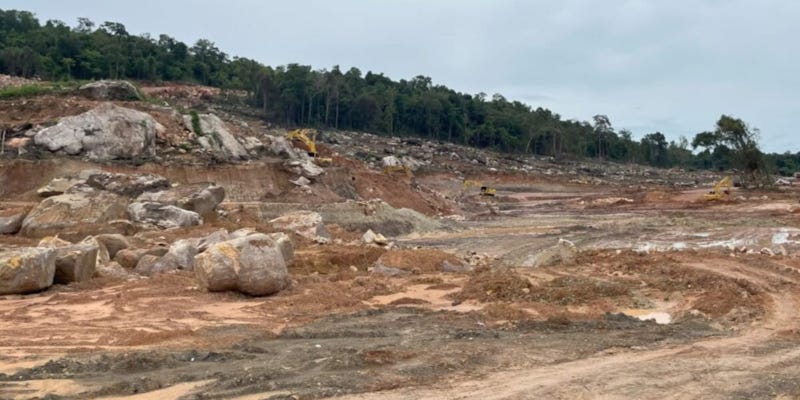
The Samkos REDD project in Cambodia aims to “promote climate change mitigation and adaptation, maintain biodiversity and create alternative livelihoods”. The project was created by two US-based companies: Wildlife Works Carbon, LLC; and Wildlife Alliance, Inc. Both companies are incorporated in the tax haven of Delaware.
The Samkos REDD project covers a total area of 297,397 hectares in three projected areas in the Cardamom Mountains in southwest Cambodia. The project area is is adjacent to the controversial Southern Cardamom REDD project, which was set up in 2016 by Wildlife Alliance and Wildlife Works.
The Samkos REDD project has not yet undergone validation and verification under Washington DC-based firm Verra’s carbon certification process. On Verra’s registry, the project is currently listed as “Inactive”.
This week, Gerald Flynn reports for Mongabay on the construction of an irrigation dam inside the Samkos REDD project. The Irrigation Dam 2 project is one of a series of dams under construction and already completed inside the Samkos and Southern Cardamom REDD projects.
A Mongabay map from March 2025 reveals the scale of the problem (in this map, Irrigation Dam 2 is number 7: “Pursat”):

“It is true that the construction of these dams and roads will cause significant forest loss,” Suwanna Gauntlett, director of Wildlife Alliance, told Mongabay.
The new irrigation dam will clear more than 7,300 hectares of protected forest in Kravanh National Park. Construction started in February 2025.
A 10-kilometre-long road was cut through the forest to the dam construction site between February and March 2025.
1,800 hectares of forest inside the Samkos REDD project will be flooded by the reservoir behind the dam. Wildlife Alliance told Mongabay that, “The construction of the water reservoir project in Stung Arai, Pursat province is expected to cause deforestation of approximately 0.6% of the Samkos REDD+ Project Area.”
Wildlife Alliance added that “all deforestation will be fully accounted for during the project’s upcoming validation and verification”.
Flynn writes that,
No company appears to have been announced as attached to the dam project. Provincial government officials contacted by Mongabay would only confirm it was being overseen by the Ministry of Water Resources and Meteorology. Representatives of the Ministry of Environment did not respond to requests for comment.
Tonlé Sap Lake
Irrigation Dam 2 is one of several dams and other barriers that have restricted the access of fish to and from the Tonlé Sap Lake. The dam will be constructed in Rokat commune on the Arai River, which flows into the Pursat River, which in turn flows into the Tonlé Sap Lake.
More than 40 families in Rokat commune rely on the Arai River for cooking, bathing, and drinking water, as well as for irrigating their crops and sustaining livestock. A villager from Rokat told Mongabay that,
“Water from the new dam will not benefit our community. The downstream people will get water, while we here will lose the forest. Everyone in Rokat and Somraong communes will not get water from this dam.”
The villager asked Mongabay for anonymity because of fears of retaliation from the authorities. “We cannot say we’re unhappy because they are powerful people,” another villager told Mongabay.
Tonlé Sap is Southeast Asia’s largest freshwater lake. It is an extraordinary ecosystem, one of the most diverse and productive in the world. In the dry season the lake covers about 250,000 hectares. In the wet season the flooded area increases to 1.6 million hectares. The depth of the lake increases from about one metre to 14 metres in places.
Many species of fish feed and grow during the wet season in the floodplains of the Tonlé Sap. When water levels fall, they migrate away. But dams, weirs, regulators, floodgates, and roads all present obstacles to fish migration.
Irrigation Dam 2 is one more obstruction to fish migration in an already stressed ecosystem.
No environmental impact assessment
Under Cambodian law, starting construction on any project is not allowed until the Ministry of Environment has approved an environmental impact assessment.
Mongabay reports that it is not clear whether an environmental impact assessment was completed and approved by the Ministry of Environment before forest clearing started as part of the Irrigation Dam 2 project. Provincial government officials told Mongabay that the dam project was being overseen by the Ministry of Water Resources and Meteorology.
On 3 March 2025, Environment Minister Eang Sophalleth wrote to Water Resources Minister, Thor Chetta. Mongabay reports that the letter tells the dam developer to “proceed with the necessary procedures” for carrying out an environmental impact assessment. But when the letter was written, forests were already being cleared as part of the dam construction works.
Mongabay contacted the consulting firm CG Sustainable Co. Ltd., which is mentioned in the letter as responsible for carrying out the environmental impact assessment. The company did not reply.