

Free, prior and informed consent? Not at the Lumphat Wildlife Sanctuary REDD project in Cambodia
Meanwhile, deforestation from mining and industrial agriculture continues. And a planned hydropower dam threatens to flood large areas of forest.

The Lumphat Wildlife Sanctuary REDD project aims to generate carbon credits from almost 135,000 hectares of dry forest inside the Lumphat Wildlife Sanctuary in northeast Cambodia. The project is run by Cambodia’s Environment Ministry, BirdLife International, and NatureLife Cambodia.
According to BirdLife International a process of free, prior and informed consent took place before the launch of the Lumphat Wildlife Sanctuary REDD project. But recent reporting by Leila Goldstein and Eung Sea in The Diplomat reveals a very different story.
The status of the project is currently listed on Verra’s registry as “Registration requested”. In a letter to Verra, BirdLife states that “the FPIC process began in 2013, but the auditor required a complete consent process before we could define a project start date”.
The Khmer Times reports that from January to April 2023, NatureLife Cambodia carried out “consultations, disseminated information and obtained consent from local people in 16 targeted villages”.
NatureLife Cambodia is an NGO that was set up by BirdLife International in 2017. Bou Vorsak was Cambodia country director of BirdLife International for 15 years before becoming the CEO of NatureLife. The consultation was supported by BirdLife International and USAID Morodok Baitang (a five-year project funded by USAID aimed at biodiversity conservation in Cambodia).
“Before asking for the consent of the residents of the area, we made sure they understood the importance of the carbon credit scheme,” Vorsak told the Phnom Penh Post in May 2023.
“After learning about the project, they gave their consent with no coercion,” the Phnom Penh Post reported NatureLife Cambodia as saying.
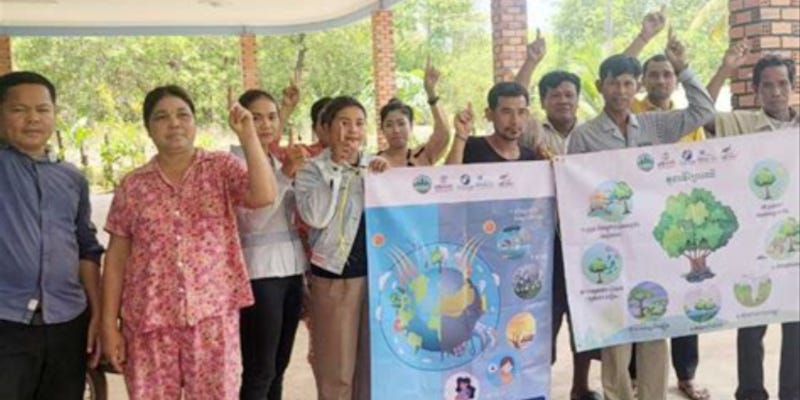
To illustrate the article, the Phnom Penh Post used a photograph (above) of the Lumphat village chief and his relatives with their hands in the air.
“How will we know where the money will be spent?” Lai Khammay, who lives in Lumphat village, asked The Diplomat. “If they got money [for the project], people in the village don’t know because everyone involved are relatives of the village chief.”
Free, prior and informed consent?
The Diplomat interviewed people from more than 30 households in villages near the project area. More than 20 households were in REDD project partner villages. The Diplomat reports that more than half of these 20 households said “they did not consent to the project and were not well informed about it”.
BirdLife International told The Diplomat that 53% of households in partner villages consented to the project. In a statement, BirdLife International explained that,
Participation and consent cleared the thresholds set by international standards and by the communities themselves. Two separate audits have confirmed that. Even so, unanimity across 16 villages is never going to happen, and we would not pretend it did. It is entirely possible some of those people [who spoke to The Diplomat] did not give consent or did not feel as well-informed as they should have.
The Diplomat visited four partner villages. In all four, villagers said they were not well informed about the project. They were not asked for their consent. And they were not even invited to take part in meetings about the project.
“Why wasn’t I invited?” Sara Sreymon from Rovak village asked The Diplomat. “The NGO wanted the village chief to invite all of the households, but he didn’t.”
She said that most villagers could not attend meetings because they had to farm. Others were not invited.
Hing Ping, a rice and cattle farmer in Thmei village, did attend a few project meetings. He was not asked to give his consent and he did not understand what the project was for, or even what it had to do with his village, he told The Diplomat.
“It’s difficult for people to understand what the project is about because they are illiterate; they just go to the meeting but do not really understand why they were invited or what the project is about.”
In a statement, BirdLife International said that the consultation process was “designed to be inclusive and iterative”. The Diplomat reports BirdLife International as saying that the consultation involved village assembly meetings in all 16 partner villages, focus group discussion and participatory mapping. NatureLife Cambodia made household visits to meet people who could not take part in meetings.
The project has set up feedback and grievance mechanisms, BirdLife International explained. The project installed mailboxes in villages so that people could provide feedback.
In Thmei village, The Diplomat found that several of the mailboxes were “completely unmarked”. One blue unmarked box was attached to a fence in front of a home. “I have no idea what it’s for or who put it there,” the home owner told The Diplomat.
REDD-funded reforestation?
In May 2025, NatureLife Cambodia announced plans to reforest more than 1,700 hectares of land in Mondulkiri Province. The land had been illegally cleared according to NatureLife Cambodia.
Although it is outside the REDD project area, the tree planting is to be funded by the REDD project. “Our reforestation efforts aim to prevent further forest loss due to opportunistic encroachment, reduce heat, mitigate erosion and address climate change,” Vorsak told the Phnom Penh Post.
The Diplomat reports that the area to be replanted overlaps the Roya Leu Indigenous community’s land. The community is applying for an Indigenous Communal Land Title on 10,000 hectares of sacred land, burial grounds, and residential areas.
Indigenous Bunong people in Memom village told The Diplomat that they were not properly informed about the reforestation project and they were not asked to give their consent. Two people said that people had been blocked from attending REDD meetings.
Teuk Kin, Roya Leu’s community leader, told The Diplomat that,
“I know very little about the REDD+ project. Environment ministry rangers installed REDD+ signs at the end of the village. They did not clarify how many hectares of forest were for the REDD+ project or how many hectares of the forest were for the community. They acted on their own on where to install the signs. There was no consultation with people.”
Tham Yan, an Indigenous villager told The Diplomat that in 2024 Environment Ministry and REDD officials had discouraged him and other villagers from applying for the Indigenous Communal Land Title. The officials said it would not benefit the community.
In 2024, Yan attended a REDD project meeting in Rovak village. He told The Diplomat that during the meeting “officials warned that opposing the REDD+ project would bear consequences”. Villagers were told that if they cleared forest on their farmland they would be arrested and put in jail or fined.
“Roya Leu (Memom village) sits outside the REDD+ project area. It hasn’t been covered by the FPIC process, and it isn’t covered by REDD+ project activities,” BirdLife International told The Diplomat.
BirdLife International pointed out that the Lumphat Wildlife Sanctuary was established by royal decree in 1993. “Therefore, any related claims should be directed to the government.” The Roya Leu territory became part of the protected area in 2023 when the government increased the area of the wildlife sanctuary by more than 106,000 hectares. Communities were not consulted about the expansion.
Cambodia’s Environment Ministry did not answer The Diplomat’s specific questions, but said in a statement that it is “aggressively implementing law enforcement to protect forests.”
Roya Leu community members have been charged with cutting down trees and clearing state land.
Stopping deforestation?
While villagers face repercussions for cutting trees on their own land, the government has handed out agricultural and mining concessions inside the wildlife sanctuary.
Coby Hobbs and Eung Sea reported on the damage to the forests in the Lumphat Wildlife Sanctuary for Mongabay in February 2026.

Roads have been cut through the REDD project area to reach the mining operations, The Diplomat reports. A proposed hydropower dam would flood 70,000 hectares including a core zone of the wildlife sanctuary. It would result in the eviction of more than 4,200 families from their homes.
Sarah Milne is an associate professor at the Australian National University in Canberra. She has worked on conservation, Indigenous rights, and REDD in Cambodia for many years. She told The Diplomat that,
“One ministry will approve the dam, another ministry will approve the mine, and another ministry is in charge of the protected area. One of the biggest problems with REDD+ is that it assumes that the state is a coherent entity that is interested in the rule of law.”