


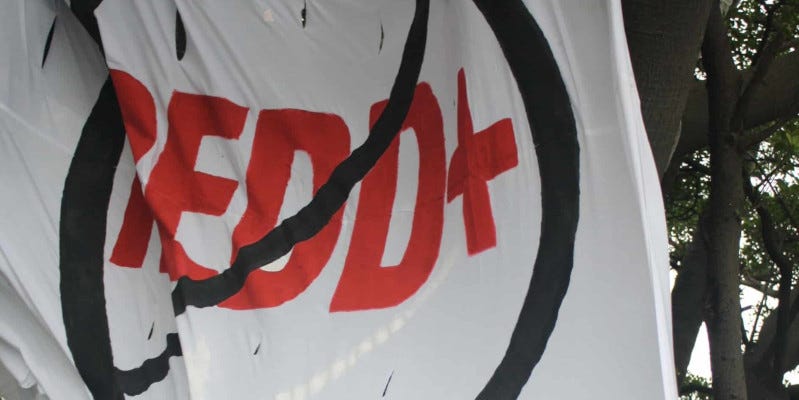
The idea behind reducing emissions from deforestation and forest degradation sounds simple. If forests are worth more standing than cut down, companies and governments will stop clearing forests. Why would anyone oppose this?
Well, it turns out that making forests worth more standing than cut down is far from simple. From the beginning, REDD was envisaged as a carbon trading mechanism. The “ultimate goal” of the World Bank’s Forest Carbon Partnership Fund is to “jump-start a forest carbon market”, according to the Bank’s press release at its launch in Bali in 2007.
Five years later, the forest carbon market is still stalled. Last year, the number of traded REDD credits fell to 7.4 million from 19.5 million in 2010. Several REDD observers have moved from questioning REDD to outright opposition.
Kjell Kühne has compiled a list of anti-REDD statements. It’s useful to have the information collected in one place so it’s posted here as a guest post. If there are statements missing, please let me know in the comments.
REDD Resistance around the world
By Kjell Kühne, November 2012
If you are against REDD, you are not alone. Around the world, a growing number of communities, organizations and movements as well as experts are not limiting themselves to asking critical questions about REDD any more, they have explicitly declared their opposition to the mechanism. A coalition of indigenous peoples’ organizations has called for a global moratorium on REDD projects. Bolivia has a mandate (from the Cochabamba People’s Summit) to not let REDD pass at the UNFCCC level. Interpol has warned about the opportunities REDD provides for organized crime. If you are not into the REDD business because you hope to make some money with it, then you should start asking yourself whether all these voices can and should be dismissed.
Here is a list of anti-REDD declarations:
Belém Letter, October 2009, Belém, Brazil.
Peoples Agreement, April 2010, Cochabamba, Bolivia.
Amigos de la Tierra Latin America and Caribbean, Position on REDD, August 2010, Paraguay.
Evo Morales, President of Bolivia, Nature, Forests and Indigenous Peoples are not for sale, September 2010
Declaración de Cancún, December 2010, Cancún, Mexico.
Declaración de Cancún de la Vía Campesina, December 2010, Cancún, México.
Declaration of Patihuitz, April 2011, Patihuitz, Mexico.
Brazilian environmental and social movements oppose REDD offsets, June 2011, Brasilia/Bonn.
Letter from the State of Acre, October 2011, Rio Branco, Brazil.
Open Letter of Concern to the International Donor Community about the Diversion of Existing Forest Conservation and Development Funding to REDD+, October 2011.
Quem ganha e quem perde com o REDD e pagamento por serviços ambientais?, November 2011, Brazil.
Indigenous Peoples Condemn Climate Talks Fiasco and Demand Moratoria on REDD+, December 2011, Durban, South Africa.
Pronunciamiento CAOI, March 2012.
No REDD+! in RIO +20: A Declaration to Decolonize the Earth and the Sky, June 2012, Rio de Janeiro, Brazil.
Kari-Oca 2 Declaration, Indigenous Peoples Global Conference on Rio+20 and Mother Earth, June 2012, Rio de Janeiro, Brazil.
Here is a more complete list with an analysis of the elements and arguments of each of the declarations.
Some resources that explain some of the reasons why REDD is not such a smart choice for people and the planet:
REDD Monitor, continuous, Chris Lang.
REDD Myths, December 2008, Friends of the Earth, English, Spanish.
Reaping Profits from Evictions, Land Grabs, Deforestation and Destruction of Biodiversity, November 2009, Indigenous Environmental Network, English, Spanish.
REDD Realities, December 2009, Global Forest Coalition.
REDD: The realities in black and white, November 2010, Friends of the Earth, English, Spanish.
NO REDD! A Reader, December 2010, English, Spanish.
Why REDD is dangerous, Kjell Kühne, January 2011.
Key Arguments Against REDD fact sheet, Global Justice Ecology Project, June 2011.
Why REDD+ is bad and will make the climate crisis worse, Kjell Kühne, Powerpoint presentation, November 2011.
No REDD Papers: Vol. 1, November 2011.
REDD Fairy Tales, Global Forest Coalition, November 2011.
Juggling with Carbon, Kjell Kühne, Video, December 2011.
A Darker Shade of Green: REDD Alert and the Future of Forests, January 2012, English, Spanish, Documentary.
REDD: la codicia por los árboles, February 2012, Spanish, Documentary.
REDDeldia, August 2012, Spanish, Website.
We must end the age of fossil fuels and transition to an economy fully powered by renewable energies, in order to reestablish climatic balance on our home planet. And we must protect what is left of our forests by focussing our energies on the principal drivers of deforestation. Both tasks are not easy. By redirecting time and efforts currently bound up in the illusion of a REDD mechanism that works for people and the climate could help move these tasks forward.
Comments following the original post on REDD-Monitor.org are archived here: https://archive.is/bifiG#selection-1097.4-1097.14