


“JREDD is the highest-quality carbon mitigation you can find. It has the greatest social benefits you can find. It has the highest environmental integrity you can find. We need both. We need to tell the story that JREDD is the highest-quality carbon you can find on the market.”
That’s Andreas Dahl-Jørgensen, Director of Norway’s International Climate and Forest Initiative (NICFI), speaking at an event at the New York Climate Week in September 2026.
Just three weeks later Dahl-Jørgensen’s story about “high quality” Jurisdictional REDD was looking distinctly shaky when Carbon Pulse reported that Guyana’s J-REDD+ had over-credited one of its vintages by 40%.
Guyana’s J-REDD+ programme is registered through the Architecture for REDD+ Transactions (ART) scheme. Here’s how the ART Secretariat, which is hosted by Winrock International, described the problem on 21 October 2026:
In early 2026, ART was contacted by Climate Focus with questions about some of the numbers used to calculate the 2023 TREES Credit volume issued to Guyana. ART did an internal review of the numbers in question and did not find any errors in those figures. In the spring, Climate Focus asked ART about the inputs and results of the Monte Carlo analysis, a standard statistical technique used to account for uncertainty in emissions estimates, helping ensure that carbon credits are issued on a conservative basis. In line with ART’s practice of referring requests for additional detailed program information to Participants, ART provided Climate Focus with an introduction to the Government of Guyana to answer questions.
And here’s how Simon Koenig, partner at Climate Focus described the problem after Carbon Pulse’s 13 October 2026 article:
For 2023, Guyana reported forest related emissions of 14,076,373 tCO2. Against a crediting level (aka jurisdictional baseline) of 21,037,534. That would result in 6,629,925 not in 10,709,227 ERs. Not too complicated and should be a red flag for any auditor.
The answer we consistently received to explain the ~3.9 million gap, was that ART-TREES uses a Monte Carlo (MC) simulation to determine the final emission reduction (ER) figure considering uncertainty distributions. In other words, the emission figures reported were supposedly not relevant in determining the ultimate volume of credits to be issued. In several rounds of questions to the ER Program, we also specifically pointed to the wrong year (2022) shown in the 2023 Excel sheet and asked whether the discrepancy could be explained by the accidental use of 2022 data. The answer we received: we checked the numbers and all was done correctly.
On 13 October 2026, Carbon Pulse reported that the carbon credits rating agency BeZero had given Guyana’s 2023 carbon credits a “D” rating, its lowest category.
In a 13 October 2026 version of its statement about the error, the ART Secretariat made no mention of Climate Focus. Instead, the ART Secretariat states that it “was aware of and working to correct the error prior to notification by BeZero”. The ART Secretariat added that it “has been working with the Government of Guyana and the Validation and Verification Body (VVB) in line with our published process for addressing an error found following verification”.
The validation and verification body for the 2023 carbon credits issuance was Aenor Confía.
Guyana’s 2023 carbon credits were issued on 21 December 2025. Climate Focus informed the ART Secretariat soon after the credits were issued, in January 2026. The ART Secretariat, however, took no action until BeZero’s D rating, nine months later. And the ART Secretariat provides no information about how it and the VVB failed to see the obvious mistake on the Excel sheet — despite having nine months to uncover the “not too complicated” problem.
Clearly, it took a public statement by BeZero to force the ART Secretariat into taking the over-crediting seriously.
“Mistakes happen,” BeZero’s CEO Tommy Ricketts told Carbon Pulse. “We are glad we caught it and have had positive engagement with Winrock to resolve the issue.”
To address the over issuance, the Government of Guyana has transferred 4 million unsold 2023 carbon credits into an ART Registry Administrator account, thus “securing the credits required for the correction”, the ART Secretariat states.
Big Polluters
But the problems with Guyana’s carbon credits go much deeper than a mistake on an Excel sheet, although that should be embarrassing enough for the ART Secretariat and for Aenor, the auditing firm.
Since 2015, oil corporations have made a series of massive oil discoveries off the coast of Guyana. A consortium of ExxonMobil, Hess Corporation, and China’s CNOOC is exploiting the Stabroek oil field.
In December 2022, Guyana signed an agreement with Hess Corporation to sell the oil company US$750 million worth of carbon credits from the country’s forests between 2016 and 2030.
Guyana’s carbon credits are also approved to be sold under the first phase of the Carbon Offsetting and Reduction Scheme for International Aviation (CORSIA). In March 2026, Pradeepa Bholanath, senior director for climate and REDD+ at the Ministry of Natural Resources, announced that Guyana had sold carbon credits to more than 19 airlines over the previous 18 months.
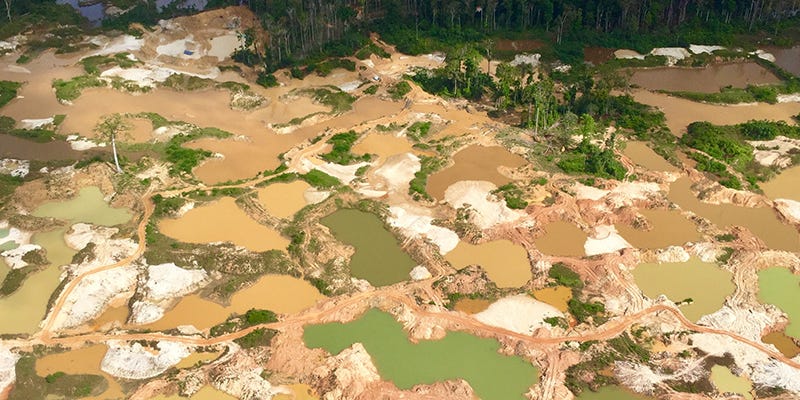
To make matters worse, the Government of Guyana has done practically nothing to reduce the damage to forests in the country from logging (including illegal logging), gold mining, and wildfires in order to generate these carbon credits for the benefit of Big Polluters.
Indigenous Peoples “were not properly consulted”
Meanwhile, Guyana’s Amerindian Peoples Association (APA) has criticised the government and Architecture for REDD+ Transactions for failing to implement a meaningful process of free, prior and informed consent before the programme started.
In March 2023, the Amerindian Peoples Association filed a formal complaint with Winrock International about the failure to carry out a process of free, prior and informed consent. APA asked for all issued carbon credits to be suspended and future issuances to be frozen.

The ART Secretariat rejected the complaint in May 2023.
APA filed an appeal to that decision in June 2023.
In October 2023, APA put out a statement explaining that it was “forced to withdraw from the appeal of its complaint to the Architecture for REDD+ Transactions (ART) Secretariat”.

In April 2025, Mario Hastings, then-president of APA gave a speech at the 24th Session of the UN Permanent Forum on Indigenous Issues in New York. He pointed out that the processes leading to the sale of carbon credits from Indigenous Peoples’ forests in Guyana were “deeply flawed”. He said that,
“We were not properly consulted on how our forests and lands would be used in this scheme. We were not allowed to consent to this programme with the mandate of our people. And, we were not part of any negotiations to determine how our peoples could have benefited from the national initiative according to our needs prior to the carbon sales agreement.”
Also in 2025, Hastings told InfoAmazonia that,
“We are now finding out that our forests may be ‘sold’ to the very companies most responsible for climate issues – the oil companies. However, we Indigenous people remain unaware of what was signed or agreed upon, as there was no proper consultation.”
When I worked in a report about energy transition and disinformation in Guyana back en 2024, carbon credits were flagged as the number one favorite narrative to push for more oil and gas in the country in the name of the transition. Sad to see the writing on the wall again.
Climate Focus's arithmetic is the striking part: reported emissions of 14,076,373 against a crediting level of 21,037,534 gives roughly 6.6 million credits, not 10.7 million. A check that simple suggests buyers and raters need assurance on the volume calculation itself, not just on the inputs. It is also a reminder that any claim built on these credits is only as solid as the issuance behind them.