

How illegal timber from Laos and Cambodia can end up in the Vietnam Timber Legality Assurance System
A new report by the Environmental Investigation Agency exposes how illegal timber from Laos and Cambodia is exported to Vietnam, where it becomes “legal”.

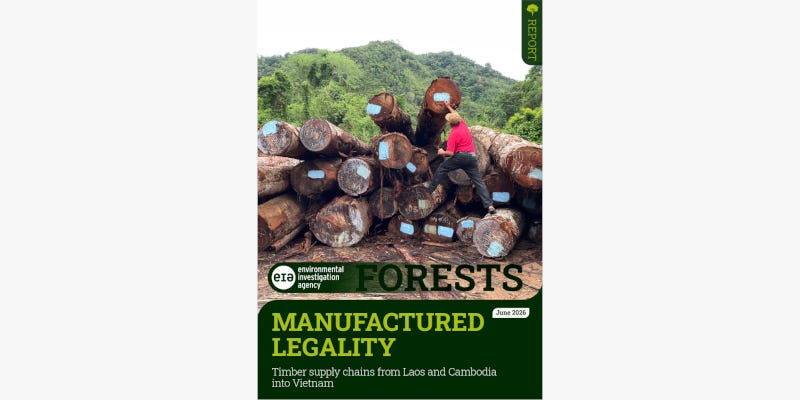
Vietnam is one of the world’s largest exporters of timber and wood products. In 2025, the total export value from Vietnam’s wood industry reached US$17.2 billion. Vietnam is the largest supplier of wooden furniture to the US. About 55% of Vietnam’s total export value goes to the US. Japan and China are also key markets.
In 1999, Global Witness published a report titled, “Made in Vietnam — Cut in Cambodia”. The report documented how the Vietnamese garden furniture industry was a major consumer of illegally logged timber from Cambodia.
Global Witness wrote that,
By buying Vietnamese garden furniture consumers risk finding out that they are at best contributing to forest destruction in Vietnam, Malaysia, Burma and Laos; countries that in part provide some of the timber used in the manufacture of the furniture. At worst there is a direct link between much of this garden furniture and the enriching of military warlords and the political elite in Cambodia.
Things have improved since 1999, although things moved a lot more slowly than we might have hoped.
The Vietnam Timber Legality Assurance System
In 2020, Vietnam set up the Vietnam Timber Legality Assurance System (VNTLAS), which was established under the EU-Vietnam Voluntary Partnership Agreement on Forest Law Enforcement, Governance and Trade (FLEGT).
A new report by the Environmental Investigation Agency describes the VNTLAS as “one of the more advanced timber legality assurance systems in the region” and praises Vietnam’s “commitment to strengthening forest governance, improving oversight and maintaining access to international markets”.
But the report also exposes how illegally logged timber from Laos and Cambodia is still being used in Vietnam’s wood processing sector. EIA’s report states that,
EIA investigations found that timber harvested in Laos and Cambodia may enter supply chains through mechanisms which are inconsistent with legal frameworks, including quota systems linked to infrastructure projects, concession-based logging and harvesting beyond authorised boundaries. In these contexts, timber from illegal sources is processed and documented in ways that allow it to enter formal trade channels.
EIA highlights the problem: VNTLAS relies on documentation issued in Laos and Cambodia to verify legality. EIA (somewhat euphemistically) notes that “governance conditions affect how such documentation is produced”.
EIA writes that,
This creates a structural tension at the heart of VNTLAS: while the system is designed to verify legality through administrative controls, it must operate across borders where the integrity of those controls cannot be assured.
Imports from Laos and Cambodia account for a small percentage of Vietnam’s total timber supply. However, EIA’s report reveals that Vietnamese importers and traders are “engaged in fraudulent sourcing, processing and documentation practices circumventing requirements on how timber enters Vietnam’s market”.
In Cambodia, EIA writes about a “parallel system” of economic land concessions, infrastructure developments, and politically connected companies. Large scale logging takes place in — and around — these concessions, including in protected areas. Logs are transported into Vietnam, using political protection, corruption, and cross-border coordination to evade domestic export restrictions.
EIA’s report includes a series of case studies in Laos and Cambodia, including one from the Phnom Samkos Wildlife Sanctuary in Cambodia.
Logging in the proposed Samkos REDD project
Two US-based companies, Wildlife Works Carbon and Wildlife Alliance, are developing the Samkos REDD project in Cambodia.
Both companies are also involved in the Southern Cardamom REDD project, which is notorious for the model of fortress conservation employed. The project has seen human rights abuses, evictions, conflict with local communities, and threats to Indigenous Peoples’ livelihoods.
The Samkos REDD project is next to the Southern Cardamom REDD project and overlaps the Phnom Samkos Wildlife Sanctuary. Cambodia’s Ministry of Environment is also involved in the project, which covers almost 300,000 hectares.
In July 2022, Wildlife Works and Wildlife Alliance produced a project description document for the project. The project document states that the “growing communities” living in the project area “present the biggest threats to the Samkos REDD+ project”.
But this statement reflects the prejudices of the organisations writing the project document rather than the reality on the ground. The Cambodian government is actually a far greater threat to the people and the forests in the project area.
Between 2010 and 2022, the government removed land from the Phnom Samkos Wildlife Sanctuary 65 times for economic land concessions, land distribution to communities, and public infrastructure.
In 2023, the area of the Phnom Samkos Wildlife Sanctuary was increased from 333,750 to 362,384 hectares, Mekong Eye reports. But the new boundary excluded 58,000 hectares of economic land concessions and development projects that the government had awarded inside the protected area.
One of these economic land concessions was re-designated as the MDS Thmor Da special economic zone — a partnership between the Cambodian MDS Group and Henghe, a Chinese company. MDS Group is linked to logging tycoon Try Pheap who “controlled a multi-million dollar timber smuggling operation in Cambodia” Global Witness writes. “Officials from government, the military, police and customs were all complicit in this operation.”
The office blocks in the 2,265-hectare MDS Thmor Da special economic zone are currently largely abandoned, following a crackdown on cyber scam operations.
Stung Meteuk hydropower dams
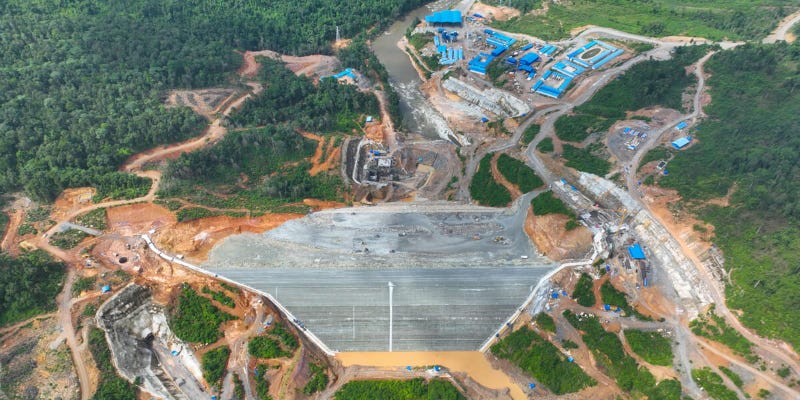
In June 2023, Cambodia’s National Assembly approved the construction of the US$440 million Stung Meteuk hydropower dams. This 150 MW, three-dam project is inside the Phnom Samkos Wildlife Sanctuary. The dams are under construction about 10 kilometres from the MDS Thmor Da special economic zone.
By January 2024, the Ministry of Environment had issued licences for a sawmill and forest clearance in the reservoir areas behind the dams.
A five-year licence was awarded to Stung Meteuk Hydropower Company to build the dams. The chair of the company is senator Ly Yong Phat, whose business empire includes hotels, casinos, infrastructure, sugar, and the media. His sugar company operations have led to some of the most violent land grabbing in Cambodia. Thousands of people have been evicted to make way for Ly Yong Phat’s sugar plantations.
Ly Yong Phat was also involved in online scams. In September 2024, the US imposed sanctions on Ly Yong Phat for his role in “serious human rights abuses related to the treatment of workers subjected to forced labor in online investment scam operations”.
In 2024, Cambodian environmentalists reported illegal logging taking place beyond the reservoir areas. And an investigation by Mongabay revealed extensive illegal logging and roads fanning out from the reservoir area into the Phnom Samkos Wildlife Sanctuary.
EIA reports that forest activists found three sawmills in operation, when permission had only been given for one. Local sources told EIA that “one of the main companies purchasing wood from the site was Angkor Plywood, which was shipping wood to Vietnam”. In September 2024, the government suspended forest clearance at the dam project. But 22 days later, provincial authorities allowed the sawmills to reopen and logging in the protected area restarted.
In early 2025, Koh Kong Hydropower Co, Ltd took over the project.
EIA writes that,
The construction of the hydropower dam continues, even though it will do little address the country’s energy needs as it will not generate any electricity during the four-month long dry season. To date the main beneficiaries have been the companies able to remove valuable timber from protected areas and those awarded lucrative contracts to construct the dam.
The Samkos REDD project is currently listed as “Inactive” on Verra’s registry.