


In November 2012, the BBC broadcast a programme about a company called Enviro Associates that is selling voluntary carbon credits as an investment. Enviro Associates was offering carbon credits for sale at a price of £5.50 each.
The BBC spoke to Edward Hanrahan of ClimateCare, an Oxford-based carbon offsets company. Hanrahan was quoted in the BBC programme as saying that “the credits should be sold at less than £1 per tonne”.
ClimateCare does not offer carbon credits for investment and in a statement on its website the company recommends that “unsophisticated investors” should not buy carbon credits as an investment. Instead ClimateCare sells voluntary carbon credits to “help individuals and businesses take responsibility for their carbon emissions by offsetting their carbon footprint”.
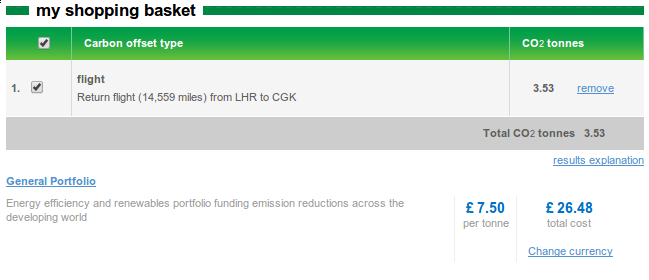
Last week, a commenter on REDD-Monitor pointed out that ClimateCare is selling carbon credits via its website for £7.50. ClimateCare’s website includes a “carbon calculator” which, for example, explains that a return flight from Heathrow to Jakarta would emit 3.53 tonnes of CO2. I could “offset” these emissions at a price of £7.50 per tonne, giving a total of £26.48 payable to ClimateCare:
I asked Edward Hanrahan how his company justifies selling carbon credits at a price even higher than Enviro Associates’ price. “The very simple answer,” he replied, “is that there is no such thing as a generic ‘price per tonne’ for voluntary carbon credits.”
ClimateCare’s price of £7.50 a tonne, “is a blended portfolio price that represents an averaged cost of the credits in the portfolio”, Hanrahan explains.
Hanrahan points out that the price of carbon credits actually decreases over time. A carbon credit’s “vintage” refers to the year that the emissions reduction took place. Hanrahan explains that the cheapest carbon credits are from fuel switch projects or large hydropower projects from older vintages.
In November 2012, the UK High Court closed down a company called Foxstone Carr Limited. “The company fleeced the public with their bogus guarantees about investment opportunities and returns,” Company Investigations Supervisor Chris Mayhew said after the Court hearing. The judge said:
“[T]he missing information customers aren’t told is the considerable difficulty they face in disposing of the carbon credits. The usual cold calling methods are used to sell and to give the impression that the credits are likely to go up in value and can be traded easily. In fact this is not the case. Information has been obtained that the older the credit the less desirable they are and therefore the less valuable the credit becomes over time. This information is concealed from consumers.”
Here is Hanrahan’s response by email to REDD-Monitor’s question about the price of carbon credits:
Here is the standard response to this question:
Carbon Credits are not a commodity like gold or oil and there is no such thing as a standard ‘price’ for a VER carbon credit – no two carbon reduction projects are the same and the costs associated with running them are very very different. They use different technologies and interventions, cost varying amounts to implement and produce different levels of carbon reduction. Their impact on the surrounding environment, economy and population is also unique. Each project therefore commands its own carbon credit price, determined by the cost of the project and market demand.
A small project, producing limited credits in a way that brings health, social and economic benefits to the local population, whilst protecting and enhancing the local environment, will command a much higher price than a large scale technology, where the sole benefit is carbon reduction.
In addition, credits are often issued from a project over a course of years. Buyers, having reduced carbon emissions as much as possible, take responsibility for their remaining carbon footprint by purchasing credits generated close to or in the same time period. This means that there is rarely demand for older credits and this reduces their price. It is therefore often older credits from large scale projects which are priced at the low end of the spectrum.
ClimateCare’s mixed portfolio of projects is designed to balance price and positive impact for people and the environment, so that our customers can be confident they are offsetting their carbon footprint with high quality projects that make a real difference on the ground. You can find details of our 2012 Mixed Portfolio here. It currently sells at £7.50 / tonne – a price that reflects the cost for us to make a reduction of one tonne of CO2 through these projects. Some larger businesses wish to get more involved in the selection of projects – perhaps in certain locations, or delivering specific benefits – and we also work with them on a bespoke basis, to select projects that best meet their needs.
Carbon markets have been created for the purpose of mitigating carbon emissions to support action on climate change. We recommend that carbon credits are bought for the purpose of offsetting carbon emissions, not as an investment opportunity.
Here is a bit more detail . . .
In the true Voluntary carbon market – i.e. where carbon credits are not sold to individuals for investment purposes, but projects are capitalised with professional capital and credits are sold, usually to large corporates, at a price which represents the actual cost of carrying out the project. As such credit prices generally have less to do with any ‘market price’ and more to do with how much it costs to run the supported projects, or subsidise them with carbon finance. The proportion of the actual running costs that carbon finance provides is different for every project type.
As such, in the Voluntary Market, there is no ‘price per tonne’ for ‘carbon credits’ generically, every project and vintage has a different pricing. African Stoves and Gold Standard credits generally fetch the highest pricing – up to $11 a tonne dependent upon the project size, its location, how much finance is put into the sustainable development outcomes etc… At the very lowest end would be mass/bulk fuel switch projects or large hydro from older vintages.
The specific project and vintage I was talking about (that which had been offered to the undercover reporter in the BBC programme) was at the very very lowest end of the spectrum. I know this for a fact as we had brokered a transaction for the same credits to a middle European utility earlier in the year for retirement purposes at under a euro per tonne. That is the market price for those specific credits – an older vintage from that specific project.
If you go to our Projects page you will see a selection of the type of projects that we supply to customers. We only supply extremely high quality projects, almost all of which will have real, measurable Development outcomes – the details of which can be tracked on the Gold Standard or, where applicable, VCS websites. For the avoidance of doubt, we do NOT sell these projects to individuals for ‘investment purposes’ – we retire the credits on behalf of clients. The money usually goes to pay for the next vintage of credits from the project itself, thus providing a continuing stream of carbon finance to projects that need that income to remain viable.
£7.50 a tonne is a blended portfolio price that represents an averaged cost of the credits in the portfolio. For many of these projects, we also have provided upfront finance, and/or taken the project through the Gold Standard or VCS process. For some, we wrote the initial methodologies, and were engaged in R+D in the technologies that allowed the calculation of emission reductions from the projects. As ClimateCare has grown, since 1997 when we were founded, we have been able to absorb greater amounts of cost, and thus the blended portfolio price we charge has not changed for over 7 years.
You may wish to compare our blended portfolio price of £7.50 per tonne with those of other similar organisations to ourselves:
We believe (in fact we know) that we have one of the lowest priced per tonne for a highest quality portfolio – and we are able to do this because of the scale we have developed since 1997. As part of this, as I mention above – we also are heavily engaged with the projects we work with.
There is simply no comparison with an old vintage carbon credit from a singular bulk project, bought at less than a euro and then offered as an ‘investment’ at £5.50 a tonne.
So the clarification is – no one has said ‘carbon credits (in general) should be bought at less than £1 a tonne’ – however we know that the market price for old vintage credits from that particular project are less than £1 a tonne.
Comments following the original post on REDD-Monitor.org are archived here: https://archive.is/eWMNy#selection-855.4-855.15