

How the UNHCR is using refugees in Uganda and Rwanda to generate carbon credits
“One of the most cynical instances of a corporate greenwashing agenda that has done little to address climate change.”

The Refugee Environmental Protection Fund was launched in 2021 by the UN High Commissioner for Refugees (UNHCR). Through the Fund, the UNHCR aims to “plant tens of millions more trees” and allow refugees to access clean cooking solutions. The Fund plans to “link refugees and host communities to the global carbon markets, empowering them to become part of the global movement to combat climate change”.
In a video launching the fund, UNHCR states that “90% of refugees come from countries on the front lines of the climate emergency. Even when they find safety from war and conflict, millions are still living in climate hotspots.”
Recently, Nicholas Beuret, Matilda Fitzmaurice, and David Harvie wrote a paper published in Race & Class, titled “The mobilisation of refugee labour for carbon credits as maladaptive practice.”
“We take issue with the REP Fund,” they write, and they highlight four problems with the fund:
there are multiple and very fundamental problems with carbon credits, offsets and carbon accounting;
the REP Fund is reliant upon and complicit in producing refugees as hyper-exploitable and precarious labour;
as an instrument of so-called social finance, the REP Fund has the potential to integrate into the web of planetary financial discipline the several million people confined to UN refugee camps; and
the REP Fund, whose advocates claim as an additional benefit a reduction in gender-based violence, risks reproducing assumptions that naturalise the primary threat of such violence as coming from outside the home, rather than inside it.
They conclude that the REP Fund is part of a maladaptive labour cycle that uses “the labour of those displaced to maintain their own displacement while worsening environmental and climate outcomes”.
In an article for Jacobin about the REP Fund, Beuret and Harvie write that,
The UN is putting refugees to work in poorly paid green jobs to generate carbon credits for billion-dollar firms. It’s one of the most cynical instances of a corporate greenwashing agenda that has done little to address climate change.
UNHCR’s funding problem
For several years, UNHCR has faced a funding problem. While the number of people being forced from their homes by conflict, violence, human rights abuses and the climate crisis is increasing, rich countries have reduced their funding to the UNHCR in recent years.
In 2025, UNHCR announced that it would have to cut 3,500 jobs. Senior positions in Geneva were reduced by nearly 50%. And globally, staffing costs were to be cut by 30%.
The REP Fund model is simple. Refugees are employed to plant trees to generate carbon credits. More carbon credits come from the use of clean cooking stoves. This work is not paid, Bueret and Harvie note, it is housework, done mainly by women.
The plan is that money from the sale of the carbon credits will be used to help fund refugee camps.
The UNHCR started with three pilot sites for the REP Fund: Bidibidi and Kyangwali Settlements in Uganda; and Kigeme Camp in Rwanda. The pilot phase covers about 20,000 hectares across the three sites.
The funding target for the pilot phase is US$30 million. In its 2024 annual report, the REP Fund states that it has raised US$7 million in funding, with a further US$5 million expected in 2025. The 2024 annual report states that,
A key priority for 2025 is securing a formalized partnership with KfW and/or another Development Finance Institution (DFI) to establish long-term financial backing and enable the transition from piloting to full scale implementation. This partnership will be critical in ensuring the Fund’s scalability and financial sustainability, as well as unlocking additional investment opportunities.
The REP Fund is receiving funding from Innovation Norway, the government of Denmark, and UNHCR’s national partner in Germany, UNO-Flüchtlingshilfe.
“In addition,” the 2024 annual report states, “the REP Fund has received initial strong feedback and interest from private sector companies interested in purchasing carbon credits to reduce their CO₂ footprints.”
While the refugees will receive low wages (or none), the intermediaries that the carbon market relies on will be very well paid. The carbon credits will benefit the corporations buying them, by allowing them to continue profiting from pollution.
The flaws of carbon trading
Beuret and Harvie ask whether the “the exploitation of vulnerable refugees trapped in camps for decades” will at least contribute to stopping climate change? “The short answer is no,” they write.
They highlight the well-known problems with carbon trading:
Voluntary carbon markets are self-regulated and there is no common set of criteria and methodologies for generating carbon credits.
Key actors in the production and reporting chain are incentivised to overstate the impacts of projects.
Carbon credits rely on counterfactual estimates of what would have happened without the project. These estimates are impossible to verify.
Climate change and land use impact local carbon sequestration rates in trees and soils.
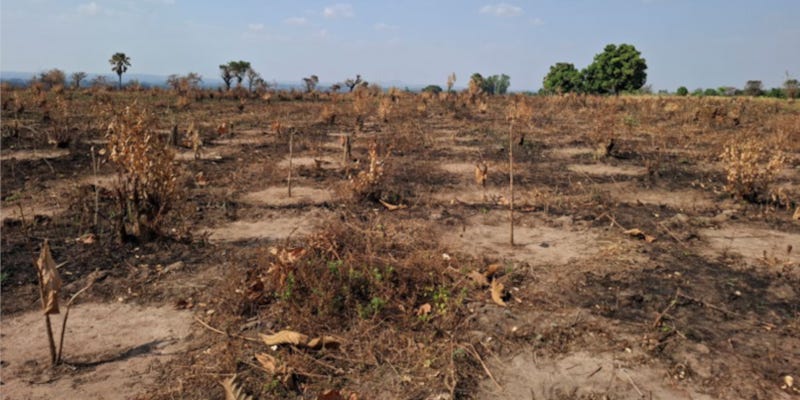
Tree planting projects often have high failure rates. The photograph at the top of this post illustrates the problem. It’s from the REP Fund’s 2024 Annual Report. The caption reads, “Woodlots in Bidibidi damaged overnight by uncontrolled wildfire from host community. UNHCR, February 2025.”
Carbon projects have repeatedly resulted in environmental and social problems for Indigenous Peoples and local communities.
There is a large amount of research that establishes that a large percentage of carbon credits are junk. And because they are traded against continued emissions from burning fossil fuels, carbon offsets are “worse than doing nothing”, as climate scientist Kevin Anderson puts it.
Beuret and Harvie conclude that,
All this means the UNHCR’s REP Fund risks making the situation worse. It is less an adaptation and more a maladaptation to climate change.
In effect, the project takes those displaced in no small part by the climate crisis and puts them to work for a pittance to benefit those companies responsible for the climate crisis. Worse, these displaced people labor to make the camps that confine them sustainable. . . .
It’s hard to see this as anything but the worst outcome in response to the existing situation, one that greenwashes the abandonment of the world’s climate displaced.
This article is also available in Spanish, here:
https://www.biodiversidadla.org/Articulos/Como-el-ACNUR-utiliza-a-los-refugiados-en-Uganda-y-Ruanda-para-generar-creditos-de-carbono