


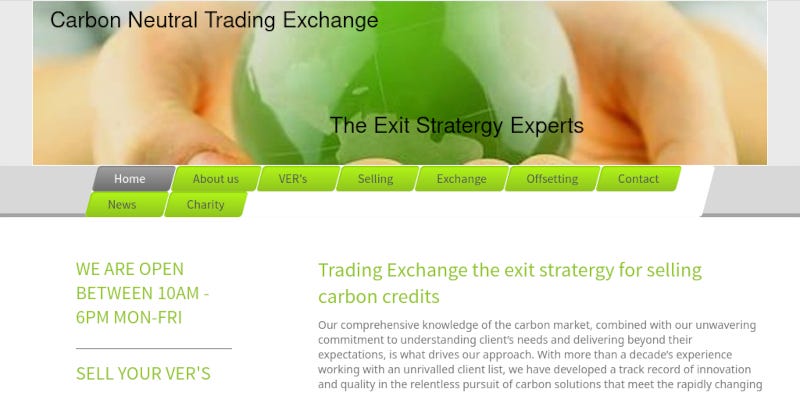
Earlier this week, a commenter on REDD-Monitor asked about a company called Carbon Neutral Trading Exchange. My response was sceptical. It seemed to me that this was a company that looked as though it was attempting to profit by selling over-priced voluntary carbon credits.
A large number of people in the UK have been sold overpriced voluntary carbon credits by companies claiming that carbon credits are a good investment. To their cost, the buyers of these carbon credits have found that selling them, at any price, is currently extremely difficult. Carbon Neutral Trading Exchange offers to sell these carbon credits to companies looking to offset their emissions – for a price. The company charges a minimum “admin fee” of £450 to people wanting to sell carbon credits, and a 6% “handling fee” to the companies buying the carbon credits.
On 22 April 2013, I received an email from Paul Green, the director of Carbon Neutral Trading Exchange, explaining that he was in the process of setting up a company to “exit people from the carbon market” and asked for my advice about whether I thought this was feasible. A couple of hours later Green sent another email, this time expressing his concerns about my criticisms of his company.
The following day, Paul Green wrote again, inviting REDD-Monitor to send questions to him about his company. I did so, and Paul Green replied by email the following day. The questions and answers are posted here in full and unedited.
REDD-Monitor: In a comment on REDD-Monitor, I wrote that Carbon Neutral Trading Exchange “looks like part 2 of the carbon credits boiler room scam”. Part 1 involves selling voluntary carbon credits that are almost worthless. Part 2 involves offering to recover the investor’s money as long as they hand over more money. Your company’s minimum “admin fee” is £450. Why is the fee so high, and what do your clients receive in return? Please break down the costs to your company covered by this “admin fee”.

Paul Mark Green: Regarding the fees we charge we are always trying to keep costing down and as you may of read we do not make a profit until completion of the offset. We obtain a profit by charging the company that wishes to become carbon neutral a handling fee and by charging this on completion we hope shows our clients we have the same goal as them to exit as soon as possible. Regarding the £450 and upwards fees that are quoted on our website this fee is solely used to buy data on our clients behalf and also used for the charges issued by the registries to change the ownership of credits with them ( nearer completion a form authorised by the registry is forwarded to the client ). Every client that we bring on we will buy a data file of companies or clients that have already been contacted by a call centre and filtered through to those that are only interested in becoming carbon neutral as this will make less man hours in quoting. The data we purchase costs a minimum of £800 for 180 warm leads already looking into carbon neutrality which is far more than the lower fees, the more credits someone wishes to sell the more data we will need to purchase. At a later date we would hope that we wont need to charge a fee for the data side as we will have a full data base but currently we are still in the process of building this side of the business, the data we have is a unrivalled list but still needs to be grown. So the fees charged gives the client a whole data file that is solely used for their credits as in many instances we have had to complete multiple offset deals as we are working in the voluntary market and only approach small to medium companies and on calculating the offset charges we only quote the company an outlay of £2000 – £4000 to complete the offset.
REDD-Monitor: You previously worked for Enviro Associates, a company that sold voluntary carbon credits as an investment. Presumably, you therefore know the actual price that Enviro Associates paid for its carbon credits and the inflated price that it sold them on as a so-called “investment”. The cheapest carbon credits on your “Trading Exchange” when I looked on 22 April 2013 were £3.50 (no details of the project generating the carbon credits or the number of credits for sale was provided, however). Most of the carbon credits in the “Trading Exchange” were priced at £7.50. Many of these were for hydropower projects, which as you know are actually worth “less than £1 per tonne”, as Edward Hanrahan of ClimateCare points out. In 2012, Andy Ager, ex-head of carbon and emissions at Bache Commodities, reckoned they were worth less than 50 pence. How do you propose finding companies that are willing to pay so much for near worthless carbon credits?
Paul Mark Green: Regarding my time at Enviro this company is the reason I set up my company and decided to set a goal to aid clients in exiting the market. I was constantly being asked about exit strategies from clients and was advised to tell clients that a platform would be available sometime in the future, I also forwarded questions to CNI as had concerns with the industry and could not understand why people could not exit the market but none of the responses I received seemed acceptable. In my time at Enviro I offset numerous companies and could not understand why we could not re sell existing clients credits for an offset and help make the client returns and make the company carbon neutral. The market was derived for this purpose and after contacting a few registries I discovered that this was feasible by paying the registry a fee to change the ownership, and a fee to retire the credits from the registry this was achievable and this is how my company was formed. As the market is a voluntary market their is no fixed price or average price and comes down to how much someone is willing to pay for credits or how good the broker is at selling them. Most of my clients had paid prices from £4.00 - £6.00 and by offering £7.50 would show a slight return and as companies work on a budget the price per ton was not as important as the overall cost. Many brokers have been charging anything from £9.00 - £12 a ton so £7.50 would still be lower quotes than the companies have already received. Regarding the comments by Climate Care they deal mainly with the compliance market and regulations in the market mean that comes have strict requirements regarding credits and the information held, as the voluntary market has no regulation and the companies involved do not have to become carbon neutral the vintage etc is not a concern for the company as they are more interested in become carbon neutral for marketing purposes. And the vintage and project a credit has come from is always over sold or sold up by a broker to sell it for more and from our experiences a carbon credit regardless of its origin has the same monetary value as another as it is solely used to issue an offset certificate to a company, if regulation comes into play that would require this to change we will then be happy to comply but at this stage our main interest is to aid the client in making a return however small it maybe in some circumstances. Not all companies will accept our quote but we state if they receive a lower quote we can look to match this by going back to our client and asking if they wish to lower there asking price as it is solely down to the client we only recommend £7.50 as an average and compared to other companies is a good starting price.
REDD-Monitor: It’s worth working through an example. On 22 April 2013, at the top of the “Trading Exchange” page on your website were 8,200 credits from Jaiprakash Hydro, selling at £7.50. The carbon credits would cost £61,500 plus your 6% “handling fee” which would come to £3,690, giving a total of £65,190. These credits are generated by a 300 MW hydropower project in India. According to Andy Ager 8,200 similar credits could easily be bought for less than £4,100 (only a little more than your “handling fee”). What kind of sales pitch would you need to convince companies to buy these credits at such an inflated price?
Paul Mark Green: Again as mentioned the price is negotiable and many companies do not go into the specifics as it is a voluntary market, they are mainly concerned with the overall price and the notion to declare themselves as carbon neutral. The compliance market are mainly concerned with the overall price and the notion to declare themselves as carbon neutral. The compliance market which many of the companies you refer to are involved in have more regulation and are required to disclose more information. The voluntary market is a lot simpler to get involved in and the main criteria is to confirm the registry has retired your credits so you can class your company as carbon neutral. We have contacted the FSA for assistance in the market but as a carbon credit is not a financial commodity its an environmental commodity they can not assist. They can look to approval us for handling money but this is the only regulation they can offer to us. Andy Ager would be correct in stating prices for credits is low but many credits even now are bought for pence and sold for pounds and this is the main flaw in the market but we aim to make the client a return and if a company is not prepared to pay the price quoted we will negotiate this with the client and company.
REDD-Monitor: Your “Trading Exchange” does not mention the vintage of the carbon credits – the year that the emissions reductions took place. As you are aware, the older the vintage, the cheaper the carbon credit. Why did you omit this important piece of information? And how could you possibly expect to sell carbon credits to companies without this information?
Paul Mark Green: Again you maybe confused with speaking to too many brokers regarding the particles of a credit many companies main concern is the price and obtaining the certificate. The market is not developed enough to be able to determine that one credits is worth more than another, the market was derived to assist in renewable energy and reducing carbon and by a company voluntarily investing into the market they are doing their bit. The only people that will spin you a yarn about credits vintage etc will be a broker as this is a sales tactic used to create more revenue, this may change in the future but the voluntary market does not need these particles and when a company becomes carbon neutral often than not they will change their logos to state they are a carbon neutral company and will not disclose the detail of the project apart form on their website. Nearly every company we speak to have no idea of the market because of how complex it is and the decision maker will have one goal of becoming carbon neutral and a budget to do this, we try and cater this and as it is voluntary market the company requirements will differ than the compliant.
REDD-Monitor: In your email to REDD-Monitor on 22 April 2013, you explained that you were “currently in the process of setting a company out that can realistically exit people from the carbon market and wanted some advice to confirm this is feasible.” In fact, you registered the company Carbon Neutral Trading Exchange on 31 December 2012. You registered the website on 20 November 2012. Your website boasts that Carbon Neutral Trading Exchange are “The Exit Stratergy [sic] Experts”. Yet you’re sending around emails asking whether the idea behind the company if feasible. Why are you now asking for advice?
Paul Mark Green: My email to you was to help build a business acquaintance as I mentioned I have numerous clients that have been seriously scammed by brokers and we have offered our services for free due to their circumstances. I wanted your help in naming and shaming them and was hoping to build an alliance and in the future and any clients you and I deemed as urgently requiring assistance I would look to offer the same free service to them and help build some trust and confidence within the market. Instead of receiving an e mail asking who the brokers was, or what the clients details was so you could contact them you remark on your site I could be part 2 of a scam? This was not my intentions I was trying to offer assistance to those clients that needed it. Regarding advice and why now, as above I have now come into contact with clients that are not in a situation to out lay any funds and as have had the police involved so I wanted to help them and was hoping you could and that is why contact was instigated by me. I also asked for guidance with my company in terms of my business plan as we are always looking for ways to improve our service and turn around times and was hoping you may give guidance. We are still in our early days of trading and are looking for as many ways we can to find alliances in a hard market and ways to improve our service.
REDD-Monitor: Is your office in Wessex House, Eastleigh a virtual office? If not, how many people work in the office in addition to you? Which floor are you on?
Paul Mark Green: We are based in Wessex House, and the second floor office is to be moved as we are recruiting more staff and need more space. We will still be in the same building but will be moving into a larger room on the next floor up. We also have an office in Southampton business park but this is used for our field agents as the first base in the south. Over time we will hope to have these spread through the U.K. The details of our office move will be documented on our website.
REDD-Monitor: You told me in your 22 April 2013 email that you “unfortunately worked as a broker for 3 months”, yet your LinkedIn page states that you worked as a “Stock Broker” for Enviro Associates for 10 months. Which is correct?
Paul Mark Green: I apologise if stated three I was there longer and can only say that it was an error of me not proof reading my email before I sent it as I was there about 10 months maybe a month less. I did learn about the market in more detail but as stated they opened my eyes to how brokers operate and is why I stipulate we are not a broker, and have no affiliation to brokers. Brokers do not do the carbon market justice and we do not in any way want to be in the same affiliation as brokers and this is why we do not sell carbon credits.
REDD-Monitor: Your LinkedIn page describes your company as follows:
“The Trading Exchange is the first and only easily accessible platform to buy and sell VER. We have teamed up with net builder and developed a platform allowing clients to buy and sell between them and the option for small to medium businesses to offset.”
When I looked at your “Trading Exchange” on 22 April 2013, it was not working – nothing happened why I tried clicking on the “Buy” button. Who was the “net builder”? I note that you’ve now removed the table of carbon credits from the “Trading Exchange” page on your website. Why? What happened to the carbon credits that were advertised there? What happened to the “platform”? Have you given refunds to your clients whose carbon credits were previously advertised on the “Trading Exchange”?
Paul Mark Green: The credits was first placed on the site in case we had hits to the website from companies and they would be able to see what projects we had available. I felt this made the company appear unprofessional and we would much prefer a company to call and enquire about availability. We still are looking to sell the credits but our business model mainly involves us calling the clients and companies on the data we have bought and offering quotes to become carbon neutral and the quotes are calculated using the clients credits, it is a simple model but as you can imagine businesses can take their time to proceed due to budgets and getting quotes signed off but we will keep quoting until we have fully exited the client. We are always open for suggestions in speeding this process up and was why I asked for advice from yourself, but we may also look to attend road shows in the UK and try and drum up business and conventions as well. Regarding net builder they are a company that derived a trading platform for Barclays Bank to help aid there asset management trading software. We have a business plan with them to build and develop a platform that will work primarily as a on line platform for companies to bid and purchase credits on line and also to help calculate a trend in prices and hopefully introduce a structure for selling. The over package for software is in stages and is extremely expenses so we are having delays with getting it up and running. This does not effect us trading and exiting from the market as we currently call companies and visit them face to face to achieve offsetting them. The on line platform would be used solely for companies to purchase on line and would hope to have it linked into the registries. Because of the complexities involved with this type of development it will be on going for a while but will no way hinder our current business model.
REDD-Monitor: Have you, so far, managed to sell any carbon credits via the Carbon Neutral Trading Exchange?
Paul Mark Green: We have been been successfully in offsetting companies and exiting clients and that is why I am confident in our business model because we have already achieved it. Business recently has gone quiet and I am unsure if it is due to us being discussed on forums or the nature of the industry but we keep our clients up to date and have always stated if we get to a point that the clients feels we are not trying our hardest to exit them we will look to refund any fees paid to date. We have already refunded one client who decided to sell else were but since has realised the other company who you have already discussed on your site recently was not legitimate and have now come back to us.
I hope now we can look to build an acquaintance and would be keen for you to assist with my clients who are struggling to get the authorities to aid them in bringing the brokers to justice.
Comments following the original post on REDD-Monitor.org are archived here: https://archive.is/eodAa#selection-1297.4-1297.15