


A debate has been raging in Australia about generating carbon credits from the proposed Great Koala National Park in New South Wales. The Labor government has made setting up the park conditional on selling carbon credits. Environmentalists, academics, and the Greens find themselves on both sides of the debate.
The Great Koala National Park
First, a brief recent history of the Great Koala National Park:
In the early 2010s, four environmental groups1 collaborated with the National Parks Association of NSW. They hired ecologist David Scotts to map koala populations. The koala national park proposal is aimed at protecting critically important koala populations.
In January 2015, Luke Foley, then-NSW Labor party leader, promised to create Australia’s first koala national park if he won the election in March 2015. The Great Koala National Park would cover 315,000 hectares, including 175,000 hectares of state forests. Foley lost the election.
In September 2018, Foley once again promised a koala national park. “None of this is rocket science,” he told reporters. “We know what can be done to save the koala, it’s a question of political will.”
(In November 2018, Foley faced allegations of sexual harassment of an ABC journalist. He resigned but denied the allegations and threatened to sue the journalist. He dropped the case a few weeks later.)
In January 2023, Chris Minns, NSW Labor leader, once again promised to establish the Great Koala National Park, if he won the election in March 2023. Minns promised that Labor would spend A$80 million setting up the National Park. Labor won the election.
The NSW Government committed A$80 million in the 2023-24 state budget to set up the Great Koala National Park. A further A$60 million was announced for the NSW National Parks and Wildlife Service to support setting up the park.
In September 2025, the NSW Government announced that, “The final creation of the park is dependent on the successful registration of a carbon project under the Improved Native Forest Management Method, which is currently moving through the Federal Government assessment processes.”
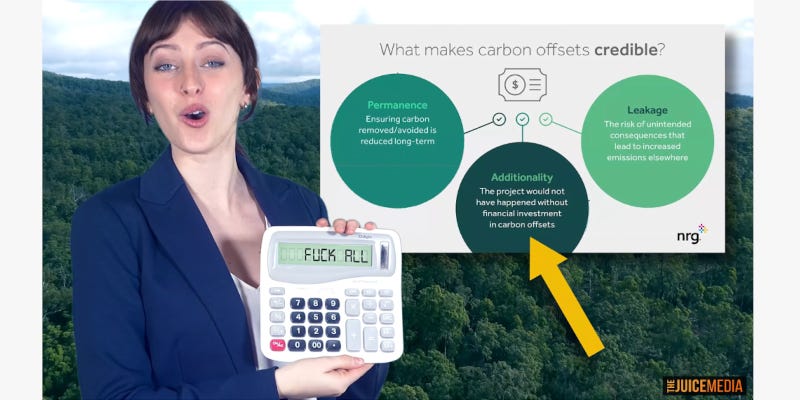
Clearly there is no additionality in this carbon trading plan. Labor first promised to create the koala park in 2015, repeated the promise twice, and budgeted for the park’s creation in 2023.
The Honest Government Ad
The Juice Media explains in its inimitable style why the NSW Labor Government is threatening not to protect koalas unless it can sell dodgy carbon credits to Big Polluters.
Last year, Energy Australia settled a greenwashing case out-of-court. The case was brought by Parents for Climate and accused Energy Australia of misleading more than 400,000 customers about its “Go Neutral” product. Energy Australia sources most of its energy from coal-fired power stations.
Following the out-of-court settlement, Energy Australia issued a statement in which it admitted that “offsets do not prevent or undo the harms caused by burning fossil fuels”.

The hardwood division of the NSW Forestry Corporation loses tens of millions of dollars every year. According to its 2024-25 Annual Report (page 47), the NSW Forestry Corporation anticipated losing A$32 million in 2025. Stopping logging would save taxpayer money. And that money could fund koala conservation.
The Senate vote
A vote is scheduled in the Senate on 15 September 2026. The Greens have the decisive votes.
Obviously, the Greens are in favour of protecting koala habitat.
The NSW Green’s policy includes protecting native forests. It also states that the NSW Greens will work towards, “Ensuring that the carbon value in existing forests cannot be traded to offset fossil fuel or other greenhouse gas-intensive industries.”
But the Labor government is holding the koala park hostage to the carbon credits deal. No carbon credits, no national park.
And, after long discussions, the Greens have now announced that they had reached a deal with Labor and decided not to block the carbon credit plan. (Three Greens remained opposed to selling carbon credits from the koala national park.)
The Greens say that the deal they’ve made with Labor will prevent carbon credits from being sold to coal and gas companies, according to reporting by The Guardian. But whether that can actually be enforced and how long it will last remains to be seen.
The reality is that this is a horrible deal. It will create more carbon credits — in a market that is already facing a glut of cheap credits. That’s why it was cheaper for mining company BHP to buy offsets instead of electrifying its truck fleet. And more carbon credits means more pollution, which makes the climate crisis worse and increases the likelihood of the forests going up in flames.
The Australia Institute points out that,
We shouldn’t have to choose between saving native forests and stopping climate change. We must do both.
The solution isn’t complicated, neither is the politics. The best way to protect forests is to implement a native forest logging ban. And the best way to tackle climate pollution is to make polluters cut their emissions – not buy cheap dodgy offsets to cook the books.
The Bellingen Environment Centre, Nambucca Valley Conservation Association, Clarence Environment Centre, and North Coast Environment Council.
Such a shit decision to have to make because of the perfidy of the Labor party and their fossil fuel mates.
The Greens achieved some other concessions in addition to the not selling credits to fossil fuel companies; of a reduction in logging outside the park going up to 28% rather than 20% and a change in the definition of plantation so regrowth native forests can’t be redefined as plantations as I noted in my piece here.
Re additionality I agree with you completely but that’s about whether the park is eligible under the method, not the method itself.
I hope the park is declared in double quick time - and the debate as to whether it’s eligible can then begin - potentially legally I understand.
https://janetrice.substack.com/p/to-allow-or-disallow?
Thank you for this succinct analysis of what would be utterly absurd if it wasn’t so abjectly depressing.