

Malawi has signed a 40-year contract with Portuguese engineering firm Mota-Engil to generate carbon credits from 550,000 hectares of the country’s forests
Trafigura will market the carbon credits.

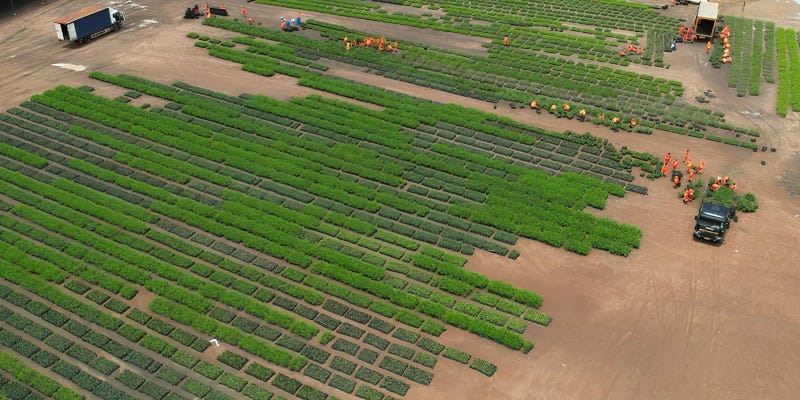
A Portuguese engineering company called Mota-Engil has signed a 40-year contract with the government of Malawi to generate carbon credits from 550,000 hectares of forest in the country. Singaporean commodities trading firm Trafigura has signed a deal with Mota-Engil to sell the carbon credits.
Mota-Engil anticipates that the project will generate more than 30 million carbon credits. The project is being developed by a subsidiary of Mota-Engil called Mamaland.
The project in Malawi is supported by the Miombo Restoration Alliance, which was launched at New York Climate Week in 2024 by the ICCF Group, Conservation International, and Trafigura. At the end of January 2026, the Miombo Restoration Alliance announced its support of four carbon projects, in Malawi, Zambia, Mozambique, and Tanzania.
In a statement, Hannah Hauman, Head of Carbon at Trafigura, said that,
“We are delighted to announce our first projects under the Miombo Restoration Alliance, proving the framework approach of mobilising private capital at scale for restoration under Article 6. We are grateful to our host country governments for their leadership and vision, and to our partners for their expertise. As the Miombo Restoration Alliance moves from design to implementation, we look forward to delivering high-integrity carbon removal credits to global customers and long-term benefits for communities across the region.”
Follow the money
Mota-Engil’s press release explains that the money from the carbon credits will go to Mamaland with a commission going to Trafigura:
These credits will be traded on the open market, with the proceeds being fully paid to MAMALAND, less than the marketing commission that Trafigura will be entitled to.
Trafigura will pay US$100 million to Mamaland for the exclusive right to sell the carbon credits and as an advance payment.
There is no mention in the press release of any payments to the local communities or to the government of Malawi. Yet the 14 forest concessions that make up the project area cover a total area of almost 6% of Malawi’s land area.
In August 2025, Malawi launched its Carbon Market Framework. According to Owen Chomanika, Malawi’s Minister of Natural Resources and Climate Change, “This Framework establishes a structured approach to carbon trading, enabling Malawi to participate in both voluntary and compliance carbon markets.”
The Framework includes the following diagram explaining how revenue from sales of carbon credits should be divided up:
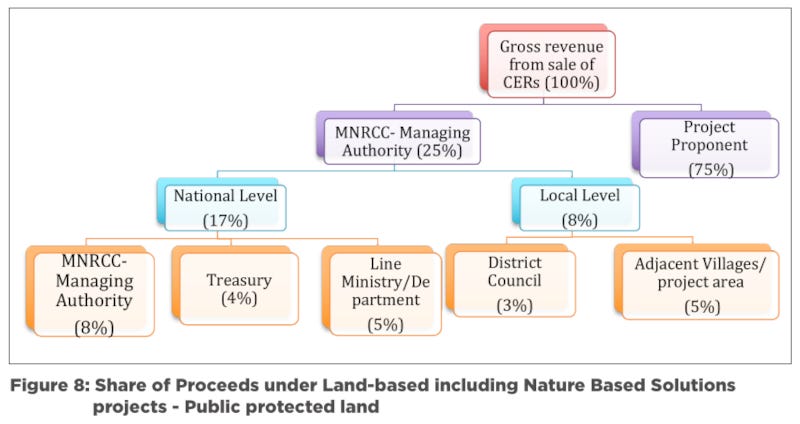
Under the Framework, project developers can only generate and sell carbon credits if they obtain a letter of authorisation from Malawi’s Environmental Affairs Department.
40-year carbon contract, but no carbon credits law
In a recent article in the Mail & Guardian, journalist Collins Mtika points out that Malawi does not yet have a standalone law on carbon credits with enforceable rules on ownership, consent, and benefit-sharing.
“Malawi is signing 40-year contracts before it has basic rules,” Werani Chilenga, a member of parliament in Malawi, told local media. “We are risking our forests becoming a playground for foreign companies while our people remain spectators.”
Mota-Engil’s spokesperson in Malawi, Thomas Chafunya, told the Mail & Guardian that questions about revenue and concession terms should be directed to the Malawi government.
But neither the Department of Forestry nor the Ministry of Natural Resources responded to the Mail & Guardian’s questions.
Mamaland is developing another project, the MoRe (Mountain Recovery) Malawi ARR project that aims to restore about 236,000 hectares of Miombo forest. The project is currently listed as “Under development” on Verra’s registry. How this project relates to the 40-year contract with Trafigura is not clear.
Creating conflict
Almost all villagers in Malawi rely on biomass for cooking. Women walk long distances to collect firewood. Farmers clear plots of land to grow maize and beans. Trees are cut to produce charcoal for the cities of Blantyre and Lilongwe.
Bruce Sosola is the co-founder of a Malawian carbon consulting firm called Natural Capital Advisory. “If we fence people out to ‘protect’ the carbon,” he told the Mail & Guardian, “we haven’t created a project, we have created a conflict.”
Mamaland commented that community benefit is “central to its model” and the project will include 10,000 hectares of trees planted to supply fuelwood.
But the Mail & Guardian spoke to a village leader who said that communities had been promised tree nurseries and jobs as forest guards. He did not know how long the land would remain under the carbon contract or how much of the money from sales of carbon credits would go to the communities.
Trafigura’s record
Meanwhile, Trafigura is the world’s largest private metal trader and the second-largest oil trader. Not only does the company profit from trading in products that are driving the climate crisis, it has been embroiled in a series of scandals. Here’s a short list of some of the most recent:
Trafigura was one of the first companies (along with Vitol) to sign a deal to export oil from Venezuela following the Trump regime’s illegal military attack on the country and the kidnapping of President Maduro.
In January 2025, Switzerland’s Federal Criminal Court convicted Trafigura and a former executive of paying bribes paid to the director of Angola’s national oil company, Sonangol.
In June 2024, Trafigura reached a settlement with the Commodity Futures Trading Commission in the US and paid a US$55 million fine following allegations of fraud, manipulation, and impeding whistleblowers related to the petrol market in Mexico.
In March 2024, Trafigura pleaded guilty in the US to conspiring to bribe Brazilian officials to gain contracts with Brazil’s state-owned oil company Petrobras. The company agreed to pay a total of US$127 million.
Trafigura and Mota-Engil are both involved in the construction of the Lobito Corridor railway in Angola. The railway line is planned to run from Kolwezi in the south of the Democratic Republic of Congo to the port of Lobito in Angola to transport minerals from copper and cobalt mines in DRC to the cost. Global Witness reports that as many as 6,500 people are at risk of forced eviction in DRC to make way for the railway.