

No, Mark Carney's speech at the World Economic Forum was not “pretty good”
Some thoughts on Carney’s “a rupture, not a transition” speech.

Last week, I posted a statement by DiEM25 opposing the World Economic Forum.
I’ve never heard of DiEM25. Who are they?
It was founded in 2016 by a group of Europeans, including Yanis Varoufakis and Srećko Horvat. DiEM25’s manifesto states that, “The one simple, radical idea that had brought us together became the foundation of DiEM25: Europe will either be democratised or it will disintegrate!”
And they don’t like the World Economic Forum?
Not at all. DiEM25 writes that “the Forum serves to reinforce the wealth and power of the richest one percent at the expense of people and the planet”.
So why are we revisiting this?
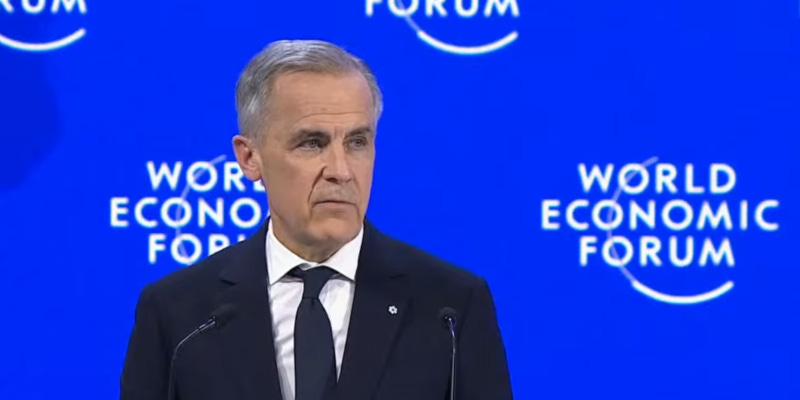
Well, the day before I posted the DiEM25 statement, Mark Carney gave a speech in Davos. The speech has been described as “blistering and remarkable”, “stark”, “historic”, “wide-ranging”, and a “call to arms”. I listened to the speech and mentioned it in my introduction to the DiEM25 statement on WEF. I described it as a “pretty good speech”.
How could the man who set up the Taskforce on Scaling Voluntary Carbon Markets ever give a “pretty good speech”?
In theory, almost anyone could give a pretty good speech.
I suppose so, but Carney spent 13 years working at Goldman Sachs. He was governor of the Bank of Canada and the Bank of England. He was on the board of the WEF. He’s hugely in favour of carbon markets.
In my defence, I did add that I’m not a fan of Carney.
So was it a “pretty good speech” or not?
No it wasn’t. I’ll update the DiEM25 post and add a link to this one.
But compared to, say, Kier Starmer’s lapdog approach to Trump, at least Carney criticised Donald Trump publicly.
Without mentioning Trump. Or fascism.
No. But he does mention Greenland.
But not Gaza.
No.
Or Venezuela.
No. There are a lot of countries that Carney could have mentioned but didn’t. We’ll come on to a list of some of those countries later on.
But Carney does mention Thucydides.
Yes, Carney starts his speech with a brief introduction in French. Then he says,
It seems that every day we’re reminded that we live in an era of great power rivalry — that the rules-based order is fading, that the strong can do what they can, and the weak must suffer what they must.
And this aphorism of Thucydides is presented as inevitable, as the natural logic of international relations reasserting itself.
Remind me who Thucydides was.
Thucydides was an ancient Greek general and historian. His aphorism comes from the Melian Dialogue in Thucydides’ History of the Peloponnesian War. The island of Melos (or Milos in Modern Greek) was neutral in the war. In 416 BCE Athens invaded Melos with 3,400 men. The Melian leaders asked to negotiate, and the Melian Dialogue is Thucydides’ fictional version of the negotiations. Early on in the dialogue, the Athenians state that,
we both alike know that into the discussion of human affairs the question of justice only enters where there is equal power to enforce it, and that the powerful exact what they can, and the weak grant what they must.
Might is right. What happened next?
The Melians refused to give in. The Athenians laid siege to the city and captured it. They executed all the adult men and put the women and children into slavery.
In his Davos speech, Carney argues against Thucydides’ aphorism (which, Thucydides probably did not intend as a general truth — it was one part of a longer dialogue that puts forward a series of arguments and counter arguments). Instead, Carney argues that complying with the strong and avoiding trouble will not guarantee safety.
Noam Chomsky has referred to Thucydides’ aphorism many times. He describes it as “not only indisputably unjust, but at the present stage of human civilisation, a literal threat to the survival of the species”.
Invoking Thucydides, given what happened to Melos, is not exactly reassuring for Greenlanders is it?
Not really, no.
Where does Carney go next in his speech?
He jumps from Ancient Greece to Czechoslovakia in the 1970s.
Carney refers to Václav Havel’s 1978 essay “The Power of the Powerless” and tells us about a greengrocer who puts the slogan “Workers of the world, unite!” in the window of his shop.
Havel writes,
That poster was delivered to our greengrocer from the enterprise head-quarters along with the onions and carrots. He put them all into the window simply because it has been done that way for years, because everyone does it, and because that is the way it has to be. If he were to refuse, there could be trouble.
Havel writes that people living in a totalitarian system are “living within a lie”.
Carney says that when the greengrocer removes his sign, the illusion of the system’s power begins to crack. “Friends,” he says, “it is time for companies and countries to take their signs down.”
Havel, of course, has a lot more to say about opposition to totalitarian regimes than taking signs down. In “The Power of the Powerless” he writes about Charter 77. Havel was one of the founding members of the Charter 77 association. It’s been described as Communist Czechoslovakia’s “most important protest movement” and was based on the Charter 77 declaration, published in January 1977.
The declaration was inspired by the imprisonment of 27 musicians on 17 March 1976. Their crime was playing at an Underground Festival.
Havel writes that,
Everyone understood that an attack on the Czech musical underground was an attack on a most elementary and important thing, something that in fact bound everyone together: it was an attack on the very notion of living within the truth, on the real aims of life.
The headline band at the Underground Festival was The Plastic People of the Universe. The band was formed one month after the Soviet invasion of Czechoslovakia following the Prague Spring of 1968.
The Plastic People of the Universe’s name came from the 1967 song “Plastic People” by Frank Zappa’s The Mothers of Invention.
I’m guessing Carney didn’t mention any of this.
Unfortunately not. The second verse of “Plastic People” is pretty relevant to today’s USA:
Take a day and walk around
Watch the Nazis run your town
Then go home and check yourself
You think we’re singing ’bout someone else
In “The Power of the Powerless,” Havel writes about Ivan Jirous, the manager of The Plastic People of the Universe. He was the first person in Czechoslovakia to put forward and apply the concept of a “second culture”. This started, Havel writes, with “nonconformist rock music and only certain literary, artistic, or performance events close to the sensibilities of those nonconformist musical groups”. But the term was soon used for “the whole area of independent and repressed culture, that is, not only for art and its various currents but also for the humanities, the social sciences, and philosophical thought”.
Havel is writing about dissident movements. Carney is talking about something else altogether.
And what would that be?
Carney moves on to the “rules-based international order”. He admits that “countries like Canada prospered” under this system. And he admits the “rules-based international order” was fake:
We knew the story of the international rules-based order was partially false, that the strongest would exempt themselves when convenient, that trade rules were enforced asymmetrically, and we knew that international law applied with varied rigor, depending on the identity of the accused or the victim.
Carney explains how this system was useful to countries like Canada — by which he means rich countries in the Global North. It provided “public goods, open sea lanes, a stable financial system, collective security, and support for frameworks for resolving disputes”.
Carney’s admission that the international rules-based order was “partially false” is nothing new. Two days before Carney’s speech, Grace Blakeley wrote that,
Of course, the liberal rules-based order was pure ideology, designed to lend legitimacy to a global economy based on imperialism. This ideology was already crumbling when Trump came to power, leaving little more than a hollow façade in its place. The rules never constrained the behaviour of superpowers like the United States, even as they were applied forcefully to weaker states. But even façades serve a function — otherwise there would be little point in erecting them in the first place.
What is surprising is to hear someone like Carney, who is so deeply enmeshed in the international rules-based order, telling us that it was “partially false”.
But Carney makes no mention in his Davos speech of what US imperialism (which is actively supported by many other countries, including Canada) actually looks like to those on the receiving end. Neither does he mention the 750 military bases around the world that the US maintains.
Media Lens gives a list of some of the horrors of US imperialism.
1945: Dropping atomic bombs on Hiroshima and Nagasaki;
1953: The coup in Iran, overthrowing the democratically-elected Mohammad Mosaddegh;
1960s-1970s: The invasion, bombing, and widespread spraying of Agent Orange in Vietnam, Laos, and Cambodia.
1965: The Indonesian coup and the murder of up to 1 million people.
1980s: Support for right-wing governments and paramilitary groups in Latin America.
1990-1991: The Gulf War, which resulted in up to 100,000 Iraqi deaths, including up to 5,000 civilian deaths.
1990s: Sanctions against Iraq, which led to the deaths of 1.5 million Iraqi civilians.
2001: The invasion of Afghanistan. The post-9/11 US wars have led to the deaths of about 5 million people in Iraq, Afghanistan, Syria, Yemen, and Pakistan.
2003: The invasion and occupation of Iraq, which led to the deaths of more than 1 million Iraqis.
2011: Bombing of Libya. This acted as a catalyst for a huge increase in jihadist militias in north Africa and the Middle East.
2014: The coup in Ukraine to impose a US-backed regime.
2023: Support for Israel’s genocide in Gaza.
2025: Joint air strikes with Israel against Iran. This followed decades of sanctions against Iran.
2026: The kidnap of Venezuela’s President Nicolás Maduro and his wife, Cilia Flores.
Some “rules-based order”, eh?
Carney says that because “countries like Canada” prospered under “American hegemony” (by which he means US imperialism) “we placed the sign in the window”.
We participated in the rituals, and we largely avoided calling out the gaps between rhetoric and reality.
This bargain no longer works.
Let me be direct. We are in the midst of a rupture, not a transition.
Carney acknowledges the crises in finance, health, energy, and geopolitics over the past two decades. These have “laid bare the risks of extreme global integration”.
But Carney says that recently “great powers” (by which he means Trump’s fascist regime) have started using “economic integration as weapons, tariffs as leverage, financial infrastructure as coercion, supply chains as vulnerabilities to be exploited”.
Carney appears to have forgotten the role of the International Monetary Fund and the World Bank in imposing structural adjustment programmes on countries in the Global South. During the 1970s oil crisis, massive amounts of oil money poured into Western banks. Flooded with money, these banks started lending to dictators and governments in the Global South.
This, predictably, led to a debt crisis in the 1980s when countries couldn’t repay the loans. The IMF stepped in with offers to refinance the loans. But as a condition for this refinancing, countries had to reduce government spending, abandon price supports on food, scrap free health care and free education, remove trade protections, open up markets to foreign investment, impose financial deregulation, and privatise state-owned enterprises. The results were devastating for many countries in the Global South.
The difference today, is that Trump is imposing tariffs on countries in the Global North as well as the Global South. This is the “rupture” that Carney is talking about.
Carney says that the multilateral institutions are under threat. He describes the WTO, the UN, the COP, as “the very architecture of collective problem solving”.
But in his speech, Carney doesn’t make any proposals for rebuilding or strengthening these multilateral institutions.
And after almost three decades of utter failure to address the climate crisis, describing the COP process as anything to do with “problem solving” is completely delusional.
Does Carney mention climate change in his speech?
No. Not a word.
Instead, he talks about what his government is doing:
Since my government took office, we have cut taxes on incomes, on capital gains and business investment. We have removed all federal barriers to interprovincial trade. We are fast tracking $1 trillion of investments in energy, AI, critical minerals, new trade corridors and beyond. We’re doubling our defence spending by the end of this decade, and we’re doing so in ways that build our domestic industries. And we are rapidly diversifying abroad.
These are all policies that deny the reality of the climate crisis. Later in his speech, Carney describes Canada as “an energy superpower”. What he doesn’t say is that Canada has the fourth largest oil reserves in the world and has the world’s fourth largest proven oil reserves.
Carney announced the $1 trillion in investments over the next five years in his budget speech in November 2025. He also said then that, “This is a rupture, not a transition”.
Carney is supposed to know all about the climate crisis. In 2015, when he was the governor of the Bank of England, he gave his “Tragedy of the Horizon” speech about climate change and financial stability. “The catastrophic impacts of climate change will be felt beyond the traditional horizons of most actors,” he said.
In 2019, after he was appointed UN Special Envoy on Climate Action and Finance, he said that “Climate change is an existential threat.”
In 2021, he announced the Glasgow Financial Alliance for Net Zero (GFANZ) at COP26. “The transition to net zero is becoming a strategic imperative for companies and financial institutions,” he said. In August 2025, the Net Zero Banking Alliance, which was part of the GFANZ, suspended activities after many financial institutions left the Alliance.
But since Carney became Prime Minister of Canada in March 2025, his record on climate change has been disastrous. He removed the consumer carbon price. He scrapped energy efficiency retrofit programmes. He delayed the electric vehicle mandate. The government is in discussions with energy companies about eliminating a cap on emissions from the country’s oil and gas sector. He has announced plans that would allow the government to override environmental regulations. And under the “Building Canada Act”, the government limits opportunities for Indigenous consultation and consent on projects deemed in the “national interest”.
In June 2025, Carney spoke about building new bitumen pipelines for “decarbonized” oil. As DeSmog points out “decarbonized oil” is as real as vitamin cigarettes.
In November 2025, at the G20 meeting in South Africa, he talked in favour of nature-based solutions and the Tropical Forest Forever Facility. Carney called for the development of standardised, high-integrity carbon markets. He said AI data centers should be “carbon neutral” which would “catalyze enormous private sector demand” for carbon credits.
Also in November 2025, Carney signed a memorandum of understanding for a new oil pipeline to the coast of British Columbia.
Canada’s National Observer reports that Carney has announced support for “LNG Canada Phase 2, the Ksi Lisims LNG terminal, the Prince Rupert Gas Transmission pipeline, and supported the auction of 85,000 square kilometres of new offshore oil exploration off the coast of Newfoundland and Labrador”.
Naomi Klein comments that this is a classic example of the “shock doctrine”. Canadians voted for Carney in a state of shock following Trump’s threats of Canada becoming the 51st state. But since the election, Carney has pushed a corporate wishlist that existed long before Trump. Carney is “completely trashing Canada’s climate commitments, and ramming through extractive projects that make a mockery of the commitments to UNDRIP [the United Nations Declaration on the Rights of Indigenous Peoples]”, Klein says.
Uh oh.
The reality is that Carney’s interest is in finance and not in addressing the climate crisis. He is interested in protecting profits, not in protecting people and the planet.
Thanks Chris 💯
As usual, you are providing much needed couterpoint to all the blind Carney Coddling that's currently going on.