


In November 2012, Indonesia’s Minister of Forestry, Zulkifli Hasan, visited the Harapan Rainforest Project in Jambi Province, Sumatra. “The squatters must be removed from the forest and moved to another place,” he said. “Do not allow the recovery programme of the last lowland forest in Sumatra to fail.”
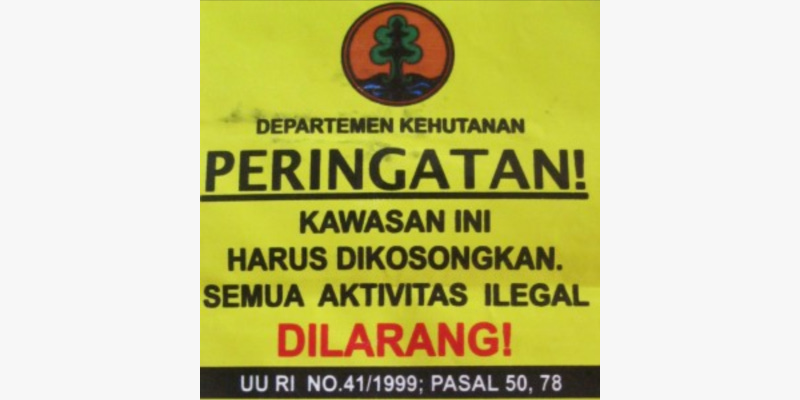
A few days ago, Ministry of Forestry notices were posted in an area of the Harapan Rainforest Project where around 500 people are living. The notices state: “Warning! This area must be vacated. All illegal activities are forbidden!” The people living there are given one week to leave.
The conflict over land in and around the Harapan Rainforest Project has been going on for several years. The first post on REDD-Monitor about Harapan was in December 2008. Sarwadi Sukiman, a farmer and member of Serikat Petani Indonesia (SPI – Indonesian Farmers Union), travelled to Poznan to complain about the way the Harapan Rainforest Project had been treating farmers living in what had become a conservation area (previously it had been a logging concession).
The Harapan Rainforest Project is surrounded by oil palm and logging concessions. There is little doubt that without the project the forest would be destroyed. The project accuses SPI farmers of building houses and farming, “deep inside Harapan, on a scale large enough to compromise the ecological integrity of the forest”.
The project is supported by a range of funders, including Germany’s Federal Ministry for the Environment, Nature Conservation Nuclear Safety (BMU), Singapore Airlines, Conservation International and the European Union. Support also comes from the Royal Society for the Protection of Birds in the UK and the Nature and Biodiversity Conservation Union, NABU, in Germany. Despite the four-year-long conflict, no process of conflict resolution has been successfully established at Harapan.
BMU has given a €7,575,000 grant to Harapan, which is being implemented by Germany’s KfW Bank. Earlier this year, KfW carried out a mission to Harapan. Little information about the project is available on either BMU’s or KfW’s websites. On 5 December 2012, REDD-Monitor wrote to BMU and KfW to request more information about the German government’s actions to help address the land conflict at Harapan. BMU responded only to request more time. KfW has so far not replied. The emails are below, with the response from BMU. REDD-Monitor looks forward to posting BMU’s and KfW’s full response, in particular KfW’s report from its mission earlier this year.
UPDATE – 19 December 2012: REDD-Monitor received an email from KfW today, explaining that BMU and KfW are currently coordinating a response which will be sent in due course. REDD-Monitor will post the response in full when it arrives.
UPDATE – 21 December 2012: The response from Germany’s International Climate Initiative is available here.
From: Chris Lang
Date: 5 December 2012 10:11
Subject: Harapan project and BMU
To: Michael Huettner (Programmbuero Klima, BMU)Dear Michael,
Greetings from Jakarta! My name is Chris Lang and I work on a website called REDD-Monitor (www.redd-monitor.org). I understand that BMU, through its International Climate Initiative, is supporting the Harapan project in Sumatra. There are several posts on REDD-Monitor about Harapan, here.
As I’m sure you are aware, there is a serious on-going conflict between people living near the Harapan project area and PT REKI, the company that is managing the project. The project has released photographs and satellite images showing the settlements inside the project area and the resulting damage to the forest. I was surprised, therefore, to find the following statement on BMU’s website, implying that there is no conflict (dated 23 July 2012):
“In consultation with the residents, the project creates new sources of income through reforestation work, the use of non-timber products, sustainable agriculture in the buffer zone and ecotourism. Together with the local authorities, Yayasan KEHI engages in an ongoing dialogue with new settlers to keep them informed of the current geographical boundaries and to enter into agreements on sustainable use of the forest.”
Further evidence of the ongoing conflict, from the Harapan project perspective, is documented here. According to a recent post about a visit to Harapan by the Minister of Forestry, Zulkifli Hasan, 17,000 hectares of the project area has been occupied. The Minister’s response was to say that, “The squatters must be removed from the forest and moved to another place.”
I understand that in August this year, KfW (which is implementing the €7,575,000 BMU grant for Harapan) sent a mission to Harapan. Could you please send me a copy of KfW’s report of the mission? I have also written to Marcus Stewen at KfW to request a copy of the report.
On 19 September 2012 (i.e. after KfW’s mission), the Federal Government responded to a “Kleine Anfrage” about Germany’s involvement in REDD. The Government response included the following statement about Harapan:
“Criticism has been raised in the context of a tropical forest conservation project in Indonesia (protection of the “Harapan Rainforest” in Sumatra, supported by the International Climate Initiative of BMU). In the project good relations based on partnership exist with the Indigenous People living there, whereby mistakes and inaccuracies were detected in the media coverage. The complaints are thus not from the local population, but by new settlers who exploit the partially unclear legal situation and partly promoting illegal logging and land grabbing in protected areas under the cover of advocacy for the rights of small farmers. A clarification process with Indonesian (government) institutions has been initiated.”
Could you please provide further details of the “clarification process” that has been initiated with the Indonesian government? Which Indonesian government institutions are involved? Which organisation initiated the clarification process?
Is BMU, KfW, Yayasan KEHI, PT REKI or any other institution involved with the Harapan project in the process of establishing a conflict resolution process, or already involved in a conflict resolution process?
Thank you for your time and I look forward to hearing from you. I would be grateful if you could respond by 12 December 2012. Please consider your response to be on the record.
Regards, Chris Lang
From: Göhler, Daniela (BMU)
Date: 5 December 2012 16:58
Subject: AW: Harapan project and BMU
To: Chris Lang, REDD-Monitor
Cc: Huettner, Michael (Programmbuero Klima, BMU), Tscherning, Karen (Programmbuero Klima, BMU), Reuter, Hanna (Programmbuero Klima, BMU), Freiberg, Horst (BMU), Specht, Rudolf (BMU)Dear Chris,
Thank your for your email. We are aware of the situation you describe and have been trying to uncover what is happening in Harapan, what is being reported through various channels, and what can or should be done to solve the conflictive situation together with the Indonesian government. We remain engaged sur place mainly through the implementing organisations of the project (KfW and NABU) and the German Embassy in Jakarta.
We will certainly compile information in order to respond to your questions and to help promoting transparency and conflict resolution. I believe that we share the same interest here.
I can assure you that we take this serious. That is why we may need some more time to get back to you (after Dec 12th). I hope for your understanding, you will hear from us as soon as possible.
Best regards,
Daniela_______________________________________________
Daniela Göhler
Advisor
Federal Ministry for the Environment, Nature Conservation and Nuclear Safety (BMU)
Division E III 7, International Climate Finance, International Climate Initiative
From: Chris Lang
Date: 5 December 2012 10:14
Subject: Harapan project and KfW
To: Marcus Stewen (KfW)Dear Marcus,
Greetings from Jakarta! My name is Chris Lang and I work on a website called REDD-Monitor (www.redd-monitor.org). I understand that KfW is the implementing agency for a €7,575,000 grant from BMU for the Harapan project in Sumatra, Indonesia.
There are several posts on REDD-Monitor about Harapan, here.
I’m afraid I could find very little information on the KfW website about the project and would be grateful if you could answer the following questions:
I understand that at least two KfW missions to Sumatra have taken place to look into the Harapan project, one in 2011 and one this year. Could you please send me copies of the reports from these missions?
As I’m sure you are aware, there is a serious on-going land conflict between the project managers, PT REKI, and people living near the project area. The project has released photographs and satellite images showing the settlements inside the project area and the resulting damage to the forest. What is KfW doing to address these problems and what has KfW done over the past three years of the project to address these problems, or to ensure that the project management is addressing the problems?
The conflict is not a recent phenomena. In 2008, Sarwadi Sukiman of the SPI – Indonesian Farmers Union travelled to Poznan to protest about the Harapan project. That is one year before the KfW project started. What due diligence did KfW carry out before the project started? Did KfW (or BMU) make any attempt to determine whether a process of free, prior and informed consent had been carried out with all the local communities living around the Harapan project?
The Harapan project has set up a blog to document the conflicts. According to a recent post 17,000 hectares of the project area has been occupied. On a recent visit to Harapan, the Minister of Forestry, Zulkifli Hasan said, “The squatters must be removed from the forest and moved to another place.” What is KfW’s response to this approach to the conflict
According to a press release on KfW’s website, last year you informed Prince Charles about the results of KfW’s 2011 mission to Sumatra. Did you mention the land conflict with local communities?
Thank you for your time and I look forward to hearing from you. I would be grateful if you could respond by 12 December 2012. Please consider your response to be on the record.
Regards, Chris Lang
Comments following the original post on REDD-Monitor.org are archived here: https://archive.is/sNWzZ#selection-1197.4-1197.15