The state of Acre hit the world’s headlines in December 1988 with the murder of Chico Mendes, the president of the Union of Rural Workers of Xapuri. A year before his death, Environmental Defense Fund and National Wildlife Federation flew Mendes to Washington, D.C. aiming to convince the Inter-American Development Bank, the World Bank, and U.S. Congress to support the creation of extractive reserves.
Thanks for reading REDD-Monitor! Subscribe for free to receive new posts and support my work.
Since then, Acre has received finance from the World Bank, the Inter-American Development Bank and the Brazilian Development Bank (BNDES) to protect its forests. Ecosystem Marketplace reports that in 2007, the German Agency for Technical Cooperation (GTZ – now renamed as GIZ) funded a report on the potential for a state-level REDD programme in Acre. WWF, IUCN, the Federal Univesity of Acre, IPAM, the Woods Hole Research Center, Embrapa and GTZ started working on REDD in Acre.
Six months of workshops took place in 2009-2010 to discuss draft guidelines for a PES-Carbon Programme in Acre. After attending one of these workshops, Beto Borges, of Forest Trends’ Communities and Markets Programme, described Acre as,
“The most advanced of all Amazonian states in Brazil to develop and implement PES policy . . . a state with a proven track record of forest conservation and involvement of traditional communities.”
In 2010, the state launched a System of Incentives for Environmental Services (Sistema de Incentivo a Serviços Ambientais, or “SISA”).
But not everyone is happy with Acre’s promotion of market based solutions to its environmental problems. An article by Elder Andrade de Paula, a professor at the Federal University of Acre, published in the October 2012 issue of World Rainforest Movement’s Bulletin questions Acre’s adoption of the “Green Economy” and market mechanisms supposedly aimed at saving the forests. In a longer piece about Acre, Paula writes:
The trade in “carbon” and other environmental services, represents a frontal attack on forest peoples’ autonomy, freedom and control over their territories, in addition to erroneously “offsetting” continued pollution in the industrialized countries of the North, as in the case of California and its agreement with the states of Acre (Brazil) and Chiapas (Mexico). In spite of all this, just as they did in the past, the communities and peoples for whom the forests are their “place in the world” are reacting and fighting back against old and new forms of destruction and plunder.
Paula notes that Acre remains one of the poorest states in Brazil. Indigenous peoples continue to struggle for the demarcation of their territories. Meanwhile the number of cattle in Acre has increased over the past decade from 800,000 to 2.5 million. Logging continues and the area of forest cleared in increasing.
Paula quotes Dercy Teles, the president of the Union of Rural Workers of Xapuri:
“PES policies only serve to silence these people, who have no opportunities or a voice. They have no voice because they sign a contract which is for at least 30 years. And for 30 years they place the area in which they live at the disposal of the government and the multinationals to do research and use all of the knowledge of the area in exchange for a meagre, insignificant amount of money. And what is even worse is that they can’t do anything in this area, they can’t fish anymore, they can’t remove wood for their own use, they can’t hunt anymore, they can’t do anything anymore.”
The Union of Rural Workers of Xapuri also produced a leaflet outlining their concerns about REDD and PES in the state of Acre. The leaflet can be downloaded here and is posted in full below:
How REDD and Environmental Services Threaten the Lives of Forest People in Acre
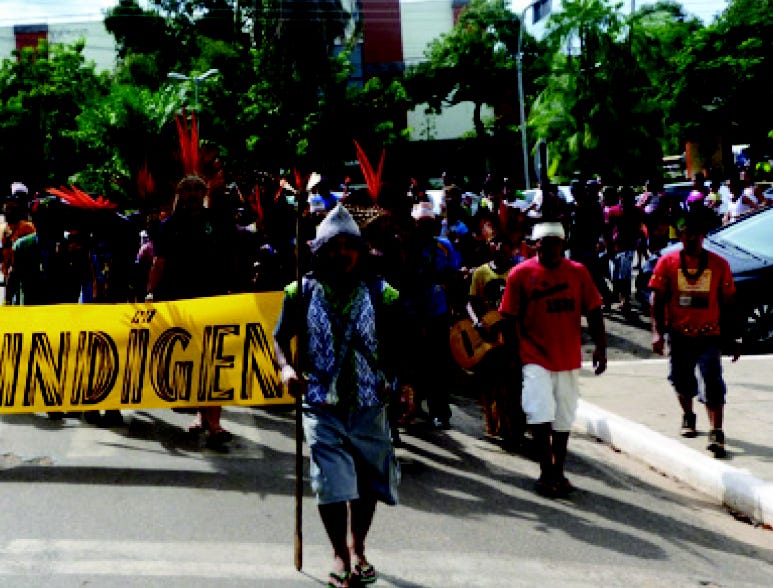
April 2012: Indigenous people protest against the violation of their rights in Rio Branco, the capital of Acre.
What are the real problems of forest peoples in Acre? Land and territory: Land ownership in Acre remains highly concentrated: 583 large landholdings have 15 million acres or more, while 23,500 small landholdings have less than 2.5 million acres. There are 21 indigenous territories that have yet be demarcated – but all processes of demarcation of indigenous lands are paralyzed because these territories are coveted by large landowners and timber companies, which wield strong influence on the state and federal governments.
Health: Indigenous peoples, peasant communities and poor people in general in the urban peripheries in Acre suffer from serious health problems. Many of the diseases, in the case of indigenous peoples, are caused by contact with white society and the degradation and contamination of the environment. Significant numbers of children and adults die from curable diseases because health care is precarious.
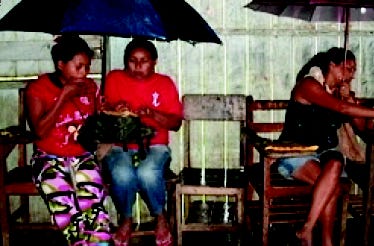
Indigenous people having class in their village during the rainy season.
Education: In order to build their own future and to cope with the rapid pace of change, indigenous peoples in Acre need education that respects their cultures, languages, and practices. However, government resources for education do not reach the communities, and schools in the villages are in a virtual state of abandonment. Out of 120 indigenous schools in the state, ten are in good condition – and these few are held up by the government to convince the public that the indigenous school situation has been resolved.
Why aren’t REDD and environmental services a solution to these problems? Demarcation of indigenous lands, health care and education are constitutional rights of indigenous peoples and local communities in Brazil. The problem is not lack of money to meet these demands, but lack of political will and preferential treatment of large land-owners.
What concerns forest peoples about REDD and environmental services? The decision-making process is topdown and authoritarian Environmental services policies such as REDD are being implemented by the state government in a unilateral, accelerated, and forced manner. The headlong creation of state law No. 2.308/10 which implements the State System of Incentives for Environmental Services (SISA) is strongly criticized by sectors of the Acrean population, and is currently being investigated by federal prosecutors at the request of CIMI, the Indigenous Missionary Council.
Consultations are insufficient and questionable In accordance with ILO Convention 169, the government must consult the peoples through appropriate procedures. However, the “consultations” promoted by the government in Acre, are restricted to NGOs, organizations, and government-financed institutions. The government “strengthens” these leaders and then accepts their consent as if it were representative of all communities. But the fact is, uncertainties and contradictions about REDD and environmental services are causing divisions among forest peoples in Acre. Most are excluded from the consultation process, and a growing number of people are articulating resistance against REDD.
Territorial sovereignty is under threat In order for forest peoples to maintain their ways of life and protect natural resources, they must have sovereignty over their territory. This means not only physical land demarcation or ownership titles, but includes the right of these peoples to manage their resources without interference. Contracts for the provision of environmental services interfere with territorial and environmental management and may also facilitate acts of biopiracy, allowing unauthorized access to genetic resources and associated traditional knowledge.
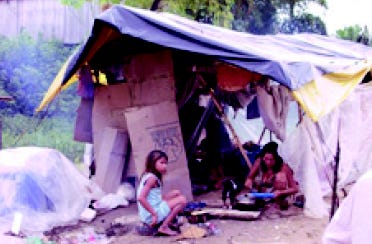
Not having their territories demarcated, Madiha people in Acre are frequently found “camping out” in urban areas.
Food security and food sovereignty are at risk Indigenous and local peasant communities live from planting and harvesting, gathering, hunting and fishing. Besides this being their way of life it is their sustenance and ensures their independence from the cash economy. Environmental services contracts restrict or prohibit these activities during periods of up to one hundred years. Once forced into the market by such programs, intact communities lose the knowledge and ability of obtaining their subsistence from the earth and become dependent on market economy.
Loss of traditional knowledge Forest dwelling people have complex systems of knowledge that are profoundly embedded in practices of resource management, food production, and ecosystem stewardship. The generation and preservation of knowledge about the ecosystem is based on the community’s vital relations with plants and animals: planting, harvesting, gathering, hunting and fishing. Once these relations are cut off, traditional knowledge is doomed to disappear.
Ecosystem services promote a reductionist and mercantile view of the forest The forest is much more than a “carbon sink” or “environmental service provider.” REDD projects and environmental services emphasize the economic aspects and ignore and subvert the holistic view that forest people traditionally hold. Among other meanings for indigenous peoples in Acre, the word “forest” signifies “the abode of a multitude of spirits.”
Official policies are built on a distortion of history Aligned with its questionable “environmental sustainability” programs, the Acre state government has created a distorted version of the history of the Acrean people. In this version, the image of the founder and former president of the rubber tapper syndicate STTR Xapuri, Chico Mendes, who was murdered by landowners in 1988, is being hijacked to reinforce government policies, as if he were the “patron” of green economy in Acre.
REDD will cause an exodus from rural areas Why continue living in a forest, if you are not allowed to live with it? Dercy Teles, the current president of the Rural Workers Union of Xapuri, says, “These policies are nothing more than the confinement of populations within their own territory, so they will eventually give up. Life in the forest makes no sense without the ability to enjoy the goods the forest offers.”
Concern about impacts beyond the own territory The logic of “compensation” for emissions or environmental damage is strange to the thinking of the people of the forest. Promoting preservationist projects in one place while exposing communities and ecosystems to pollution or degradation somewhere else is contrary to the spirit of the forest. We must preserve the bonds of solidarity that unite forest people with each other and with other communities affected by pollution and environmental degradation.
REDD undermines local peoples’ ability to address climate change as they know best Forest people feel climate change and ecosystem imbalance in their daily lives and are fully aware that they are caused by industrialized societies. They need the freedom to apply their experience, intelligence and wisdom to adapt to these changes and contribute to the mitigation of climate change in an active and self-determined way.
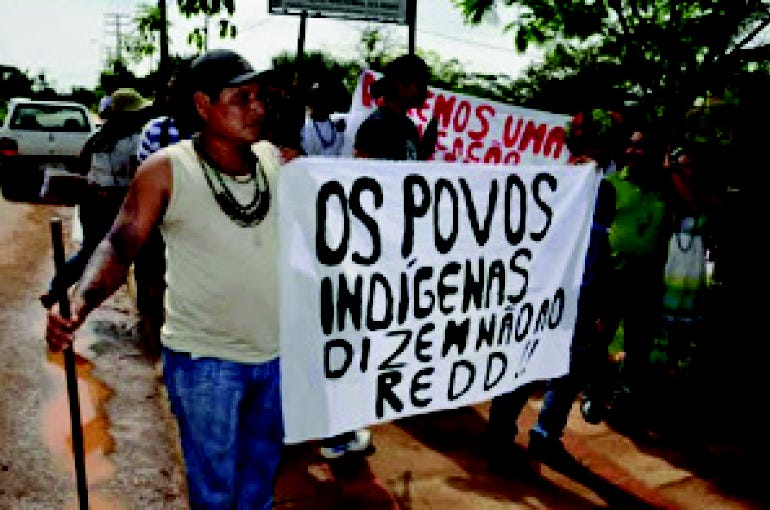
June 2012, Rio Branco, Acre: “The indigenous peoples say no to REDD!!”
Forest people know how to preserve the forest!
They demand recognition of their constitutional rights and claim autonomy in managing their territories, resources and knowledge.
For all of these reasons, the Sindicato dos Trabalhadores Rurais de Xapuri says NO to REDD.



Comments following the original post on REDD-Monitor.org are archived here: https://archive.is/bQuje#selection-1047.4-1047.14