

Questions raised about Finnfund’s support to Tozzi Green’s land grab for carbon plantations in Madagascar
Finnish and Belgian development finance institutions are funding a land grab.

Andreas Tozzi is an Italian businessman. He is CEO of his family’s renewable energy company, Tozzi Green. In 2012, the government of Madagascar leased almost 7,000 hectares of land in the Ihorombe region to JTF Madagascar, a Tozzi Green subsidiary. And in 2018, the company signed a lease for a further 4,000 hectares of land.
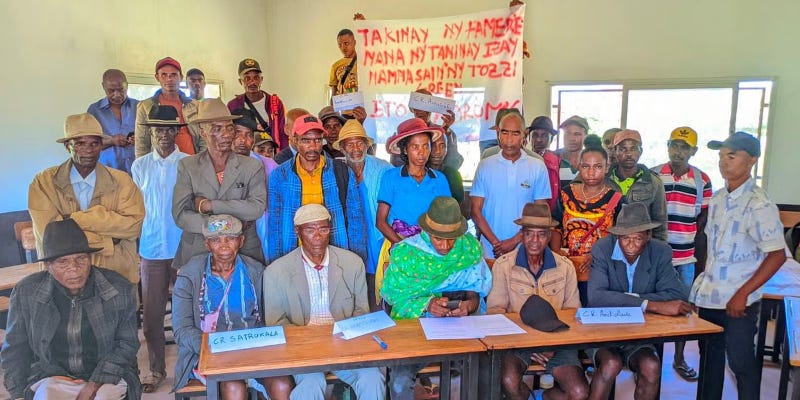
Communities living on the Ihorombe plateau accuse Tozzi Green of land grabbing. They have been protesting against the company’s operations for more than a decade. Tozzi doesn’t seem to care.
At first JTF Madagascar planted jatropha as a biofuel crop. The jatropha plantations failed and the company planted maize for poultry feed. This also failed and JTF Madagascar subsequently started planting acacia and eucalyptus trees as a carbon offset project.
On it’s website, the Tozzi Green explains that,
In 2023, after an initial testing phase with the ongoing climate change in Madagascar, particularly with the worsening drought conditions, Tozzi Green, through its subsidiary JTF, redirected its investments towards a reforestation activity involving and engaging local communities.
Tozzi Green describes the land it has planted trees on as “originally degraded and marginal land”. The company even claims to be “saving it from desertification and transforming it into agricultural land”.
The reality is that communities were using the land to graze their cattle and to grow food for their families. For more than a decade, communities living in the area have protested against the company’s operations. The communities accuse Tozzi Green of land grabbing.

Funding from Finland and Belgium
Tozzi Green is receiving funding for its operations in Madagascar from the Finnish and Belgian development finance institutions: Finnfund and BIO. In 2020, when JTF Madagascar was still planting food crops, Finnfund and BIO invested €7.5 million in JTF Madagascar.
At the time, Jari Matero, Associate Director of Finnfund commented that,
“This is our first direct investment in Madagascar and we are excited about partnering with the leading agricultural company in the country. We’re convinced that the social and environmental development impacts are already significant and we look forward to seeing how modern agricultural technology utilized by JTF Madagascar can increase the productivity and improve food security in the country.”
Mamy Rakotondrainibe disagrees. She is the executive director of the organisation Collectif TANY — which was established in 2009, to defend community lands against land grabbing.
Collectif TANY has written to Finnfund and BIO several times highlighting the problems that Tozzi Green is creating for communities. In December 2025, Collectif TANY and five other local organisations send an open letter pointing out that the majority of people living in the area did not agree to leasing the land to Tozzi Green. They demanded that the company does not expand its tree plantations further and leave the land that it currently occupies.

Rakotondrainibe told Emma Strömberg, a journalist with the Swedish-language newspaper Hufvudstadsbladet, that,
“Tozzi Green promised improvements for the local population, including building schools and infrastructure and providing jobs for young people. But the company has not fulfilled all its promises and the local population feels cheated.”
Collectif TANY’s December 2025 letter was also addressed to the Washington DC-based carbon certification company Verra. “We also want to draw Verra’s attention to the fact that the land has been acquired without the consent of the local population,” Rakotondrainibe told Hyfvudstadsbladet.
The status of the project is listed on Verra’s registry as “Under Validation (Public Comment Period Closed)”.1 The project title is Satrokala ARR Grouped Project and the project number is 5755. No carbon credits have been generated by the project so far, as the project has not yet been validated and verified.
Additionality?
The Project Document, which was prepared by a company called Carbon Credits Consulting SRL, claims that the project is additional — in other words without the money from the sale of carbon credits, the project would not go ahead.
The Project Document states that,
According to the applied methodology, for the area-based project the investment barrier analysis is in addition to the regulatory surplus check and the performance benchmark. Since the proposed area-based project does not generate revenues nor receive financial incentives from sources other than the sales of carbon credits, the investment barrier analysis is not required.
The Project Document makes no mention of the €7.5 million that Tozzi Green received from Finnfund and BIO. Which is presumably what is paying for the tree planting operations.
Finnfund’s response
Strömberg, the journalist with Hufvudstadsbladet, asked Kaisa Alavuotunki, director of sustainability at Finnfund, about the Tozzi Green project.
“We have been monitoring the project company and have seen the tangible benefits it has brought,” Alavuotunki told Hufvudstadsbladet. “But we also understand that there are local tensions, and the company has been responsive to these.”
Alavuotunki states that Finnfund is “in constant contact with Tozzi Green’s project company”.
However, she provides no information about how Tozzi Green has actually responded to the “local tensions”.
When asked about the reports from local communities that JTF Madagascar has not kept its promises to build schools and infrastructure, Alavuotunki says,
We cannot speak on behalf of the company, and I do not wish to dispute people’s experiences. If people feel that not all agreements have been fulfilled, this is precisely the sort of issue it is important to discuss through dialogue.
And when asked about how the local communities benefit from Tozzi Green’s tree-planting operations to sell carbon credits, Alavuotunki refers to “Verra’s report” which she says “clearly highlights all the benefits that the company’s presence has brought”.
Alavuotunki appears blissfully unaware that “Verra’s report” was written by an Italian company called Carbon Credits Consulting. That, of course, is the company hired by Tozzi Green to get the project through Verra’s rubber stamp certification process.
Strömberg also spoke to Jenni Mölkänen at the University of Eastern Finland, who has carried out research at Tozzi Green’s tree plantations in Ihorombe.
Mölkänen told Hufvudstadsbladet that the Finnfund and BIO funding to Tozzi Green highlights the conflicts of interest that result from development finance going directly to companies:
“The rules of the game change when the partner shifts from local civil society organisations to companies. A company’s ultimate aim is to generate profit for itself, whilst organisations have different objectives. This affects the kind of society that is built: who benefits and who does not?”
Verra recently launched a new registry which it calls “the most significant user experience upgrade in the organization’s history”. I didn’t think it was possible, but Verra has managed to make the registry even worse than it already was. It’s much slower to load, searching for projects is worse than it was, project documents are even more difficult to find, and public comments appear not to be available since the “upgrade”.