Response from Harapan Rainforest Project: “The SPI settlement is deep inside Harapan, on a scale large enough to compromise the ecological integrity of the forest”
The Harapan Rainforest Project has featured several times on REDD-Monitor. Since COP14 in Poznań, La Via Campesina has criticised the Harapan project because of the impacts of the project on local farmers.
Thanks for reading REDD-Monitor! Subscribe for free to receive new posts and support my work.
On 27 March 2012, REDD-Monitor interviewed Tejo Pramono of La Via Campesina, and Elisha Kartini of SPI, the Indonesian Farmers Union. The Harapan Rainforest Project was among the issues discussed. Ten days after the interviewed was posted, REDD-Monitor received an email from the Harapan Rainforest Project in response to the interview.
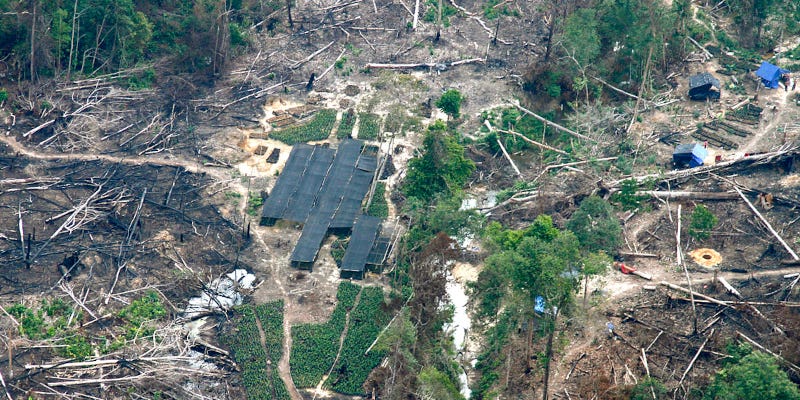
Harapan’s response is posted here in full with photographs (click on the images below for larger versions).1
From: harapanrainforest To: reddmonitor Date: 5 April 2012 Subject: SPI interview regarding Harapan Rainforest and REDD+
Harapan Rainforest conserves about 20 per cent of the last Sundaic forest on Sumatra’s dry lowlands, one of the most biodiverse and threatened habitats on Earth. Not only is it unique in its importance for species such as the critically-endangered Sumatran tiger (holding perhaps more than five per cent of the remaining wild population) and other threatened species, but it is home to one of the most marginalised peoples in Indonesia, the Bathin Sembilan.
The Bathin Sembilan have been living in and around Harapan for centuries, depending on it for their survival. They are being squeezed out of existence by oil palm and timber plantations, and by speculators and so-called small farmers who consider the forest has no value and can be destroyed for short-term profit. We believe this is not acceptable. Furthermore, there are millions of hectares of forest under threat from conversion to large scale plantations. The Harapan model gives a viable alternative to conserve these forests and the people, animals and plants that depend on them. We are proud that we can help lead the way.
The attached satellite image sequence for 2011 and the accompanying photographs show that, contrary to the assertions of Tejo and Alisha, the SPI settlement is deep inside Harapan, on a scale large enough to compromise the ecological integrity of the forest, and the ability of the forest-dependent Bathin Sembilan to continue their traditional forest-based livelihood. It makes us wonder how much Tejo and Alisha actually know about what is really going on at Harapan, and whether they are receiving accurate information from their Jambi colleagues.
Landsat images at Harapan also indicate that large-scale forest destruction by encroachers in the northeastern part of Harapan Rainforest took place after 2006. Prior to 2005 there were no settlements in the concession, save for the Bathin Sembilan. About 9,000 ha of forest were partially cleared between 2005-2008 and approximately 4,000ha has been cleared between 2009-2011.
There is also a strong indication of a formal link between large-scale, organised illegal logging as a precursor to settlement by SPI members. By illegal logging we mean felling trees specifically for their commercial sale offsite, rather than small-scale felling for the construction of dwellings on site. Many of the tributaries of the Lalan River within the SPI encroachment area were full of log rafts awaiting the rainy season in the second half of 2011. In one location alone there was 700 cubic metres of timber measured.
Contrary to the claims made by SPI in your interview, surveys in the encroached areas of Harapan between May and December 2011 indicate that less than 8% of encroachers plant rubber, compared to nearly 60% who plant oil palm. Only 12% plant rice, and then for a limited period until the oil palms and rubber trees close canopy. Rice is only planted over a limited area. Satellite images indicate that it covers less than one per cent of cleared areas. Up to a third of cleared lands appear to never be planted most likely because it was cleared to establish a land claim with a view to land speculation.
As few as one in twenty of settlers within Harapan have cleared two hectares or less. More than 60% have cleared 25 hectares or more. It is not possible for plots of that size to be managed by a single person or family– they will need labourers to manage the crops. Some of these larger areas extend up to 300ha. One of them includes an oil palm nursery that itself extended to two hectares.
According to surveys between May and December 2011, settlers who recently arrived from Java and Lampung make up over half the encroachers. Where there is representation from what could be considered “local” ethnic groups – Bathin Sembilan, Melayu Jambi and Melayu Palembang – they make up a low proportion. Surveys indicate 10%, a figure that drops to less than 3% if that is limited to the Bathin Sembilan people considered indigenous to this forest.
Where communities work together with Harapan Rainforest they can feel real benefits. For example, there are four tree nurseries operated by communities local to Harapan. They get training and materials support in establishing the nursery and then collect seeds from the forest to be grown on in the nursery and then sold to the project.
We welcome and support the presence of the Bathin Sembilan communities in Harapan. They can access healthcare and schooling. They also take part in participatory mapping to define their traditional use areas within Harapan, and are supported to get higher prices for the non-timber forest products they collect – honey, rattan and damar Meranti.
There are over 260 employees at Harapan. The vast majority of these staff are from local communities.
Elisha says the letter of January 2012 was the first invitation to sit down and talk. In fact, on June 26 2011, the vice chair of the national SPI Council, Julian Junaidi “Polong” visited Harapan, along with Roni, SPI’s head of research and development. They travelled with Harapan staff to the encroached area. They saw evidence of illegal logging and forest clearance by SPI members. They met Marhadi, a member of an SPI settlement scheme, on the area he had cleared inside Harapan. Marhadi said settlers from various parts of Indonesia are gathered in organised units given divisions of forest to clear. Notes from the discussions with Polong during the visit, and after discussing with Marhadi, show that he believes the encroached areas should be returned to natural forest and settlers removed, for these reasons:
SPI’s vision is of land-reform as part of a formal process together with government, which is not what is happening at Harapan.
SPI’s model of land reform is for farmers to be working with blocks of land of around two hectares per family, with land reform for local people. Again, he saw that this was not the case at Harapan.
Crops should not contravene national legislation. The use of oil palm within Harapan does just that.
So, SPI, at the highest level, has been involved in reviewing this encroachment and was NOT supportive. The invitation to SPI to discuss and make further site visits to see actual field conditions remains open.
The importance of forest for providing environmental services and sustainable livelihoods for the rural poor is widely accepted. At Harapan, a forest that five years ago was intact (though partially degraded) and supporting sustainable livelihoods for the Bathin Sembilan is now being rapidly cleared by SPI settlers planting oil palm for speculation. Contrary to the assertions in the interview, SPI is reducing livelihood options for the indigenous forest communities and removing the social safety net that the forest gives them.
As with every other forest-focussed social development or conservation effort in Indonesia, and across the tropics, Harapan is following developments with REDD+ very seriously, and REDD was considered part of the Harapan business model from early on. If developed and implemented with full environmental and social safeguards, and in a national REDD+ framework that defines equitable income distribution from REDD+, it could provide some of the funds needed to protect important habitat like this, and the livelihoods of those that depend on it. Harapan is NOT a pilot REDD+ project and does not yet have a PDD, but will move towards developing one over the next couple of years. We hope lessons learned will be able to feed into the development of a rigorous REDD+ system for Indonesia that delivers real and measurable climate benefits and equitable benefits for project proponents (to enable them to conserve the forest) and local communities.
The delay in posting this response was due to a misunderstanding. After receiving the email I wrote to Harapan requesting permission to post the email on REDD-Monitor. Harapan did not reply until 29 April 2012, when Kim Worm Sorensen posted a comment on REDD-Monitor asking why Harapan’s response had not been posted yet and requesting that it be posted in full.




Comments following the original post on REDD-Monitor.org are archived here: https://archive.ph/KmLwI#selection-1049.4-1049.14