

Rio +20: The Earth Summit debacle continued


This month sees the 20th anniversary of the UN Conference on Environment and Development. Rio +20 is expected to be the largest event in the history of the United Nations.
20 years ago, “sustainable development” was supposed to save the world. The UN has now added the “green economy” into the mix. But neither of these address the problems and both increase the role of markets and the power of institutions such as the World Bank.
Rio +20 should really be called Stockholm +40, after the 1972 UN Conference on the Human Environment, that was held in Stockholm. The United Nations Environment Programme was proposed in Stockholm and created shortly afterwards. UNEP’s mission is supposed to be,
To provide leadership and encourage partnership in caring for the environment by inspiring, informing, and enabling nations and peoples to improve their quality of life without compromising that of future generations.
These days, UNEP’s mission involves creating market mechanisms to support the “green economy”. For UN-REDD and the UNEP, REDD is a key part of the “green economy”. In a recent Policy Brief, “REDD+ and a Green Economy,” UNEP explains that it hopes to leverage REDD, “to generate additional investments in a Green Economy”. There’s even a diagram:
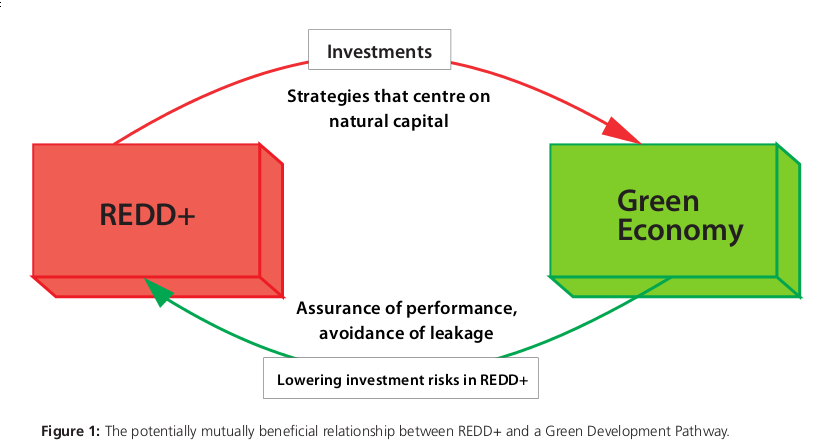
So REDD investments are to contribute to the green economy and the green economy will reduce the risks of investing in REDD. But neither the diagram nor the Policy Brief gives details about exactly how this is supposed to happen. Instead, it seems to be based on the wishful thinking of the UNEP experts.
UNEP’s Policy Brief tells us that,
Essentially REDD+, is an investment focusing on retaining or enhancing natural capital, and provides an opportunity to enable countries to move towards realizing green development.
The Policy Brief suggests that investing US$40 billion for “afforestation and forest conservation and paying forest and paying forest landholders and users to conserve forests and improve forest management”, could contribute 20% more value added than business as usual. (No time period for the US$40 billion is given, but the report states that “currently investment in forests are [sic] about US$70 million dollars”.)
It’s as if nothing has happened in the seven years since Kevin Conrad and the Coalition for Rainforest Nations presented the idea of REDD to the UN in Montreal. Since then there has been a great deal of discussion about REDD, but comparatively little investment in REDD projects. The complexity of REDD has become apparent to even the most enthusiastic REDD proponents.
Since then there has been a global economic crisis (which has not gone away – if anything it looks like it may well get much worse, sooner rather than later).
UNEP explains that REDD investments,
will need to espouse both valuation – internalizing the costs of externalities and pricing goods with missing markets; and technology transfer – in making natural resource sectors more efficient; in monitoring, reporting and verification activities; and in valuing and monetizing ecosystem goods and services.
Again, there’s no explanation of how any of this might happen, or what the implications are of “monetizing ecosystem goods” for local communities and their relationship with the forests. There is no mention of regulations The “green economy” just does away with the economic crisis and somehow creates investors who will not look for the highest possible return in the shortest period of time.
It’s difficult to know which planet UNEP’s experts were thinking of when they wrote the Policy Brief. They refer to countries with recognisable names, such as Indonesia and the Democratic Republic of Congo, but the similarity with anything on planet earth ends there.
There is no mention in UNEP’s report of the ongoing deforestation in Indonesia, or the continued expansion of oil palm plantations, coal mines, oil and gas exploration and pulpwood plantations. Norway’s environment minister, Bård Vegar Solhjell, has acknowledged that the moratorium is not enough to reduce Indonesia’s emissions or to stop deforestation. And the achievements of UN-REDD in Indonesia are minimal (to put it politely).
Neither does UNEP make any mention of the sales of billions of dollars worth of state assets in DR Congo. Last year, UK Member of Parliament Eric Joyce released a series of documents that,
appear to show a systematic pattern of underselling Congolese mining assets to off-shore ’shell’ companies incorporated almost exclusively in the British Virgin Islands (BVI), the ultimate beneficial owners of which are often unknown, with the result that the Congolese people do not benefit from the vast mineral wealth in their country.
But this isn’t what either the UNEP Policy Brief or the Rio +20 meeting is about. Neither is interested in raising awkward questions. Both are about continuing the illusion that “we” all want the same things and can work together for “The Future We Want”. After the 1992 UN Conference on Environment and Development in Rio, The Ecologist magazine produced an issue titled “Whose Common Future?”. The editorial summarises very well what happened in Rio in 1992. It is reproduced here as a reminder of what Rio +20 is about.
The Earth Summit Débâcle
The Ecologist Vol. 22, No. 4, July/August 1992
The United Nations Conference on Environment and Development, the self-styled Earth Summit, finished where it began. After ten days of press conferences, tree-planting ceremonies and behind-the-scenes wheeling and dealing, the diplomats went home to their various other assignments and the politicians to their next round of international talks. Rio gave way to the Munich conference and the more familiar territory of GATT, G-7 power politics and interest rates.
For the major players, the Summit was a phenomenal success. The World Bank emerged in control of an expanded Global Environmental Facility, a prize that it had worked for two years to achieve. The US go the biodiversity convention that it sought simply by not signing the convention on offer. The corporate sector, which throughout the UNCED process enjoyed special access to the secretariat, was confirmed as the key actor in the “battle to save the planet”. Free-market environmentalism – the philosophy that transnational corporations brought the Rio through the Business Council on Sustainable Development – has become the order of the day, uniting Southern and Northern leaders alike. For many environmental groups, too, the Summit was a success: credibility has been achieved (some even having seats on government delegations) and their concerns are no longer marginalized. They are now recognized as major players themselves.
The Summit, in fact, went according to plan: indeed the outcome was inevitable form the start. Unwilling to question the desirability of economic growth, the market economy or the development process itself, UNCED never had a chance of addressing the real problems of “environment and development”. Its secretariat provided delegates with materials for a convention on biodiversity but not on free-trade; on forests but not on logging; on climate but not on automobiles. Agenda 21 – the Summit’s “action plan” – featured clauses on “enabling the poor to achieve sustainable livelihoods” but none on enabling the rich to do so; a section on women but none on men. By such deliberate evasion of the central issues which economic expansion poses for human societies, UNCED condemned itself to irrelevance even before the first preparatory meeting got under way.
The best that can be said for the Earth Summit is that it made visible the vested interests standing in the way of the moral economies which local people, who daily face the consequences of environmental degradation, are seeking to re-establish. The spectacle of the great and the good at UNCED casting about for “solutions” that will keep their power and standards of living intact has confirmed the scepticism of those whose fate and livelihoods were being determined. The demands from many grassroots groups around the world are not for more “management” – a fashionable word at Rio – but for agrarian reform, local control over resources, and power to veto developments and to run their own affairs. For them, the question is not how their environment should be managed – they have the experience of the past as their guide – but who will manage it and in whose interest. They reject UNCED’s rhetoric of a world where all humanity is united by a common interest in survival, and in which conflicts of race, class, gender and culture are characterized as of secondary importance to humanity’s supposedly common goal. Although they acknowledge that a peasant in Bihar shares the same planet as a corporate executive, they view the suggestion that the two share a common future as farcical. Instead, they ask, “Whose common future is to be sustained?” Their struggle is not to win greater power for the market or the state, but to reinstate their communities as sources of social and political authority. This special issue of The Ecologist is an attempt to describe the background to that struggle.
Comments following the original post on REDD-Monitor.org are archived here: https://archive.ph/flN80#selection-7327.0-7327.10