


Governors from 22 states have signed the Rio Branco Declaration, committing to reduce deforestation by 80% by 2020. If they receive a guarantee of “adequate, sufficient, and long‐term performance‐based funding”, that is.
The Rio Branca Declaration was produced at the eighth meeting of the Governors’ Climate and Forests Annual Meeting, that took place from 11-14 August 2014 in Rio Branca, Acre, in Brazil.
Daniel Nepstad, Executive Director of Earth Innovation Institute, says that reducing deforestation by 80% by 2020, “would avoid approximately 3.8 billion tons of CO₂ emissions and 9 million hectares of tropical deforestation”.
Nepstad’s calculation is explained in a document posted on the GCF Taskforce website, titled, “What could the GCF Contribute to Climate Change Mitigation by 2020? A preliminary assessment.”
Earth Innovations’ document includes this graph to illustrate the reduction in deforestation:
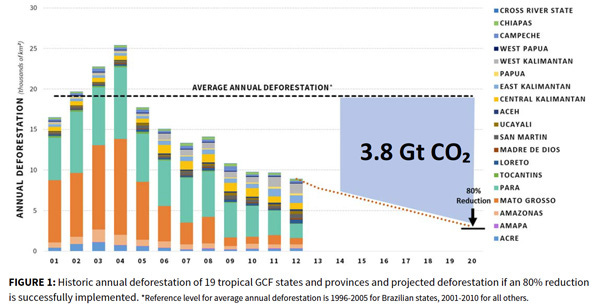
The graph shows that the vast majority of the reduction in deforestation is from Para and Matto Grosso in Brazil. (These two states account for a predicted 3.1 billion tons of avoided CO₂ emissions, out of a total of 3.8 billion tons by 2020, in Nepstad’s calculations.)
When we look at the small print on the graph we see that the reference level for average annual deforestation for Brazilian states is 1996-2005. For other states the reference is 2001-2010.
No explanation is given for the different reference levels in different countries. But since 2004, deforestation in Brazil has fallen dramatically. Obviously, using a reference level calculated using deforestation data from 2001-2010 for Brazil would give a smaller emission reduction.
Elsewhere, Earth Innovations argues that REDD offset credits should be included in California’s cap and trade scheme, arguing that doing so will double or triple the emissions reductions achieved.
It’s a bizarre argument, even putting aside the dodgy reference level calculation. Earth Innovations appears oblivious to the fact that carbon offsets do not reduce emissions, because buyers of carbon offsets use them in order to continue polluting.
According to the Rio Blanca Declaration, the six GCF states in Brazil reduced deforestation by 70% between 2006 and 2012, “resulting in more than three billion tons of avoided CO2 emissions”.
Despite these substantial, globally significant contributions to ongoing efforts to protect forests and climate and despite the $7.3 billion pledged by donor governments for REDD+ since 2009, the GCF states and provinces have received very little financial support through existing pay‐for‐performance mechanisms and other funding sources.
The progress GCF states and provinces have achieved to date is significant but fragile. More support is urgently needed to ensure the economic and political sustainability of these programs.
Another bizarre argument. Brazil’s reductions in deforestation started before REDD, and took place largely without REDD payments or REDD credits. GCF now seems to be threatening that the deforestation will increase again, unless companies, donors and investors hand over large slabs of cash.
Governors’ Climate & Forests Task Force (GCF)
Rio Branco Declaration
Building Partnerships & Securing Support for Forests, Climate, & Livelihoods
Rio Branco, Brazil
August 11, 2014We, the members of the Governors’ Climate & Forests Task Force (GCF), a subnational collaboration of 22 states and provinces in Brazil, Indonesia, Mexico, Nigeria, Peru, Spain and the United States, during the VIII GCF Annual Meeting held between the 11th and 14th of August, 2014 in the city of Rio Branco, Acre, reaffirm our commitment to reduce tropical deforestation, protect the global climate system, improve rural livelihoods, and reduce poverty in our jurisdictions.1
Together with our partners, we are on the front lines of the effort to reduce tropical deforestation, protect the global climate system, and improve rural livelihoods. Our efforts to build jurisdictional strategies and programs for low emissions development cannot be sustained without additional support. We call upon the international community to partner with us as we continue to build robust jurisdictional programs that will enable large-scale, integrated transitions to sustainable development.
This Declaration formalizes our commitment to continue reducing deforestation, to develop partnerships with private sector initiatives that leverage the opportunities available through jurisdictional programs, and to rapidly and effectively channel performance‐based funds for the promotion of forest‐based and forest‐friendly economic development to producers, foresters, farmers, ranchers, indigenous peoples, local communities, and other forest stakeholders. In order to accomplish these objectives, it is imperative that we have greater access to financial and technical support and, most importantly, to domestic and international market‐ and non‐market opportunities for the emissions reductions achieved by our programs.
* * *
Tropical forests play a crucial role in sustainable development by protecting air and water quality, soils, and plant and animal habitat, by contributing to flood mitigation and climate protection, and by providing abundant sources of medicines, food, energy, and other forest products, and they are essential to the livelihoods and cultures of forest peoples and rural communities.
One fourth of the world’s tropical forests are in GCF states and provinces, including more than three fourths of Brazil’s and Peru’s forests, and more than half of Indonesia’s.
Since 2008, GCF states and provinces have pioneered efforts to promote the integration of forest and climate protection. Together with our civil society partners, we have been leading the way in building comprehensive, jurisdiction‐wide approaches to REDD+ and low emissions development.
GCF states and provinces have contributed to substantial reductions in deforestation and associated emissions. In the six Brazilian GCF states, for example, deforestation declined by more than 70% from 2006‐2012, resulting in more than three billion tons of avoided CO2 emissions.
Despite these substantial, globally significant contributions to ongoing efforts to protect forests and climate and despite the $7.3 billion pledged by donor governments for REDD+ since 2009, the GCF states and provinces have received very little financial support through existing pay‐for‐performance mechanisms and other funding sources.
The progress GCF states and provinces have achieved to date is significant but fragile. More support is urgently needed to ensure the economic and political sustainability of these programs. These programs must include simple and transparent mechanisms to deliver benefits to communities, indigenous peoples, small‐scale farmers, and rural producers.* * *
The GCF states and provinces recognize and support the important private sector efforts that are dedicated to improving the social and environmental performance of supply chains and other corporate activities. In particular, we applaud the Natural Capital Declaration, a global initiative of financial institutions launched during Rio+20, and the recent commitment by the Consumer Goods Forum, a consortium of over 400 companies with $3.1 trillion in revenues, to achieve deforestation‐free supply chains by 2020.
The GCF states and provinces also recognize that sustainable supply chain and other corporate initiatives are far more likely to succeed at scale if they take advantage of the frameworks provided by robust jurisdictional programs for REDD+ and low emissions development. At the same time, the prospect of market transformation to carbon neutrality and sustainability that is underway with, for example, sustainable supply chain efforts should encourage governments to continue investing in jurisdictional programs for REDD+ and low emissions development, given the possibility that commodities produced in those jurisdictions that demonstrate superior environmental and social performance will enjoy preferential sourcing and market access.
GCF states and provinces are also building new partnerships to encourage environmentally and socially sustainable production and commercialization of agricultural and forest products by developing and expanding new market opportunities for sustainable products at local, national and international levels, as well as new programs to incentivize and support innovative approaches to sustainability at the local level.
* * *
We call upon donor governments and the private sector to work with us to mobilize additional capacity-building and pay-for-performance funds for ongoing efforts in GCF states and provinces.
We call upon donor governments, the private sector, standards developers, and civil society groups to work with us to develop simple and robust performance metrics that will allow our jurisdictions to access results-based financing today.
We call upon the Consumer Goods Forum and other private sector initiatives aimed at achieving deforestation‐free supply chains to partner with us as we build robust jurisdictional programs for REDD+ and low emissions development and to develop programs for preferential sourcing of agricultural commodities from GCF jurisdictions that demonstrate performance.
We are committed to making significant emissions reductions provided that adequate, sufficient, and long‐term performance‐based funding is available, whether through market or non‐market sources. If guarantees of this financing are made, we commit to reducing deforestation by 80% by 2020.
We are committed to ensuring that a substantial share of any additional pay‐for‐performance benefits that flow to our jurisdictions will be dedicated to forest‐dependent communities, smallholders, and indigenous peoples.
We call upon our partners to work with us to develop clear and transparent mechanisms for securing and delivering performance‐based benefits to forest‐dependent communities, smallholders, and indigenous peoples.
We call upon our respective national governments, donor governments, the private sector, and civil society to join with us and to agree that at least a substantial part of all pay‐for‐performance funds that flow into the promotion of jurisdictional REDD+ and low emissions development will be dedicated and delivered to forest‐dependent communities, smallholders, and indigenous peoples.
Signed:
Federative Republic of Brazil
Governor of Amazonas
Governor of Acre
Governor of Amapá
Governor of Mato Grosso
Governor of Pará
Governor of Tocantins
Republic of IndonesiaGovernor of Aceh
Governor of Central Kalimantan
Governor of East Kalimantan
Governor of Papua
Governor of West Kalimantan
Governor of West Papua
United Mexican StatesGovernor of Campeche
Governor of Chiapas
Republic of PeruGovernor of Loreto
Governor of San Martín
Governor of Madre de Dios
Governor of Ucayali
Federal Republic of NigeriaGovernor of Cross River State
Kingdom of Spain
Governor of Catalonia
United States of America
Governor of California
Governor of Illinois
Acre, Amapá, Amazonas, Mato Grosso, Pará, and Tocantins (Brazil), Aceh, Central Kalimantan, East Kalimantan, Papua, West Kalimantan, and West Papua (Indonesia), Loreto, Madre de Dios, San Martín, and Ucayali (Peru), Campeche and Chiapas (Mexico), Cross River State (Nigeria), California and Illinois (U.S.), and Catalonia (Spain).
Comments following the original post on REDD-Monitor.org are archived here: https://bit.ly/4j4zRzf