The Salvadoran Ecological Unit (UNES – Unidad Ecológica Salvadoreña) and other social organisations in El Salvador have written to Benoît Bosquet, the coordinator of the Forest Carbon Partnership Facility (FCPF) demanding the El Salvador’s R-PP is not approved.
UNES also wrote to the Government demanding that the R-PP be withdrawn. (The letter is available here – in Spanish.)
Thanks for reading REDD-Monitor! Subscribe for free to receive new posts and support my work.
The letter to Bosquet is copied to Laszlo Pancel, the REDD-GIZ Regional Programme Coordinator, with a demand for REDD-GIZ “to suspend the co-financing”. The letter is based on a detailed review of the R-PP (available in Spanish here and in English here). The letter points out “conceptual and methodological deficiencies” in El Salvador’s Readiness Preparation Proposal. As with other critiques of the World Bank’s FCPF, UNES is concerned about the consultation process carried out, which it describes as a “restricted, poorly consulted and transparency-lacking process”.
The letter is posted in full below (in English and Spanish).
But UNES is not just presenting a technical critique of REDD and the World Bank’s FCPF. In an interview last year, Carolina Amaya of UNES explains how the organisation views the climate crisis and how this view is in contrast with the “development” promoted by organisations like the World Bank:
We, as social movements, differentiate the climate crisis from other social crises, because this crisis has a component that cannot go unnoticed. It is the component of capacity: to recognize the capacity that the planet has. What do we say? First, as social movements we have to deconstruct the false paradigm of development because societies that are rich don’t want to give up this paradigm, and southern societies aspire to it, despite the fact that this is development that has lead us to climate change. The first challenge to the movements is to deconstruct the false paradigm of development that has led us to the climate chaos that threatens civilization.
Second, we need to reorient the way of life. We need to restructure our standard of living, according to the load bearing capacity of nature. Our ecosystem is finite, it has a limited capacity and this chaos is a result of exceeding the carrying capacity and limited capacities that the planet has.
This factor is the challenge we face. We must start placing limits and recognizing that we live in an ecosystem that is a planet that has limits and a limited capacity. This is our challenge because many of us also saw nature as infinite, but now we see it as a living organism, and that we are part of it, and can’t keep seeing it as a commodity from which we take.
An article published this week by IPS highlights one aspect of UNES’ work in El Salvador. The article describes how a local community is managing what they call an “energy forest”, that provides both food and fuelwood:
The idea came from UNES environmentalists who were working in the area, establishing an “agroschool” to teach the basic concepts of agroecology. But soon the local women made the idea their own. They have made it flourish – without financing.
It’s an approach that is in stark contrast to the top-down, carbon trading approach of the FCPF.
SUBJECT: Refusal to El Salvador R-PP approval and demand for withdrawal by the Government
Mr. Benoît Bosquet Forest Carbon Partnership Facility (FCPF) Coordinator Environmental Department World Bank Washington D.C., US
Dear Mr. Bosquet,
The below signatories social organizations of El Salvador, would like to express our more profound concern and refusal to the eventual approval of the document Readiness Preparation Proposal (R-PPPP), submitted by El Salvador government through the Ministry of Environment and Natural Resources (MARN), to the FCPF of the World Bank (WB), on April 23d this year. At the same time we request you to interpose your endeavors in order for the FCPF Participants Committee (PC) not to approve such R-PP proposal.
Our demand is based on the review, in-depth analysis and specific observations to the referred R-PP (document attached to this letter). The R-PP has serious conceptual and methodological deficiencies, and if it were approved by the FCPF, it would imply adverse consequences for the Salvadoran society, increasing vulnerability and disasters frequency, and postponing the accomplishment of urgent national and international commitments related to climate change. Also, we are requesting the Minister of Environment of Natural Resources to withdraw the R-PP from the official FCPF process, and the Regional Coordinator of the REDD-GIZ Program, to suspend the co-financing.
We demand that any consultation process in regard to REDD has to be organized and promoted on the basis of transparency, information, true participation, the best scientific knowledge available and the international commitments adopted; in order to define the pertinency and role of REDD+ in mitigating climate change appropriately under the framework of a National Climate Change Strategy and Plan and the commitments adopted in Cancun and Durban, considering different national approaches and proposals, including those of indigenous people.
Our organizations disagree and refuse the approach referred to as “Mitigation based on Adaptation” (MbA), in the way it has been conceived by MARN in the R-PP. We consider that such approach lacks a robust conceptual basis and generates a series of incoherencies, inconsistencies and gaps that would be reflected in every relevant result of the Readiness Phase. The MbA approach does not recognize neither rely on the adaptation knowledge produced by the scientific community, and it overlooks the climate change science findings, about which there exists a broad global consensus articulated in the IPCC technical and scientific reports.
As well, we express our high concern and discontent because of the restricted, poorly consulted and transparency-lacking process conducted by MARN minister during the R-PP formulation and elaboration process, particularly in the MbA approach. Such a process has not consulted relevant stakeholders and sectors, some of which had already proposed climate change policies and measures. It has also been driven with secretiveness and hastiness, separated from the multilateral climate change process, and overlooking governmental current commitments related to the definition and implementation of climate change policy frameworks, particularly national climate change strategies and plans, adaptation national plans, national appropriate mitigation actions, education, public awareness and social participation to face climate change effectively.
Based on previous argumentation, the criteria exposed in the analytical document attached and the current WB guidelines on indigenous people; we reiterate our refusal to the R-PP and the process under which it was conceived and officialized by MARN. We consider that the R-PP lacks scientific and technical basis, as well as social legitimacy, as to guarantee the political viability that is required for its successful internalization and implementation by all relevant stakeholders; particularly the most vulnerable populations to climate change and related variability, such as indigenous people, farmers, forest communities, disadvantaged women and marginalized rural and urban populations.
We rely on your concern as for the success of FCPF operations, which are evaluated in terms of their effective contribution to the accomplishment of decisions adopted by governments under the UNFCCC multilateral process. We also rely on your effective endeavors to operationalize recommendations given by such decisions in order for multilateral and bilateral organizations to adopt the “best practices” in the processes of definition, management and assessment of their programs.
We will be expecting for your favorable response to our inquiry.
Respectfully yours,
Ce: • Facility Management Team of the FCPF (FMT) • Joélle Chassard, WB Carbón Financing Unity Manager • Gerardo Segura, Agriculture and Development Team, LCA Región, WB Environmental Department • Alberto Leyton, WB Representative El Salvador Office • Ken Andrasko, Rajesh Koirala, Peter Saile, Stephanie Tam, Raju Koirala, Ken Andrasko, Pierre-Yves Guedez y Leonel Iglesias del BM • Laszlo Pancel, REDD-GIZ Regional Program Coordinator • Hermán Rosa, Ministry of Environment and Natural Resources of El Salvador • Chris Lang, REDD-Monitor director
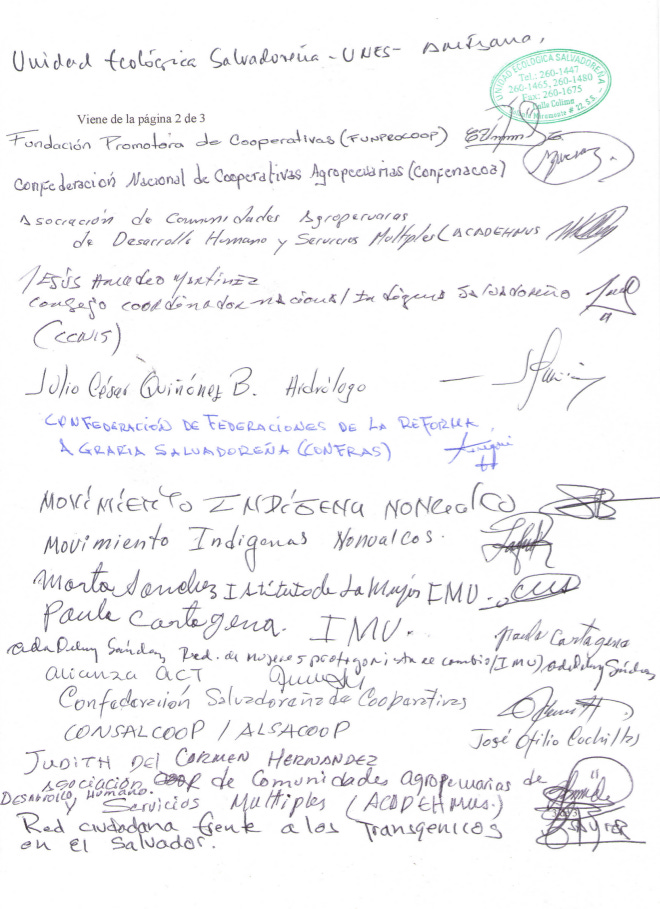
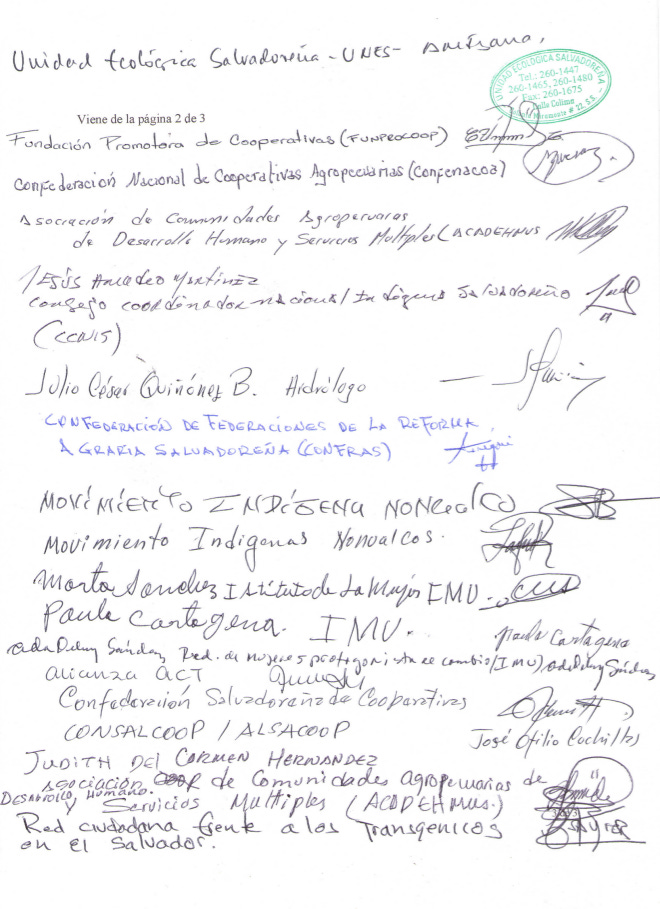
SIGNATORIES SOCIAL ORGANIZATIONS OF EL SALVADOR
San Salvador, 15 de Mayo de 2012
ASUNTO: Rechazo a aprobación R-PP de El Salvador y exigencia de retiro por el gobierno
Señor Benoît Bosquet Coordinador Fondo Cooperativo para el Carbono de los Bosques (FCPF) Departamento de Medio Ambiente Banco Mundial Washington
Estimado señor Bosquet,
Las organizaciones sociales de El Salvador abajo firmantes, nos dirigimos a usted para expresarle nuestra más profunda preocupación y rechazo al documento Readiness Preparation Proposal (R-PP) presentado FCPF del Banco Mundial (BM) por el gobierno de El Salvador, a través del Ministerio de Medio Ambiente y Recursos Naturales (MARN), el 23 de abril del año en curso; y que interponga sus buenos oficios para que el Comité de Participantes del FCPF (PC) no apruebe dicho R-PP.
Nuestra demanda está sustentada en la revisión, análisis a profundidad y observaciones específicas al R-PP referido, las cuales le compartimos en el documento adjunto; ya que el R-PP presenta graves deficiencias conceptuales y metodológicas, y de ser aprobado por el FCPF tendría graves implicaciones negativas para la sociedad salvadoreña, aumentando su vulnerabilidad y la frecuencia de los desastres, y retrasaría el cumplimiento de los compromisos nacionales e internacionales urgentes en materia de cambio climático. Al mismo tiempo, nos aprestamos a solicitarle al titular del MARN que retire el R-PP del proceso oficial del FCPF y al coordinador del Programa Regional REDD-GIZ que suspenda el cofinanciamiento del mismo.
Exigimos que cualquier proceso de consulta que surja en nuestro país en torno a REDD, sea organizado e impulsado de manera transparente, informada, verdaderamente participativa, sustentado a la luz del mejor conocimiento disponible y de los compromisos internacionales adquiridos; a fin de definir la pertinencia y papel de REDD+ para la mitigación apropiada en el marco de una Estrategia y Plan Nacional de Cambio Climático y de los compromisos adoptados en Cancún y Durban, considerando los diferentes enfoques y propuestas nacionales, incluyendo las de los pueblos indígenas.
Nuestras organizaciones se desligan y rechazan el enfoque referido como “Mitigación basada en la Adaptación” (MbA), tal como ha sido adoptado en la propuesta del R-PP endosada por el titular del MARN, ya que consideramos que no se sustenta en un marco conceptual sólido, lo cual genera toda una serie de incoherencias, inconsistencias y vacíos reflejados en todos los aspectos relevantes de la propuesta, y que constituirían los resultados de la fase de ejecución del R-PP. El enfoque MbA planteado en dicha propuesta no reconoce ni se fundamenta en el conocimiento generado por la comunidad científica en materia de adaptación al cambio climático, ya que desconoce los hallazgos científicos generados por la ciencia del cambio climático, sobre los cuales ya existe un amplio consenso mundial reflejado en los hallazgos, propuestas e informes del IPCC.
Asimismo, expresamos nuestra alta preocupación y descontento por el proceso cerrado, inconsulto y poco transparente, conducido por el titular del MARN, para la concepción y elaboración del R-PP, particularmente el MbA, ya que además de no haber realizado consultas con los actores y sectores relevantes, algunos de los cuales ya han realizado propuestas en materia de políticas y medidas ante el cambio climático; dicho proceso ha sido manejado con alta secreticidad y premura, desvinculado del proceso multilateral de cambio climático y desconociendo los compromisos que actualmente tienen nuestros gobiernos en lo que respecta a la definición e implementación del marco de políticas y los instrumentos para su ejecución en materia de cambio climático, particularmente las estrategias y planes nacionales de cambio climático, los planes nacionales de adaptación, las acciones nacionales apropiadas para la mitigación, la educación, sensibilización, concienciación y participación social para enfrentar de manera efectiva el cambio climático, entre otros.
Con base en lo anteriormente expuesto y a los criterios y argumentos planteados en el documento adjunto, y considerando las directrices operacionales del BM en materia de pueblos indígenas, le reiteramos nuestro rechazo a la propuesta de R-PP y al proceso bajo el cual ha sido concebida y oficializada por el MARN. Consideramos que el R-PP no tiene la sustentación científico-técnica, ni la legitimidad social para garantizar la viabilidad política requerida para su apropiación e implementación exitosa por los actores relevantes; particularmente las poblaciones más vulnerables al cambio climático y a la variabilidad asociada, dentro de las cuales las comunidades indígenas, campesinas y dependientes de los sistemas forestales, las mujeres en desventaja económica y las poblaciones rurales y urbanas marginadas, juegan un papel preponderante.
Confiamos en su preocupación por el éxito de las operaciones del FCPF, el cual es evaluado por su contribución efectiva al cumplimiento de las decisiones adoptadas por los gobiernos, en el marco del proceso multilateral de la Convención Marco sobre Cambio Climático. Asimismo, no dudamos en sus buenos oficios para el cumplimiento de las recomendaciones emanadas en dichas decisiones para que los organismos multilaterales y bilaterales adopten las “mejores prácticas” en los procesos de definición, gestión y evaluación de sus programas. Reciba la expresión de nuestro más sincero respeto, y quedamos en espera de una decisión y respuesta favorable a nuestro requerimiento.
Ce: • Equipo de gestión del FCPF • Joélle Chassard, gerente Unidad de Financiamiento de Carbono del BM • Gerardo Segura, Aequipo Agricultura y Desarrollo, Región LAC, Dpto. Medio Ambiente, BM • Alberto Leyton, representante oficina de país en El Salvador del BM • Ken Andrasko, Rajesh Koirala, Peter Saile, Stephanie Tam, Raju Koirala, Ken Andrasko, Pierre-Yves Guedez y Leonel Iglesias del BM • Laszlo Pancel, coordinador del Programa Regional de REDD-GIZ • Hermán Rosa, ministro del ambiente y recursos naturales de El Salvador • Chris Lang, director de REDD-Monitor
ORGANIZACIONES SOCIALES DE EL SALVADOR SUSCRIPTORAS



Comments following the original post on REDD-Monitor.org are archived here: https://archive.ph/VRRMx#selection-1119.4-1119.15