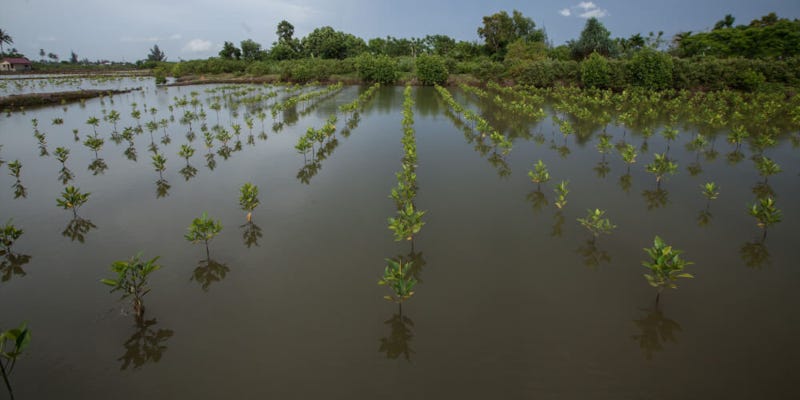
The Mangrove restoration and coastal greenbelt protection in the East coast of Aceh and North Sumatra Province, Indonesia is run by the Paris-based investment vehicle Livelihoods Funds. The carbon project has been operating since 2011 and was registered under Verra’s carbon certification system in April 2020.
While Livelihoods Funds claims that the project is “revitalizing coastal villages” a letter from 72 organisations paints a very different picture. The impacts are “severe” the letter states. “The project threatens the very existence of Indigenous peoples and their role in the autonomous protection and use of the forests.”
REDD-Monitor is a reader-supported publication. Paid subscriptions keep all posts on REDD-Monitor free and accessible for everyone. If you can afford it, a paid subscription supports this work. Thank you!
The letter calls on the Livelihoods Funds to stop trading carbon credits from the mangrove forests on the east coast of Aceh.
In October 2025, Verra and the Indonesian government signed an agreement to “expand the country’s access to climate finance and strengthen the integrity of its carbon markets”. Under the agreement, projects can be registered under both Verra’s system and Indonesia’s national registry system (SRN-PPI). The carbon credits will be accounted in Indonesia’s Nationally Determined Contributions under the Paris Agreement.
Stop carbon credit trading by the Danone Group in Aceh’s mangrove forests!
Ladies and Gentlemen,
The Mangrove restoration and coastal greenbelt protection in the East coast of Aceh and North Sumatra Province, Indonesia project, run by the investment vehicle Livelihoods Fund and the carbon standards body Verra, has been operating since 2011.
According to its own figures, this project has restored more than 5,000 hectares of degraded mangrove forests and has already been validated and verified under Climate, Community and Biodiversity (CCB) standards.
The stated aim of the project is to improve the ecological capacity of the mangrove ecosystems along the east coast of North Sumatra in order to enhance carbon sequestration, reduce the risk of natural disasters and strengthen local livelihoods.
This Carbon Capture and Storage (CCS) project is intended to generate 124,706.67 tons of CO₂ equivalent (CO₂e) from projects to reduce greenhouse gas (GHG) emissions.
The Livelihoods Fund SICAV-SIF registered the project on the Verra platform on April 6, 2020.
In October 2025, Verra signed an agreement with the Indonesian government to speed up the integration of local projects into the global carbon market and to ensure alignment with Indonesia’s SRN PPI certification system. As a result, the project is considered one of Indonesia’s most significant blue carbon initiatives.
The impacts, however, are severe. The project threatens the very existence of Indigenous peoples and their role in the autonomous protection and use of the forests.
Livelihoods Fund, based in Paris, is an SICAV-SIF impact investment fund designed to generate returns for investors from CO₂ emissions. Major corporations are involved, including Danone (founding member and investor), L’Oréal, Mars Incorporated, Schneider Electric, Crédit Agricole, Michelin, Hermès, SAP, La Poste and Veolia.
Verra, based in Washington, D.C., USA, is a global carbon standards organization that certifies climate projects. Verra’s CCB standard is regarded as a certification framework intended to ensure that land management projects reduce CO₂ emissions while also delivering positive impacts for local communities and biodiversity.
What are the negative impacts of this carbon project?
Emissions trading projects give large corporations the option to continue damaging the environment by buying carbon credits instead of making the direct emissions cuts that are actually necessary.
Emissions trading, including under Verra’s Verified Carbon Standard (VCS), often has negative ecological and social consequences.
Some of the long-term impacts include:
• Risks of greenwashing and low effectiveness
Many carbon projects, especially those based on offsetting mechanisms, do not actually reduce emissions in the long term but merely shift the burden of emissions. Some studies show that forest project credits (such as those in the Verra system) are frequently overvalued, so that real emissions are higher than the claimed reductions. Emissions trading by the Livelihoods Fund SICAV-SIF via Verra has weakened the governance of Indonesia’s mangrove forests.
• Threats to Indigenous and local communities
Forest projects often spark land conflicts with Indigenous communities. These communities’ rights to their traditional lands and forests are frequently ignored in favor of ‘conservation’ projects that generate carbon credits for foreign actors. In this case, the forest rights of Indigenous communities along the east coast of Aceh have not yet been officially recognized. At the same time, certain groups and institutions have already parceled up the mangrove forests and are trading carbon credits from them. The trade in carbon credits by the Livelihoods Fund SICAV-SIF via Verra is already threatening the existence of Indigenous communities and their ability to protect and use the forests on their own terms.
• Commercialization of nature (land grabbing)
Emissions trading turns the forest’s life-giving role into a tradable commodity. This can restrict Indigenous communities’ access to forest resources they have depended on until now. Emissions trading by the Livelihoods Fund SICAV-SIF via Verra deprives Indigenous communities of the right to protect, manage and use mangrove forests independently.
• New environmental problems
Emissions trading can distract from the need to phase out fossil fuels. On top of this, local carbon projects do not always succeed in maintaining forest cover in the long term. Emissions trading by the Livelihoods Fund SICAV-SIF via Verra has created new environmental problems, further eroding the Danone Group’s role and responsibility in cutting emissions and moving away from fossil fuels.
Demands
On the basis of the above data and facts, the Aceh Wetland Forum – a nonprofit organization that advocates for the protection, management and use of mangroves by Indigenous and local communities along the east coast of Aceh – calls on the Paris-based Livelihoods Fund SICAV-SIF, in particular its founding member Danone Group, and the Washington, D.C.-based Verra to take the following action:
Stop trading carbon credits generated from mangrove forests along the east coast of Aceh, especially in the districts of Aceh Tamiang, Kota Langsa and Aceh Timur.
We call on the Indonesian government and, in particular, the Ministry of Forestry of the Republic of Indonesia to:
exclude the mangrove belt along the east coast of Aceh from the Mutual Recognition Agreement (MRA) with Verra;
upgrade the status of the 45,000-hectare mangrove area to an Essential Protection Area (Kawasan Perlindungan Esensial) or Essential Ecosystem Area (Kawasan Ekosistem Esensial, KEE), as this area has high biodiversity value and plays an important role in protecting, conserving and ensuring the sustainable use of biodiversity;
grant forest rights to the Indigenous communities in the districts of Aceh Tamiang, Kota Langsa and Aceh Timur.
For the protection, sound governance and just, sustainable use of mangrove forests!
Yours faithfully,
(For more information please see annex on page 6)
Co-signed by 1.Aceh Satu Media, Indonesia 2.Aceh Waste Platform, Indonesia 3.Acehnesia, Indonesia 4.AcehNet, Indonesia 5.AMAN Tano Batak, Indonesia 6.Apel Green Aceh, Indonesia 7.ARA, Germany 8.Auriga Nusantara, Indonesia 9.AWF, Indonesia 10.Balkan Centre for the Rights of Nature, Serbia 11.Biofuelwatch, United Kingdom 12.Centre d’Actions pour le Développement, Republic of the Congo 13.Chafran, France 14.change.org, Kenya 15.Coal Action Network, United Kingdom 16.Colectivo Voces Ecológicas, Panama 17.Dauerwaldstiftung in Pommern, Germany 18.Earth Thrive, United Kingdom 19.ECODEV, Cameroon 20.FIAN Deutschland e.V., Germany 21.FIAN Switzerland, Switzerland 22.FLIGHT: Protecting Indonesia’s Birds, Indonesia 23.Forum Ökologie & Papier, Germany 24.Forum Penjaga Hutan dan Sungai Harimau Pining, Indonesia 25.GRAIN, Spain 26.GREEN BOOTS, Switzerland 27.Igapo Project, France 28.Indonesia for Global Justice (IGJ), Indonesia 29.Inisiasi Masyarakat Adat (IMA), Indonesia 30.Institut für Ökologie und Aktions-Ethnologie e.V., Germany 31.JARINGAN ADVOKASI TAMBANG, Indonesia 32.JATAM SULTENG, Indonesia 33.JPIC Kalimantan, Indonesia 34.JPIC SVD Ruteng, Indonesia 35.Jumu’eha renda keruhu - Centro de Formação Saberes Ka’apor, Brazil 36.JusticeMakers Bangladesh in France (JMBF), France 37.Komunitas Meubumoe, Indonesia 38.Korjuang, Indonesia 39.Lembaga Teraju Indonesia, Indonesia 40.LinkAR Borneo, Indonesia 41.Mangrove rescue forest, Indonesia 42.Not1More, United Kingdom 43.Organisation pour la Protection de l’Environnement et des Droits Humains, Republic of the Congo 44.Partner Indonesia, Indonesia 45.Penggiat Lingkungan, Indonesia 46.Perkumpulan Hijau Jambi, Indonesia 47.Rede Cooperação Latina de Educação Comunitária com Pedagogias Próprias, Brazil 48.Regenwald-Institut e.V., Germany 49.Rettet den Regenwald, Germany 50.Rettet den Regenwald - Schweiz, Switzerland 51.RIAO-RDC, Democratic Republic of the Congo 52.SAN Germany, Germany 53.Save Our Borneo, Indonesia 54.SDE (School of Democratic Economics), Indonesia 55.Selamatkan Hutan Hujan, Indonesia 56.Setara Jambi, Indonesia 57.Stadtwaldfreunde Lübeck, Germany 58.Stiftung Asienhaus, Germany 59.Sumatera Environmental Initiative, Indonesia 60.Tasha Research Institute Africa (TASHA), Uganda 61.The Coalition Against Mining in Aceh, Indonesia 62.The Gaia Foundation, United Kingdom 63.Tuxa ta pame - Conselho de Gestao Ka’apor, Brazil 64.Unir en Haití, Haiti 65.WALHI JAKARTA, Indonesia 66.WALHI Nasional, Indonesia 67.WALHI NTT, Indonesia 68.WALHI Sumatera Utara, Indonesia 69.Watch Indonesia!, Germany 70.World Rainforest Movement, Uruguay 71.Yayasan Insan Hutan Indonesia, Indonesia 72.Yes to Life, No to Mining global solidarity network, United Kingdom
ANNEX with additional information to the Letter “Stop carbon credit trading by the Danone Group in Aceh’s mangrove forests!”, sent to Livelihoods Fund SICAV-SIF, VERRA, Ministry of Forestry of the Republic of Indonesia
16 June 2026
General information about the Livelihoods Funds carbon project in Aceh/Northern Sumatra and its certification by VERRA:
The Livelihoods Funds mangrove restoration carbon project in Aceh/Northern Sumatra was certified to the international Verified Carbon Standard (VCS) program of VERRA. It is registered in VERRA´s database under project number 1493. The local organisation, hired by Livelihoods Funds to implement the project, is called Yagasu.
The objective of the project is to generate carbon credits, certified by VERRA-accredited auditors and issued by the carbon certification body VERRA. According to Livelihoods Funds, approval by the VERRA registry would give credibility to the carbon credits issued to the project. The credits are used by corporations – most from Europe - that have invested in Livelihoods Funds. They want to claim that their products or their business is “carbon neutral” or “CO2-neutral” – understood by its customers to mean that the product does not damage the climate. At the time the project in Sumatra started, in 2011, the companies involved in Livelihoods Funds were: Danone (the creator of Livelihoods Funds), Schneider Electric, Crédit Agricole S.A., Michelin, Hermès, SAP, Groupe Caisse des Dépôts, La Poste, Firmenich, Voyageurs du Monde.
The VERRA website makes information available about the so-called ‘issuance’ of credits (that is, the credits approved within VERRA’s certification system), and which of these credits were ‘retired’ (that is, used) by companies/entities to offset their emissions. Credits from Livelihoods Funds’ carbon projects are specifically aimed at offsetting the emissions from those companies/entities that have put money in the Livelihoods Funds.
VERRA offers buyers the possibility to make purchases anonymously, without their name appearing on the public part of the VCS registry. Interestingly, among the few buyers who are identified, is the International Monetary Fund (IMF). The IMF is not a direct investor in Livelihoods Funds.
A key part of the VERRA documentation is the carbon project description and the carbon calculations and, in this particular case, the calculation of how much CO2 the project hopes to remove from the atmosphere and store in mangrove trees that the project claims will be planted. These documents form the basis for the first of two certification audits, the so-called validation, in which auditors accredited by VERRA assess whether the project is in conformity with the Verra standard and methodology requirements. According to Verra’s VCS registry, US-based consultancy SCS Global Services validated the project in December 2015. In parallel to the validation, SCS Global also carried out the first verification audit. This second audit procedure determines the volume of credits issued to a carbon project for the time period audited. The Livelihoods Funds project in Aceh has been verified twice; the first verification audit covered the time between 14 June 2011 to 30 September 2015. The second verification audit was carried out by consultancy TUEV Nord CERT GmbH, and covered the period of 1 October 2015 to 31 July 2019. No audits appear to have taken place since then, with the second verification audit report by TUEV Nord CERT dated 6 February 2020.
Since 2011, the Livelihoods Funds carbon project in Aceh/Northern Sumatra claims to have planted mangrove trees in 2,600 plots, totalling 5,000 hectares. The plots are distributed over an area of 497 km along the coast of Aceh/Northern Sumatra crossing 13 districts: Aceh Besar, Banda Aceh, Pindie, Pidy Jaya. Bireun, Lhoksemawe, Aceh Utara, Aceh Timur, Langsa, Aceh Tamiang, Langkat, Medan and Deli Serdang.
The project claims that it will remove from the atmosphere 2,494,121 tons of CO2, on average 124,706 tons of CO2 per year, during the project´s lifetime of 20 years (2011-2031) by restoring “more than 5,000 ha of degraded mangrove ecosystem by planting at least 16.5 million new mangrove trees”.
The first verification report over the period 2011-2015, published by SCS Global, reports an amount of 125,391 carbon credits (called VCUs in the reporting) to be issued. The second verification report, over the period 2015-2019, issued by TUEV Nord CERT, confirmed an amount of 271, 680 credits.
By 2019, VERRA had thus issued 397,071 carbon credits which were available to the corporations that invested in the Livelihoods Funds. Livelihoods Funds holds the property rights to any credits generated by projects that are part of the Funds.
Communities are blamed for mangrove forest destruction
To have its project certified by VERRA’s Verified Carbon Standard (VCS), the project proponents Livelihoods Funds and its local partner Yagasu need to argue that the actions they plan to implement in the project area in Northern Sumatra, would not have taken place in the absence of their project.
According to Livelihoods Funds/Yagasu, the plots to be restored under the ‘project scenario’ are areas that were deforested to set up fishponds that, later on, were abandoned. The baseline scenario of the project is that without the carbon project, the mangrove restoration would not have taken place.
In the very first pages of the project document summary, Livelihoods Funds/Yagasu already make clear who they think is to blame for deforestation in the project region: the coastal communities.
While mentioning the objectives of training and capacity building activities they intend to do with the local communities, Livelihoods Funds/Yagasu state that capacity building, among other things, is about: “Implementing awareness programs among local communities to increase their appreciation of the long-term value of biodiversity and their understanding of the impact of their activities to the mangrove ecosystems.”
Several other statements in the project documents suggest a condescending attitude towards communities’ knowledge and care of mangrove forests. They depict communities as in need of knowledge that they, the project proponents, can provide through ‘capacity building’. For example, Livelihoods Funds/Yagasu claim that the project “shows the locals how to go about the plantation and naturally regenerated mangroves in a scientific manner, so that these resources have better chances of survival, and the people are equipped with the knowledge base to manage their forests in the future” (p. 39). Other examples from the project documentation include: “local people’s commitment is low, an awareness program needs to be implemented in order to help people understand the importance and value of the mangrove trees in supporting their livelihoods” (p.54); “lack of intensive awareness for local people” (p. 37); “weak community awareness on the totality of the functions of mangroves” (p. 20).
Strong indication that ‘climate benefits’ are overestimated
According to the project documentation, 16,500,900 mangrove trees have been planted, covering 5,000 hectares, in the period 2011-2015, and maintenance and replanting activities have allegedly taken place. An additional planting of trees on 278.1 hectares in the years after 2015 supposedly also took place. This brings the total area planted, according to the project proponents, to 5,278.1 hectares.
The second monitoring report (2015-2019) submitted to the VCS standard was prepared by the consultancy company Agreste S. Coop. In the report, 1,975 hectares of the total area of 5,274 hectares planted since 2011 with mangrove trees are classified in the stratum “low crown cover and high mortality” of trees . The monitoring report thus explicitly acknowledges a high mortality of trees planted but that this ‘only’ took place on 37 percent of the planted area.
An analysis of Google Earth images between 2023 and 2025, 4-6 years after 2019, the end of the second monitoring period end date, suggests that the CO2 removal claimed in 2019 does not seem to match the carbon removal still observable through Google Earth 2023-2025 images. This gap between the information contained in the 2019 monitoring report and the Google Earth images from 4-6 years later, suggests that the amount of carbon dioxide allegedly removed by 2019 as a result of the Livelihood Funds Aceh project was overestimated.
There might be two reasons:
Biased sampling – The evidence of a much bigger tree mortality might not appear in this 2nd monitoring report due to a biased sampling of the plots – that is, the sampling might not have been as “random” as is suggested in the project documentation. In fact, while the method is described as random, the report itself admits that because of “high sampling uncertainty” (p.47) the stratification/classification used in the second monitoring report was different from the one used for the first verification (2011-2015). Because of the heterogeneity of the area, the proponents claim that the number of plots required for obtaining a low sampling error was “too high” and “not feasible” (p.51). Therefore, the sampling decisions had to be taken based on “expert criteria” and on “previous experience” (p.51). These admitted limitations might explain the much lower reported tree mortality in the 2nd monitoring report, compared to the tree mortality rate shown on Google Earth images.
Non-permanence – Yagasu or the VCS auditors could claim that the higher tree mortality shown on Google Earth 2023-2025 images is due to mortality after 2019. High tree mortality has been reported in other mangrove restoration projects and there are many causes that can lead to high mortality in such projects. These include diseases, lack of maintenance in the years following planting, or planting in areas too far from the tidal zone. In any case, the higher tree mortality based on the Google Earth 2023-2025 images suggests that a third monitoring report would have to apply a much higher ´non-permanence´ risk rating than the 13 percent risk used for the first two reports. Besides, it shows the risk of tree planting projects: carbon that the project proponents claim was stored in restored mangrove plots in 2019 has already been released into the atmosphere again, calling into question any compensation claim made by those who bought carbon credits from the project.
In their verification report from 2020, the consultancy firm TUEV Nord CERT basically confirms the methods used and findings of the aforementioned 2nd Monitoring report of the project, including the estimated CO2 removals. The auditor´s calculation of CO2 removed is slightly less because they excluded 119.67 hectares from the project, they argue due to land use change.
In Senegal, Livelihoods Funds is also involved in a mangrove restoration project of planting trees. The project has also been certified by VERRA. Livelihoods Funds claims it has restored 10,000 hectares of mangrove forest in the Sine Saloum and Casamance deltas. However, research by professor Juliene Andrieu from the Côte d´Azur University in France, showed a very different picture. In an article published in 2026, he states that “36% of the mangrove plots failed completely. The remaining 64% had at least some surviving mangroves, but survival within these plots was low. Overall, only 18.3% to 20.5% of the planted mangroves survived across the project area”. “Because so many trees died or never grew,” Andrieu writes, “the total amount of carbon stored in the trees was overestimated.” As a result, Andrieu’s research team estimates that about 168,000 carbon credits were “ghost carbon” and “this has no benefit to people or the environment”.
Communities are object in a project benefiting polluting industries
According to the VERRA documentation, the Livelihoods Funds mangrove tree planting project in Northern Sumatra was validated as a project that also meets the requirements of the CCB (Climate, Community and Biodiversity) standards. The CCB standards would ensure the project supports and generates positive benefits for communities. The Livelihoods Funds/Yagasu project was even awarded for the highest level of this certification standard, the so-called ‘gold standard’, which stands for “exceptional benefits”.
However, an analysis of one of the 198 MOU’s (Memorandum of Understanding) which Yagasu signed with community groups and which this research had access to, shows that the main beneficiaries of the project are Livelihoods Funds and the companies that are members of the fund. The MOU states that “The Second Party [read: Yagasu] has the right on every unit of carbon sequestration resulting from the project period”, that “will be transferred to Livelihoods”. In return, the First Party [read: the community group] “benefit from mangrove forests, seafood products and land use, except for carbon credit rights”. The supposed socio-economic benefits for the community group are described as mere promises, rather than explicit commitments of the project proponents. By contrast, the obligations and restrictions for communities are quite explicit: providing labour for the project; following the conservation plan as stipulated by the project proponent; not cutting any of the trees planted as part of the carbon credit project; and committing to not carry out any activity that could change, that is interfere with, the mangrove forest.
Besides, the project does not seem to be connected to the wider process of struggle and mobilization in Indonesia and Sumatra for more social justice in mangrove forest areas that indeed are facing many threats of destruction such as large-scale industrial oil palm projects. In the Livelihoods Funds/Yagasu project, communities are rather objects in a top-down approach that fully benefits the polluting companies behind Livelihoods. And although Yagasu claims in the project documentation that it carried out a process of consultation in the coastal communities, applying the Free, Prior and Informed Consent principle, no evidence can be found that the perverse logic behind this and other carbon offset projects was explained.
Communities are expected to provide cheap labour to the project proponents, to plant the mangrove trees as stipulated by the project proponents. According to the project documentation, village people were involved in all planting activities – and priority was given to the participation of women and youth/students. Everyone would have received training on how to do the tree planting.
Community people are also hired as patrols, with the objective to avoid that other people ‘invade’ mangrove areas. Beyond the 5,000 hectares of land on which the project claims to have carried out restoration activities, the project proponents claim to protect a total of 25,000 hectares of mangrove forest. The monitoring report of the project mentions 241 ‘illegal’ activities detected, 77 percent of which were supposedly in connection with illegal logging. No information, however, is provided on whether they were community members using the mangrove as they have traditional done, or illegal loggers from outside the community. The monitoring report only says Yagasu cooperates with the District Forestry Department and the local police.
As one of the community benefits, the project claims that “people have management right to land”. This sounds strange: would a project supposed to provide ‘exceptional’ benefits for communities not assure that communities have and retain right to land, their autonomy and control over the land and forest they depend on? However, this perspective does not seem to be part of the project proponents’ approach.
Finally, the project claims it contributes, through training and capacity building, with small business development inside communities, for instance, supporting women to become entrepreneurs running their own small businesses. Despite the impressive number of such activities presented and supposedly carried out, including 1,417 village meetings, 360 district meetings, totalling 23,573 people involved, many doubts remain of the real impact of the trainings and capacity building activities. On the one hand, the numbers of meetings are detailed, with village names and mentioning several registering methods which in principle ensure that the impressive figures are not just ‘hot air’. On the other hand, the project documentation states that “all raw data, reports of analysis and supporting spreadsheets will be stored [ . . . ] for at least 2 years”. It means that after two years these files might simply be deleted from the records. Another remark is that the project documentation does not make clear if and how follow-up to all the training and capacity building activities has in fact taken place, that is there is a lack of evidence that community people improved their lives and livelihoods thanks to the training and capacity building of the mangrove restoration project.