

Survival International: “Nature-based offset projects enable polluters to continue high emissions under the guise of carbon ‘neutrality’”
Two new briefings from Survival International on COP30.

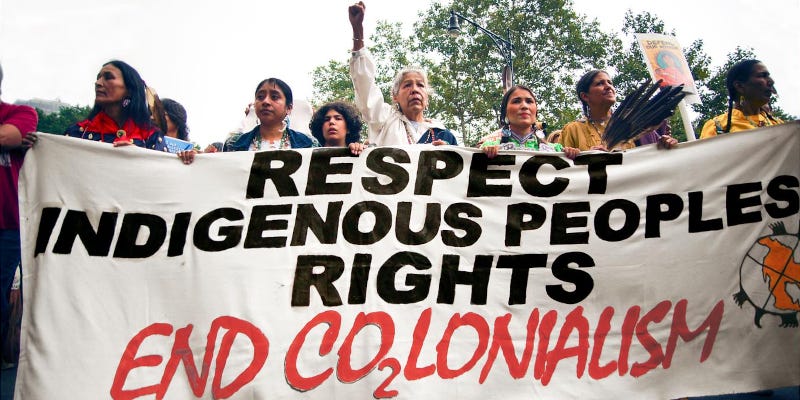
COP30 will start next week in Belém, Brazil. Today, Survival International has published a briefing on COP30 and dangers of carbon offsetting for the climate and for Indigenous peoples.
Survival International writes that,
COP 30 in Belem is being called ‘the forest COP’, but it needs a radical change of direction to uphold the rights of the Indigenous peoples — including uncontacted peoples — who have always lived in and protected many of these forests.
Survival International notes that less than 320 kilometres from Belém, Awá people are fighting to survive. There territory is being invaded by loggers, ranchers, and settlers. Some of the Awá people are uncontacted. They deep in the forest, isolated from the outside world. “They are some of the most resilient people in the world,” Survival International writes, “and are also the most vulnerable, falling prey to murderous criminals and illness brought by invaders.”
But COP30 will do little or nothing to help them, Survival International points out. Neither will it help the other 195 groups of uncontacted peoples around the world. Half of these peoples could be wiped out in the coming decade and the lives and cultures of 96% of them are threatened by extractive industries.
Carbon offsetting is one of the key mechanisms that will be pushed during COP30 by conservation organisations, governments, and Big Polluters. But offsetting is a false solution and dangerous distraction from the urgent need to stop burning fossil fuels. “Nature-based offset projects enable polluters to continue high emissions under the guise of carbon ‘neutrality’,” Survival International writes.
Carbon offset projects are increasingly being developed in Protected Areas. Indigenous Peoples are often evicted from these conservation areas, dispossessed of their lands and face devastating restrictions on their livelihoods.
Survival International is running a campaign called “Blood Carbon” against these carbon offset project in Protected Areas and the threats they cause:
Human rights abuses and evictions: The creation or expansion of Protected Areas often comes with forced evictions from Indigenous peoples’ ancestral lands, arbitrary arrests, torture, killings, and violence by rangers or security forces. Carbon offsetting schemes replicate the “fortress conservation” logic: evicting or excluding Indigenous peoples from their lands in the name of “protecting” nature. They reinforce colonial patterns of dispossession and destroy lives and livelihoods.
No fair benefits to Indigenous communities: The bulk of profits from carbon credits flow to intermediaries such as project developers, certification bodies, consultancies, and conservation NGOs — not to the communities whose lands and carbon are being traded.
Cultural destruction and undermining livelihoods: As projects seek to supposedly absorb more carbon in grasslands’ soil, pastoralist peoples are pushed to abandon long-held movements, their traditional grazing systems, customary laws, and social governance. This undermines their resilience, food security, and their capacity to adapt to climate change.
Questionable legality and ownership of carbon rights: There are legal challenges around who “owns” the carbon rights, and many projects do not have the Free, Prior and Informed Consent (FPIC) of affected Indigenous communities.
Survival International points out that,
The best way to protect the rights and lives of Indigenous peoples and their forests is to stop using their lands to greenwash consumption, and to recognize and enforce their rights in the territories that they have managed and protected for millennia.
COP30 concerns
Survival International has published another briefing outlining “Key points of interest and concern” at COP30. Nature-based solutions and carbon offsetting distract from Brazil’s role as a major oil producer. In June 2025, Brazil’s National Petroleum Agency auctioned exploration rights for 172 oil and gas blocks in the Amazon and offshore, “almost within sight of Belém”, as Survival International notes.

The briefing highlights five key items on the COP30 agenda:
New Nationally Determined Contributions (“NDCs 3.0”) due in 2025 with an end-date of 2035. These are the formal (though voluntary) commitments governments make to mitigate their carbon emissions. Requested by COP28 two years ago, many are late; as of 22 September, only 36 countries (out of 195 parties to the Agreement) are reported to have submitted their new NDCs.
The Global Goal on Adaptation (GGA): A key focus will be on implementing the UAE–Belém work program, which aims to develop a framework of indicators to track progress toward the Global Goal on Adaptation. Negotiations are expected to center on 1) which indicators make it into the official COP30 decision text and 2) how these indicators are applied in
planning processes and finance.
Climate finance: After the “Finance COP” (COP29) set a new collective quantified finance goal (NCQG), COP30 will discuss how it’s delivered (grants vs loans, tracking, access . . . ). This is likely to be very controversial.
Article 6 (carbon markets & non-market cooperation): Parties agreed at/after COP29 to keep a dialogue on Art. 6.2 (bilateral carbon trading) going; questions about how to operationalize Art. 6.4 (a global carbon market) are still open, and include issues around environmental integrity, human-rights safeguards and use of credits toward NDCs.
Presidency priorities: especially the launch of the Tropical Forests Forever Facility (TFFF), a Brazilian proposal for a $125 billion fund that would invest money in global markets and use the profits for forest protection. The fact that this has been dismissed as “the worst conservation fund ever” will no doubt not prevent it being launched.
In a press release, Fiore Longo, coordinator of Survival International’s Decolonize Conservation campaign says,
“The Tropical Forests Forever Fund (TFFF) is fundamentally flawed as it would rely on earnings from the very companies that have been responsible for destroying tropical forests. It would then direct only a derisory twenty percent of its funds to the people who have been most effective in protecting tropical forests, that is Indigenous peoples.”
Concerns about Indigenous Peoples’ rights
The Paris Agreement includes only weak requirements on Indigenous rights. The preamble to the Paris Agreement urges governments to “respect, promote and consider their respective obligations on human rights, the right to health, the rights of indigenous peoples . . . ”. The Nationally Determined Contributions are the main tool for implementing the Paris Agreement and are therefore an indication of how well governments are upholding these rights. Yet only a small minority of NDCs mention Indigenous Peoples and “almost none in the context of enforceable rights”, Survival International points out.
Apart from the preamble, the only other mention of Indigenous people in the Paris Agreement is in Article 7, which concerns adaptation to the impacts of the climate crisis. Article 7 states that adaptation action “should be based on and guided by the best available science and, as appropriate, traditional knowledge, knowledge of indigenous peoples and local knowledge systems”. Survival International writes that, “There should should therefore be indicators on this in the GGA indicators under the UAE–Belém work program.”
In October 2024, the Article 6.4 Supervisory Body adopted the “Sustainable Development Tool”. This includes the right of free, prior and informed consent for Indigenous peoples regarding the development of any Article 6.4 carbon trading activities impacting their land, culture, and spiritual values. “However, it is not clear how these requirements will be enforced,” Survival International notes. It is also not clear exactly how the grievance and appeals mechanism that is included in the Sustainable Development Tool will operate. “These need to be clarified as a matter of urgency,” Survival International writes.
During COP30, the Brazilian government will use its role as COP president to announce new programmes, national and international alliances, and financial mechanisms. These will include the Tropical Forest Forever Facility, REDD initiatives, and afforestation and restoration plans. In June 2025, the Coordination of the Indigenous Organisations of the Brazilian Amazon (COIAB) put out a statement of demands for COP30. This includes the demand to:
Declare indigenous territories as exclusion zones from extractive activities because they are areas of f particular importance for biodiversity and ecosystem functions and services, in particular the Amazon, Congo, and Borneo-Mekong-Southeast Asia basins.