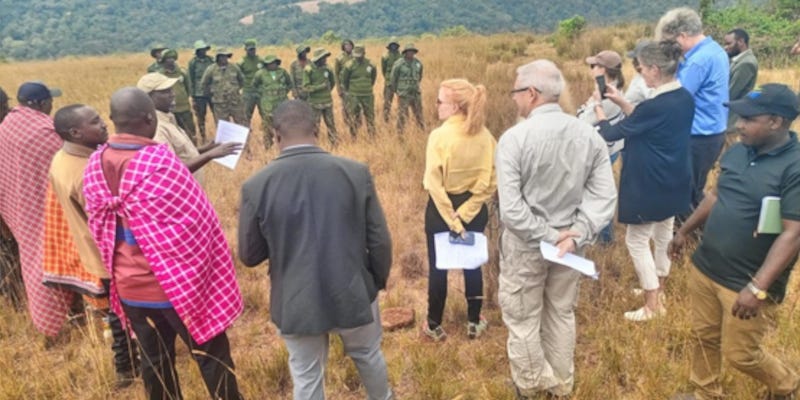
Tanzanian NGO statement calls on German aid agencies “to conduct an independent, transparent, impartial, and rights-based investigation” about conservation on Maasai territories
“Conservation with communities, not conservation over communities.”
In 1992, the Tanzanian government signed a deal with a company called Otterlo Business Corporation. The company is a hunting and tourism company owned by wealthy sheiks from the United Arab Emirates, including Brigadier Mohamed Abdul Rahim Al Ali, a former UAE deputy minister of defence.
The following year the Tanzanian government gave Otterlo Business Corporation the right to hunt on 4,000 square kilometres of land — reportedly in exchange for millions of dollars for Tanzania’s army.
REDD-Monitor is a reader-supported publication. Please subscribe!
In 2022, Tanzania’s Ministry of Natural Resources and Tourism posted a statement on its Instagram account:
The German Ambassador to Tanzania, Hon. Regina Hess has supported the ongoing efforts of the Government of Tanzania in rescuing the Ngorongoro Conservation Area by protecting the conservation and environment of the area to address the effects of climate change.
Given that the Tanzanian government was at the time threatening the Maasai living in Ngorongoro with evictions (a threat that has not gone away) this statement certainly gives the impression that Hess supports the evictions of Maasai Indigenous people from Ngorongoro.
When Survival International Germany asked the German Embassy about its position on the land rights of the Maasai, the Embassy did not answer.
The Instagram post came in March 2022. Just three months later, the Ministry of Natural Resources and Tourism announced the creation of the Pololeti Game Controlled Area on the edge of Serengeti. This announcement annexed 1,500 square kilometres of Maasai village land — land that Otterlo Business Corporation had been lobbying for control of since its arrival in Tanzania.
Following the announcement of the Pololeti Game Controlled Area came massive evictions carried out by state agencies, including the Tanzania National Parks Authority (TANAPA). Thousands of people were left homeless, dozens of Maasai were injured, and the Maasai lost important grazing land for their cattle.
The Frankfurt Zoological Society, which receives funding from the German government, has also funded and equipped TANAPA. Benjamin Hindrichs reports in Mongabay that the Frankfurt Zoological Society’s funding to TANAPA continued as TANAPA “carried out both violent and nonviolent evictions from high-conservation value areas on the edge of Serengeti”.
A spokesperson for the Frankfurt Zoological Society toldMongabay that the organisation “is not involved directly or indirectly, in any resettlement activities in Loliondo or the Ngorongoro Conservation Area”.
“If the rangers are using vehicles to hunt the Maasai, who provided the cars? Who provided the fuel? Who pays for them?” Joseph Oleshangay, a Maasai lawyer, asked. “It is not only the rangers themselves who are responsible for the violence, but also those who provide them with the means to use violence.”
In early 2024, the German government increased its support for conservation in the Serengeti ecosystem by US$9.5 million.
The statement makes clear that the German aid agencies are still in denial about the human rights of the Maasai and the fact that German finance is playing a direct role in the threats, evictions, and violence against the Maasai.
We, the representatives of Indigenous Peoples’ and civil society organizations working on Indigenous Peoples’ rights, land rights, conservation, accountability and community development in Tanzania, issue this grievance statement following the visit of representatives of the German Federal Ministry for Economic Cooperation and Development (BMZ), the German Embassy in Tanzania, the Deutsche Gesellschaft für Internationale Zusammenarbeit (GIZ), the Frankfurt Zoological Society (FZS) and the German Development Bank (KfW) to Tanzania, including their engagement on conservation and development initiatives in Loliondo.
On 11 August 2026, a roundtable discussion was held in Arusha between German institutions and invited local CSOs, including ourselves, during which Maasai representatives respectfully raised serious concerns regarding the impacts of prevailing conservation models, the handling and resolution of community grievances, and the implementation of development programmes supported through German development cooperation. Particular concerns were raised in relation to interventions involving BMZ, KfW, GIZ, and FZS, especially where these affect community land, livelihoods, participation, and rights.
Community grievances must be taken seriously and should not be treated merely as matters of project performance. We therefore issue this statement to call on the respective German entities to conduct an independent, transparent, impartial, and rights-based investigation capable of addressing community concerns and ensuring meaningful accountability.
When we raised our grievances, we were surprised that German entities place the responsibility for these complaints primarily on Tanzanian institutions such as TAWA and TANAPA, without acknowledging the primary role of German institutions that finance and support conservation programmes implemented by these institutions. We respect Tanzania’s sovereignty. However, sovereignty does not remove the responsibility of development partners to ensure that their support does not contribute to human-rights violations. The way conservation operates in Tanzania is through the collaboration of three key actors: investors such as OBC, who benefit from grabbing the land; Tanzanian state operatives, who provide the necessary violence to create space for investors; and the conservation donor community, which provides the moral cover to justify displacement, either by presenting it as necessary for conservation or by funding small projects and amenities just outside the areas where authorities have carried out violent operations.
All actors involved in funding, designing, or supporting projects must be accountable for impacts on human lives caused by or in the name of these projects. As financiers and development partners, they have to exercise due diligence and accountability processes regarding the impacts of supported projects.
We therefore respectfully request BMZ to formally acknowledge and document the grievances raised by the Maasai community; establish an independent assessment process; engage directly and confidentially with affected communities, including elders, women and youth; review compliance with applicable human rights, including land, participation and FPIC; and transparently communicate findings and corrective measures. We respectfully request BMZ to provide a written response to this statement, clearly indicating:
How the grievances presented by the Maasai representatives have been recorded;
What process BMZ proposes to investigate them;
How independence and confidentiality will be ensured;
How affected communities will participate;
What role Maasai leadership will have in the process; and
When BMZ proposes to convene the next high-level conservation dialogue.
We also call on FZS to give adequate attention, investigation, and a meaningful response to our concerns. The Maasai community across Loliondo, through its legitimate leadership, has repeatedly raised serious concerns on the complicit role of FZS in land grabbing including supporting Tanzanian authorities financially and morally in the illegal establishment of the Pololeti Game Reserve and planning to grab Enguiserosambu Forest, in furtherance of exclusive conservation objectives supported by other German institutions. Despite these grievances having been raised consistently over a prolonged period, they have not received an adequate response.
We further call on KfW and FZS to clarify their safeguards and policies on Indigenous Peoples’ rights in Tanzania, including:
Community participation and FPIC in project design and implementation;
Assessment of land and livelihood risks;
Grievance and accountability mechanisms; and
Response to allegations of adverse impacts.
Finally, we call on GIZ to reconsider the findings and narrative of its Loliondo study, which appears to portray Maasai communities as threats to conservation, while insufficiently examining how restrictive conservation policies and land-use measures may contribute to livelihood insecurity. GIZ should recognize coexistence as a community-led conservation approach, acknowledging that people, livestock, wildlife, and ecosystems can sustainably share landscapes through customary governance, Indigenous knowledge, and community-led stewardship. We remind you of our Maasai conservation vision that can serve as a useful guide in that regard.
Everyone who intends to undertake conservation projects in Maasailand must understand we are all equal in dignity and rights. German institutions should stop implementing conservation projects based on the assumption that we are easily disposable or displaceable. We are not.
Our concerns extend beyond individual projects to broader issues of land and territorial rights, customary governance, pastoralists’ livelihoods, cultural integrity, Indigenous knowledge, participation in conservation governance and benefit-sharing. We therefore request meaningful recognition and participation of legitimate Maasai leadership in all German funded programmes affecting Maasai territories. We emphasize that our intention is to ensure that German-Tanzania cooperation intended to support conservation and development does not inadvertently violate or erode the rights, dignity, cultural integrity, livelihoods, and customary governance systems of the communities it is intended to serve. We believe in “Conservation with communities, not conservation over communities.”
To make this a reality, we propose a structured Maasai–Germany conservation policy dialogue on land and territorial rights, cultural integrity and customary governance, and rights-based conservation and community development. Our intention is not confrontation, but to build a stronger partnership grounded in mutual respect, transparency, accountability, and genuine participation. Maasai and Indigenous Peoples’ organizations remain ready to engage constructively and in good faith with BMZ and other German institutions to address the grievances raised and identify meaningful, rights-based solutions. We respectfully urge BMZ and other German institutions to treat these concerns as matters requiring substantive institutional review and accountability, rather than limiting them to routine project performance monitoring.