

The carbon land grab: A debate between GRAIN and the Land Matrix
We need better land governance, better standards, and more transparency says the Land Matrix. We need to “put an end to offsetting as a false solution to the climate crisis — urgently” says GRAIN.

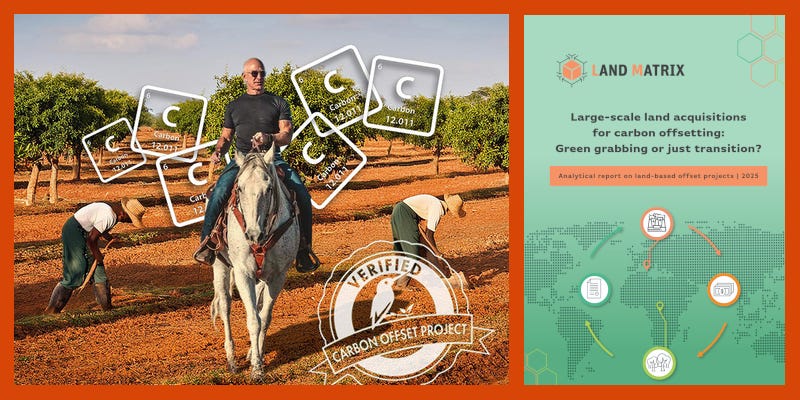
In October 2025, the Land Matrix published a report documenting land-based offset projects and the large-scale land acquisitions for these projects. Written by Christoph Kubitza, Quentin Grislain, Nikka Rivera, Gabi Sonderegger, and Jann Lay the report is titled, “Large-scale land acquisitions for carbon offsetting: Green grabbing or just transition?”
The report finds that:
Carbon offset projects cover approximately 8.8 million hectares worldwide — almost one-third of the global rush for agricultural land that began in the late 2000s;
Brazil, the Republic of Congo, and the Democratic Republic of Congo have more than 1 million hectares of carbon offset projects. In Indonesia carbon offset projects cover nearly 500,000 hectares; and
REDD projects total 7 million hectares while reforestation and afforestation account for 1.5 million hectares.
In a 2024 report, GRAIN came up with a similar total figure for the area of land deals for carbon projects worldwide.

However, there are important differences in the way the Land Matrix and GRAIN calculated the area of these projects. GRAIN pointed out these differences in an article for Mongabay in December 2025.
The Land Matrix looked at land deals from 2000. GRAIN looked at land deals between 2016 and March 2024. The Land Matrix found that the vast majority of the land area was for REDD projects. GRAIN excluded REDD projects and focused instead on large-scale tree and crop planting projects established to generate carbon credits.
The Land Matrix excluded China “due to lack of a country partner”. GRAIN included China and found a large area of land-based carbon offset projects in the country.
GRAIN notes that the Land Matrix excludes key projects that started before 2000 such as REDD projects linked to Ricardo Stoppe Júnior, the largest seller of carbon credits in Brazil. He is also the leader of the criminal organisation at the centre of Operation Greenwashing, launched by Brazil’s police in June 2024.
The Land Matrix also excluded the United Arab Emirate company Blue Carbon LLC’s massive land deals for carbon projects in Africa because the land transaction details are unclear. That was probably a correct decision. Blue Carbon has been silent since COP28. By July 2025, the company’s website had disappeared. The deals appear to have lapsed.
“Community or farmer-based projects”
The Land Matrix differentiates between large-scale land acquisitions and what it calls “community or farmer-based projects”. As GRAIN points out, even though such projects may not involve a company acquiring lands, communities are contracted to plant and/or keep trees on their lands for a long period of time.
GRAIN writes that,
For GRAIN, these projects, in which villagers sign contracts that give the companies exclusive rights to the carbon in their soils and that commit them to growing and maintaining trees or other crops on their lands for decades, essentially transfer control over the lands to the companies. The villagers, from our discussions with them, rarely fully understand what they are signing up to, and allocate critical areas of land needed for their families and their communities in order to produce carbon credits to offset the corporate climate pollution. In exchange, they may or may not get some small payments, if and when the company manages to sell the carbon credits.
The TERAKA smallholder tree planting project in Madagascar
The Land Matrix highlights just one project to back up its support of “community or farmer-based projects”. That’s the TERAKA smallholder tree planting project in Madagascar. The Land Matrix writes that, “the project seeks to ensure the fair distribution of revenues from the sale of carbon credits”.
The project is run by a French company called iTeraka. Farmers taking part in the project have to sign several contracts with iTeraka. GRAIN notes that one agreement prohibits villagers from talking to journalists or researchers who have not signed an agreement with iTeraka. Another contract requires farmers to keep the trees on their land for 100 years and cover all the costs of planting and maintaining the trees.
In return, farmers get 70% of the net revenues from the sale of carbon credits. GRAIN comments that net revenues are what is left after iTeraka has deducted its costs, which could include salaries, consultant fees, business lunches, travel to conferences, and anything else the company decides to include as an expense.
The project has not yet sold any carbon credits. The project status is listed on Verra’s registry as “Registration requested”.
GRAIN explains that until carbon credits are sold, iTeraka will pay villagers just €0.02 to €0.03 per year for each living tree over one year old that is part of the project. This money will later be deducted from the money farmers receive from the sale of carbon credits.
Project documents state that the TERAKA project will not be verified before 2028. The project cannot sell any carbon credits before this date. Farmers will have to pay for tree planting and maintenance upfront.
GRAIN lists some of the other costs farmers involved in the project will face to take part in the TERAKA project: “going to regular project meetings, providing proof of land titles, filling out paperwork, maintaining the trees (including protecting them from fires and storms) and, most importantly, sacrificing portions of their farmland that could otherwise have been used to grow crops for food or other income”.
The Land Matrix report highlights the fundamental problems with carbon offsetting. But the report includes policy recommendations aimed at preventing a “business-as-usual scenario” with carbon offsetting projects.
The first recommendation is “Prioritising community schemes in land-based offsets over LSLAs [large scale land acquisitions]”. The Land Matrix accepts that land-based carbon offsetting will remain a “policy priority” and argues that carbon offset projects should “at least strive to access land in an inclusive manner, promoting the participation and ownership of IPs & LCs [Indigenous Peoples and local communities]”.
“We strongly disagree,” GRAIN writes.
Both types of projects are causing land grabs and other harms and injustices across the world, and are based on a false equation between the burning of fossil fuels — which releases a source of carbon buried deep under the Earth’s surface for millions of years — and the sequestering of carbon in a thin layer at the top of the Earth’s surface, which is highly susceptible to being released back into the atmosphere at any moment.
The Land Matrix’s recommendations for better land governance, better standards, and more transparency cannot address the fundamental problems with carbon offsetting. GRAIN argues that we have to build stronger analyses of carbon land grabs, and “put an end to offsetting as a false solution to the climate crisis — urgently”.
There is a large amount of evidence to support GRAIN’s argument. In October 2025, the most comprehensive review of evidence on the effectiveness of carbon offsetting was published. It concludes that the problems with carbon offset project are “intractable”.

In a statement, Amna Alshamsi, one of the authors of the report, writes that,
Despite efforts to implement safeguards, carbon offset projects continue to face documented cases of weak accountability, risking the perpetuation of neocolonial patterns of appropriation.
Kubitza’s response
In February 2026, one of the authors of the Land Matrix report, Christoph Kubitza of the German Institute for Global and Area Studies, wrote a response to GRAIN’s critique. Kubitza defends the Land Matrix’s focus on large-scale land acquisitions:
This focus reflects the Land Matrix’s long-standing mandate to monitor land acquisitions that contribute to land concentration, shifts in control, and power asymmetries at scale. We argue that this massive scale of land acquisitions occurring under the auspices of voluntary carbon markets, and often within countries with weak land governance systems, has profound implications for land access for affected communities as well as for broader debates on climate justice.
And he points out that the Land Matrix report acknowledges that community- or farmer-based carbon projects can “have serious risks”, “are not a cure-all”, “are also fraught with implementation challenges”, or “associated with elite capture”.
However, he repeats the claim in the report that “prioritising well-implemented projects with clear ownership by IPs & LCs or farmer groups could address the dearth of financial resources in many target regions”.
Interviews with journalists and researchers
Kubitza was part of the team that researched the TERAKA project in Madagascar for a report published by the Lincoln Institute of Land Policy in September 2025. He writes that researchers “interviewed farmers as part of an independent research effort conducted with full transparency and without any agreement signed with iTERAKA”.
The researchers surveyed 167 households, including 94 members of the TERAKA project. “At no point did interviewed farmers — whether program members or nonmembers — report being prohibited from speaking with researchers or journalists,” Kubitza writes.
That’s because when the researchers carried out their field surveys in March and April 2025, iTeraka’s agreement with the farmers, which was dated 20 February 2025, made no mention of interviews with journalists or researchers.
On 7 October 2025, shortly after the Lincoln Institute published its report, iTeraka amended the agreement to include the following clause:

Which translates as follows:
8. Interviews with journalists and researchers
Before any interview or sharing of information about the TERAKA programme, TERAKA members and agents always ask journalists or researchers to sign a collaboration agreement with iTeraka. This agreement allows iTeraka to review texts before publication in order to verify the accuracy of the information disseminated. Members do not give any interviews before this agreement is signed. This rule does not limit freedom of expression; it simply aims to ensure that everything published about TERAKA is true and reliable.
Remuneration and Fairness
To make matters worse, this new clause replaced a clause in the 20 February 2025 version of the agreement about “Remuneration and Fairness”:

Which translates as follows:
8. Remuneration and Fairness
TERAKA is committed to promoting equal pay among members, service providers and programme collaborators for similar tasks.
Payments must be fair, transparent and commensurate with the efforts made by each individual.
Kubitza states that the contract between farmers and iTeraka explicitly allows farmers to “leave at any time without penalty” from the contract. But, to obtain payments, farmers are required to maintain the trees in good health for 100 years. Obviously, those payments will stop if a farmer decides to leave the contract. What will happen to the carbon credits generated by that farmer’s trees is not explained in the contract.
The Lincoln Institute report states that while the project began in October 2023, by April 2025 when the field surveys were carried out, “farmers had not yet received their annual prepayments due to technical issues with mobile money transfers”.
In his response to GRAIN, Kubitza writes that,
We agree, however, that the extent of derived benefits remains open to debate and depends critically on both the feasibility of planting and maintaining sufficient numbers of trees and future developments in carbon prices. This risk should certainly not be underestimated.
Fossil fuels?
Kubitza states that “we do not advocate carbon offsetting as a climate solution”. He writes that,
we identify deep-rooted problems in carbon markets, including weak standards, methodologies that substantially overestimate emission reductions, top-down project design, and a widespread lack of understanding of the land tenure systems in many countries.
The recommendations made in the Land Matrix report, Kubitza writes, are “intended as harm-reduction measures in a context where such projects are already proliferating”.
But since 1988, when the the first land-based carbon offset project was developed, many organisations have put forward recommendations aimed at reducing the harm caused by carbon offsetting projects. These have included (among other things) better land governance, better standards, and more transparency, as the Land Matrix recommends in its report.
The fact that organisations still feel that it is necessary to make recommendations for safeguards should give some indication of how seriously the carbon industry takes them.
GRAIN points out that all the work carried out by the farmers in Madagascar planting and maintaining trees on their land, ends up providing “cover for faraway corporations to continue belching out emissions and worsening a climate emergency that is badly affecting these very same farmers”.
Kubitza writes that whether carbon markets should persist is “another debate”. He makes no mention of fossil fuels in his response to GRAIN.