

The Petrobras “carbon neutral” greenwash machine continues
Extracting ever more fossil fuels cannot possibly be “carbon neutral”.

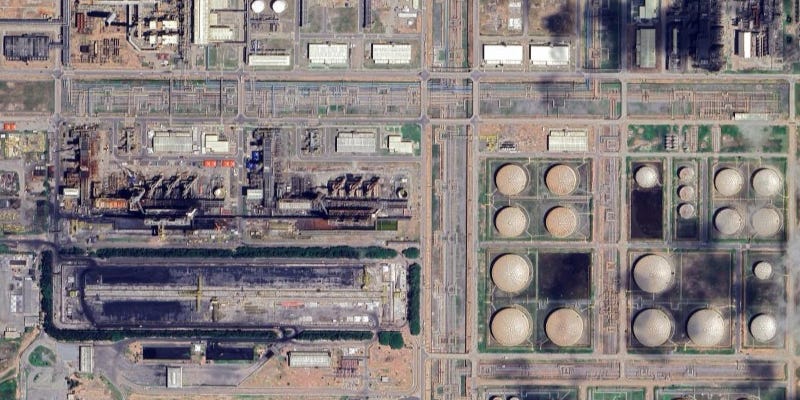
Petrobras is a massive Brazilian oil and gas corporation. It is responsible for a large contribution to the climate crisis. And it’s getting worse. In 2025, the company increased its oil and gas production by 11%.
In September 2021, Petrobras was one of 12 oil and gas companies in the Oil and Gas Climate Initiative that announced a net zero strategy. The Oil and Gas Climate Initiative is a Big Polluters’ greenwashing exercise. Its members include BP, Chevron, CNPC, Eni, Equinor, ExxonMobil, Occidental, Petrobras, Repsol, Saudi Aramco, Shell, and TotalEnergies.
Obviously, these companies are not planning to stop extracting and profiting from the sale of fossil fuels in order to achieve their net zero target. Instead, they will ignore the emissions from burning fossil fuels (scope 3 emissions) and concentrate on reducing emissions in their own operations (scope 1 and 2 emissions).
And, of course, they buy carbon credits. In its recently published, “Climate change and energy transition supplement 2025,” Petrobras explains that,
We believe emission offsets through carbon credits can complement our decarbonization journey. These credits may be nature-based, leveraging forests, soils, oceans, and seaweed, or derived from technological solutions. While offsets are expected to be used, they are intended as supplementary contributions and do not replace the need for lower-carbon energy supply.
The last sentence sounds nice, but Petrobras is increasing the amount of oil and gas it is extracting. The reality is that Petrobras is another Big Polluter using carbon credits to greenwash its destructive operations.
“Carbon neutral” petrol
Petrobras sells its Gasolina Podium as “carbon neutral”. REDD-Monitor wrote about this absolute farce in 2023:

In 2025, Petrobras bought 1.2 million carbon credits. Here’s what Petrobras writes in its recently published report:
[S]ince 2023, we have invested in the voluntary market to offset emissions from Petrobras Podium Carbon Neutral gasoline. In 2025, we acquired 1.2 million credits from the Brazilian Amazon APD Grouped project, of which 455,000 were retired to offset Podium emissions. The credits, from the 2022 vintage, are certified under the Verified Carbon Standard (VCS) by Verra . . .
The Brazilian Amazon APD Grouped project was developed by a Brazilian company called BRCarbon. The project covers a total area of more than 30,000 hectares made up of 15 properties in different the states of Mato Grosso, Acre, Amazonas, and Pará.
On its website, the project developer, BRCarbon, has this map of the project area:
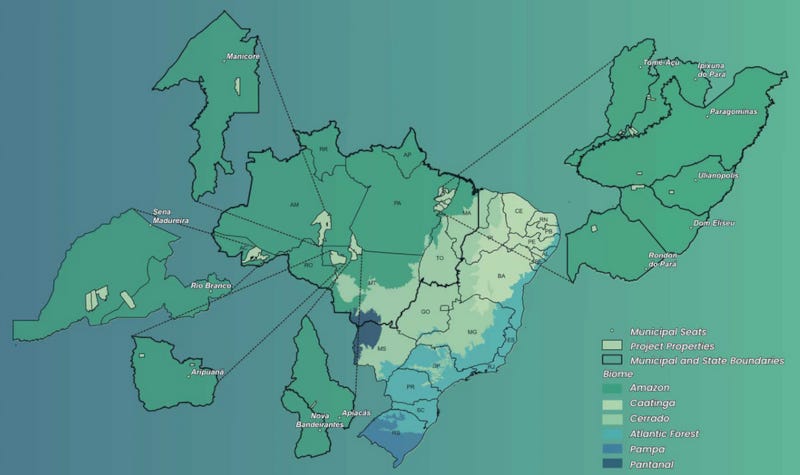
The project has sold a total of 3,220,904 carbon credits. Among the buyers, in addition to Petrobras, are Air New Zealand, trip.com, Rhodia Brasil (now owned by the Belgian-French firm Solvay), PwC International, and Air Canada.
Under Brazil’s 2012 Forest Code all properties in forested areas must maintain a minimum area of 80% with native vegetation cover as a Legal Reserve. In cerrado areas, the figure is 35%. The remaining land can legally be cleared. BRCarbon’s project document explains that,
The landowners who decide to join the initiative, by giving up their right to legally clear their forest areas will be able to access financial resources from the carbon voluntary market, becoming BRCarbon partners.
Additional? Permanent?
Whether or not the project is additional is debatable — as it is with all REDD projects. BRCarbon states that, “Any legally constituted private properties within Amazon biome, with more than 80% of forest cover (or 35% for Cerrado) is eligible for this grouped project.”
Whether the forest will remain protected for as long as the emissions from burning fossil fuels will remain in the atmosphere, and against which the project’s carbon credits are being traded, is impossible to know.
The project document acknowledges that,
The proposed project activity is economically less attractive than any agriculture project because no financial benefits other than VCS related income are expected for the project proponent due to the project implementation.
At any point in the future, a landowner could decide to make more money by clearing the forest, selling the timber, and converting the land to cattle ranching or soy plantations.
Even if the forest remained standing as a result of the REDD project for the next thousand years, the climate benefits would be cancelled out by the polluting operations of the companies buying the carbon credits.
“We see carbon markets as a crucial instrument in combating climate change and are engaged in discussions on implementing a regulated carbon market in Brazil,” Petrobras writes.
The company is even looking at the possibility of generating its own carbon credits by “optimizing transport infrastructure as a decarbonization lever via public-private partnerships”.
The oil and gas industry urgently needs to be regulated. Instead, the Brazilian government is inviting one of the country’s worst polluters to help implement the loophole of carbon trading in order to allow the destruction to continue.
As the climate crisis gets worse, the Amazon is getting ever closer to a dangerous tipping point. We simply cannot afford to trade the carbon stored in forests against continued emissions from fossil fuels. Yet that is precisely what Petrobras and other Big Polluters are doing.