


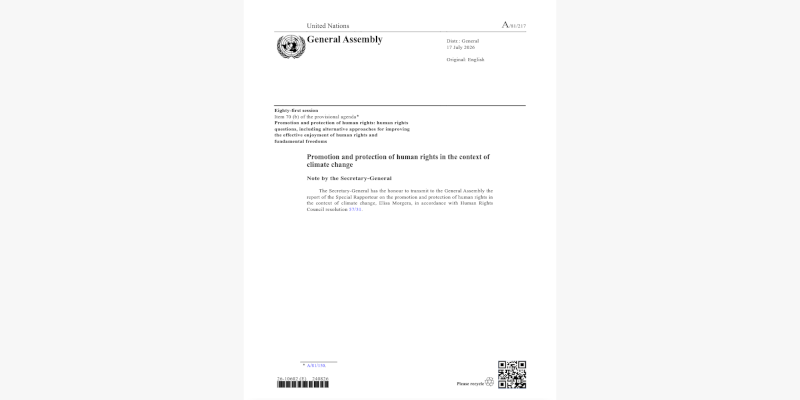
A new report by Elisa Morgera, the UN special rapporteur on the promotion and protection of human rights in the context of climate change, is titled, “Rethinking carbon credits according to international climate and human rights obligations.”
The report “identifies structural misalignments between carbon credit markets and the international obligations of States with regard to climate change and human rights”. Morgera calls for “an urgent reassessment, internationally and domestically” of carbon markets “in accordance with the advisory opinion of the International Court of Justice on the obligations of States in respect of climate change”.
The International Court of Justice’s advisory opinion was issued in July 2025, and states that countries must prevent harm to the climate and that failure to do so could result in them having to pay reparations.

Morgera’s report provides a very detailed overview of the structural and methodological problems with carbon credits. The report “builds on earlier human rights analyses, submissions, consultations with a variety of experts and human rights holders, and independent research”.
Morgera’s report is well worth reading in full and raises crucial issues that urgently need to be addressed, particularly as carbon trading under Article 6 of the Paris Agreement ramps up. As far as I’m aware, the report has so far received no media coverage anywhere in the world.
This following is a summary of the problems with carbon markets raised in the introduction to the report:
Growing evidence indicates that carbon credits are failing to support cost-effective climate mitigation for major polluting countries. Carbon credits are also not mobilising additional finance and technology for climate action and sustainable development in climate vulnerable countries. Carbon credits face “persistent, and in some cases structural, challenges which allow routine circumvention of even well-designed rules, despite more than two decades of reforms”. The underlying market-based logic incentivises low-quality, low-price credits as well as overcrediting. This creates “conditions conducive to greenwashing and fraud”.
“The result is not only the absence of the promised mitigation outcome but an increase in atmospheric greenhouse gas emissions in the context of worsening climate change.”
Carbon credits can be used to enable continued fossil fuel dependence, “contributing to compounding and intergenerational human rights harm of the fossil fuel life cycle, as well as further climate harm in terms of greenhouse gas emissions and degraded carbon sink”.
“Despite improvements in methodologies, there is still insufficient evidence as to whether carbon credits are capable of effectively contributing to fulfilling States’ international obligations to prevent significant climate harm, in line with best available science, and protect everyone’s human right to a healthy environment, as well as the other international obligations clarified in the advisory opinion of the International Court of Justice on the obligations of States in respect of climate change.”
Intergenerational and intragenerational equity remains a serious problem with carbon credits. Carbon credits distract from the responsibilities of those countries most responsible for historical emissions. And carbon credits reproduce historical inequities by “placing disproportionate burdens on communities that are least responsible for climate change, aggravating multiple dimensions of poverty in relation to food security, tenure, cultural practices and resilience”.
“In other words, there are concerns about perpetuating economic models that are premised on even wider economic inequality rather than supporting structural economic transformation.”
Human rights violations associated with carbon project is affecting Indigenous Peoples, peasants, and other rural communities, with “compounded impacts on women and intersectional discrimination for other community members”.
“ These patterns should be linked back to deeper structural failures of carbon credits and placed in a broader context of compounding human
rights harm arising from worsening climate change, displacement, food insecurity and widening economic inequality due to unprecedented corporate power concentration and land accumulation.”
These human rights violations should be seen in the context of States’ obligations to prioritise legal protection and financial support for small-scale food systems as a climate mitigation measure that “supports the defossilization and detoxification of food systems to the benefit of everyone’s human rights to a healthy environment, health and food”.
The International Court of Justice identified the 1.5°C global temperature limit as central to States’ climate obligations. It is extremely unlikely that we can keep global heating below 1.5°C. It is therefore “imperative to assess whether the inadequacies of carbon markets can be addressed through technical adjustments under the Paris Agreement and stronger regulation”.
“Persistent harm to the environment and to human rights across different kinds of projects over time, however, is often acknowledged and addressed only after being exposed through external investigations, media reporting or civil society scrutiny, rather than through proactive oversight or preventive mechanisms. This points to underlying issues that would not only require safeguards and governance that are fully aligned with international human rights law but also a reconsideration of structural design and underlying assumptions.”
The extreme complexity of carbon credits and the lack of transparency of international, national, and local debates and initiatives raise a distinct but related set of human rights concerns.
“It is essential to focus attention on the climate-harming actors who are benefiting directly or indirectly from carbon credits, and the implications for those attempting to implement mitigation activities in good faith while facing a maze of adverse structural drivers. Ultimately, if carbon credits – structurally or in specific, foreseeable situations – fail to mitigate climate change, they contribute to the compounding human rights harm associated with climate change globally. Therefore, States’ reliance on carbon credits may be inconsistent with their international obligations.”
Thanks, Chris. My way of describing the problem is that the international carbon accounting rules allow emitters to subtract carbon credit quantities from emissions, and that the resulting smaller number is hailed as evidence of reduced climate harm. It isn’t. There is no permanent harm reduction, and the subtraction is mainly a smokescreen hiding the lack of real progress.
I discuss this issue in detail in this video: https://youtu.be/SaFa778OsRI?si=KorO_hn6Q-IXZgYE which starts with the outcome of a recent Australian court action which was about this matter.