

Want to stop climate change? Stop eating meat

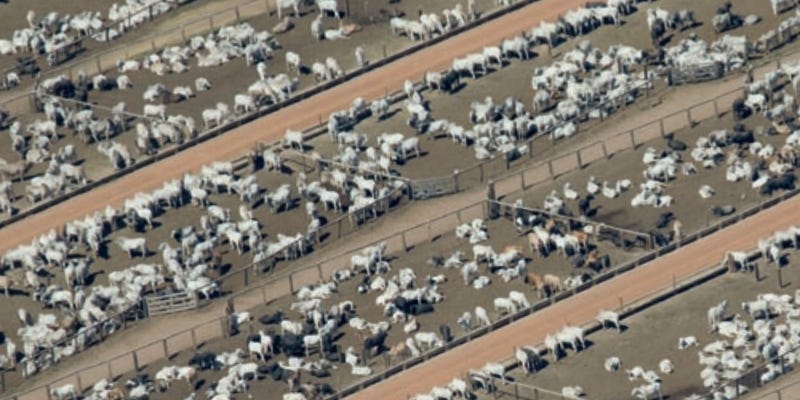
There are plenty good reasons for not eating meat. Cancer, heart disease, diabetes, meat glue, pink slime, antibiotics, steroids, pesticides, heavy metals, salmonella, E. coli, mad cow disease and the inhumane treatment of livestock – to mention just a few.
Another is climate change. Robert Goodland and Jeff Anhang argue that livestock accounts for at least half of all human-caused greenhouse gases. They also argue that “replacing livestock products with better alternatives would be the best strategy for reversing climate change.”
Goodland (who used to be an environmental adviser at the World Bank) and Anhang (who is an environmental specialist at the International Finance Corporation) wrote an article for World Watch magazine in 2009. In the article they refer to a 2006 report by the FAO, “Livestock’s Long Shadow”, that estimates that livestock accounting for 18% of annual worldwide greenhouse gas emissions. Goodland and Anhange calculate that the figure should be 51%.
Clearing rainforest for cattle pasture, or for growing feed for livestock is one of the ways that the meat industry contributes to greenhouse gas emissions. “As there is now a global shortage of grassland,” write Goodland and Anhang, “practically the only way more livestock and feed can be produced is by destroying natural forest.”
They note that the global human population is expected to grow by 35% between 2006 and 2050 and the FAO estimates that livestock numbers will double during the same period. The risk is that greenhouse gas emissions from livestock could also double. Goodland and Anhang point out that attempts to replace fossil fuels with renewable energy and energy efficiency have so far not worked. Greenhouse gas emissions have increased since the UN Framework Convention on Climate Change was adopted in 1992.
They make a series of suggestions for the food industry to produce fewer meat products and argue that,
For many years, advocacy of alternatives to livestock products has been based on arguments about nutrition and health, compassion for animals, and environmental issues other than carbon intensity. These arguments have mostly been ignored and the consumption of livestock products worldwide has increased, leading some to believe that such advocacy may never succeed.
There has been plenty support for Goodland and Anhang’s proposals.
In 2008, Dr Rajendra Pachauri, chair of the United Nations Intergovernmental Panel on Climate Change told The Guardian that, “In terms of immediacy of action and the feasibility of bringing about reductions in a short period of time, it clearly is the most attractive opportunity. Give up meat for one day [a week] initially, and decrease it from there.”
In 2009, Lord Stern said that, “Meat is a wasteful use of water and creates a lot of greenhouse gases. It puts enormous pressure on the world’s resources. A vegetarian diet is better.”
Also in 2009, the UK’s Sustainable Development Commission released a report on food. “The big thing that we can do is to cut back on meat and dairy,” Tim Lang, the Sustainable Development Commissioner told The Guardian.
In 2010, John Vidal wrote about the impacts of meat eating in an article titled, “10 ways vegetarianism can help save the planet”.
In 2010, a report from the UNEP announced that, “Impacts from agriculture are expected to increase substantially due to population growth increasing consumption of animal products. Unlike fossil fuels, it is difficult to look for alternatives: people have to eat. A substantial reduction of impacts would only be possible with a substantial worldwide diet change, away from animal products.”
WWF commissioned a report from the Rowett Institute of Nutrition and Health at Aberdeen University to develop a sustainable diet – involving eating less meat.
Last week, an article in Forbes highlighted Goodland and Anhang’s World Watch report. “The world’s best chance for achieving timely, disaster-averting climate change may actually be eating less meat,” writes Michelle Maisto.
It all sounds self-evident. If we all ate less meat we would reduce deforestation and greenhouse gas emissions. But as Larry Lohmann points out in his paper, “The Endless Algebra of Climate Markets”, Goodland and Anhang’s suggestion that this is the best way of addressing climate change neatly avoids any analysis of climate history and effectively equates eating meat with two hundred years of fossil fuel emissions and industrialisation in the global North.
So, yes, we should eat less meat. But that doesn’t let the oil industry off the hook. We still also need to reduce emissions from fossil fuels.
Comments following the original post on REDD-Monitor.org are archived here: https://archive.ph/wCSy8#selection-1021.4-1021.14