


In December 2025, REDD-Monitor wrote about Evertreen, a company that sells carbon credits and runs tree planting operations. In August 2026, Evertreen responded to the article. I had some questions about Evertreen’s response, which I sent by email on 28 August 2026 and again on 11 September 2026. Evertreen replied on 18 September 2026.
Evertreen took the somewhat unusual step of posting its response on the company’s website — with extremely short summaries of my questions.
Here are my questions, with Evertreen’s responses in full and unedited.
REDD-Monitor: My statement that “Evertreen gives no information about which company certified the carbon project, or which carbon registry the carbon credits are listed on” refers specifically to the “Indonesian Emerald Reforestation” project. Evertreen's website provided no concrete information about this project — yet Evertreen was selling “0.5 tons CO₂” through “Trees in Indonesia” for £4.99. An archived copy of Evertreen’s “Reforestation in Indonesia” webpage is available here.
I note that this webpage has now been removed. Please explain why. How many tons of CO₂ did Evertreen sell from its “Reforestation in Indonesia” project? How many trees were planted in Indonesia? Where exactly were these trees planted and by whom? Are these trees still monitored, and if so how, and by whom?
Evertreen: The “Reforestation in Indonesia” page, and what was sold there.
Indonesia: 20,926 units funded since 2020. 16,756 of those are Katingan Mentaya (VCS 1477) and 4,170 are mangroves.
We should be precise about Katingan, because it goes to your question 9. It is a REDD+ peatland conservation project. A contribution there funds the retirement of a verified carbon credit on the Verra registry — it does not plant a tree. The retirement is always made on the registry; where a client wants the registry’s own retirement confirmation and certificate issued in their name, they ask us and provide the retirement reason and an email address, and it is issued by the registry itself. That product had been classified under the tree section of our shop; it is now named “Katingan Mentaya, Indonesia — Verra VCS 1477 (REDD+ peatland)” and sits in our certified-credit pages. Other certified-credit products had been classified the same way; they are listed in answer 9.
The mangrove product is different: that is tree planting, in Sumatra, with the partner named at evertreen.com/projects/mangroves-in-indonesia. It was withdrawn when the partner could no longer commit to the annual volume our listing requires. We stop selling rather than promise delivery we cannot guarantee.
The page you archived was retired when we restructured our project pages. We have not stopped working in Indonesia. Our Indonesian project and product pages remain published, so the record of what was funded stays available.
Tonnes: we have never sold a carbon credit against tree planting. A tree product carries a modelled lifetime CO₂ estimate, stated as an estimate; our checkout lets a client express a contribution either as trees or as tonnes, but in the tree-planting case no credit is issued and nothing is retired on any registry. A certified credit — a unit retired against a serial number — is a separate product.
Monitoring: trees already funded remain monitored by the local partner, who remains active at the site. Our agreements provide for monitoring to continue after we stop selling new planting there. We do not claim monitoring in perpetuity — if a partner ceased operating at a site we would transfer monitoring to another local organisation or tell the customers affected.
REDD-Monitor: In December 2025, Evertreen was selling “0.3 tons CO₂” through “Restoration in India” for US$12.99. I pointed out that this seemed expensive. An archived copy of Evertreen’s “Reforestation in India” webpage is available here. Evertreen has now removed the option of paying for tree planting in India from that webpage.
Please explain why this option was removed. How many tons of CO₂ did Evertreen sell for its “Reforestation in India” project? How many trees were planted in India? Where exactly were these trees planted and by whom? Are the trees still monitored, and if so how, and by whom?
Evertreen: The “Restoration in India” page.
India: 26,302 trees funded since 2020, across multiple sites in Karnataka, with the partners named at evertreen.com/projects/reforestation-in-india. India was one of our earliest programmes. We publish the region rather than plot-level coordinates because planting is distributed across smallholder farmers’ own land; the marker on our map indicates the area, not a single site.
The product was withdrawn from our listings for the same reason as the Indonesian mangroves — the partner reached capacity — and, as above, it has now been properly retired rather than merely hidden.
Monitoring continues on the same basis described in answer 1.
Tonnes: as in answer 1, no carbon credit was issued or retired against Indian tree planting. The figure shown alongside the product was a modelled lifetime CO₂ estimate.
To be precise about our dates: the date we record against a tree is the date of funding. Planting follows the local season, typically one to six months later. Our counter therefore measures trees funded, and we have relabelled it accordingly.
REDD-Monitor: In December 2025, Evertreen claimed to have planted 3,129,364 trees which had absorbed 3,025,356 tons of CO₂. At the time there was no explanation on Evertreen’s website of how this was calculated. Evertreen updated its “How Much Carbon Does a Tree Capture” webpage on 1 July 2026. In your response you state that “The CO₂ figure is lifetime, not annual.” Evertreen’s webpage explaining how the company calculates CO₂ storage in trees was updated in June 2026. This information was not available when I wrote about Evertreen in December 2025.
I note that Evertreen currently claims to have planted 3,755,388 trees which have absorbed only 82,618 tonnes of CO₂. What happened? Where did almost 3 million tonnes of CO₂ go? Why did Evertreen reduce the figure so dramatically? What has happened to all the tonnes of CO₂ that Evertreen has already sold? Will customers be given a refund?
Evertreen: The CO₂ figures.
These are two different metrics.
The 3,025,356 t figure was a lifetime estimate: the total the trees we have funded are expected to sequester across their full functional lives, often several decades. It was labelled “absorbed”; it is now labelled as a lifetime estimate.
The 82,618 t figure was a different measure: CO₂ absorbed to date, rather than across a tree’s whole life. At that point it applied a single figure of 0.022 tonnes to every tree; it is now calculated per tree model, from each model’s expected lifetime sequestration and the elapsed share of that lifetime, which is why the to-date figure has since risen to about 100,000 tonnes. Young trees have absorbed a small fraction of what they are expected to absorb, which is why the two numbers are far apart.
The site now shows both, labelled distinctly: a lifetime estimate, and a CO₂-absorbed-to-date figure that grows year on year. The method is published at evertreen.com/how-we-estimate-tree-co2. We have also corrected customer forest pages that labelled the lifetime total as tonnes “being offset”.
One further thing you may notice if you compare our figures over time: the lifetime total on our homepage is lower than in December 2025, although more trees have been funded since. The lifetime method did not change. Two things did. A data-entry error in one tree model’s per-tree figure was corrected, which reduced the site-wide lifetime total. And the homepage’s trees-funded count and CO₂ totals now cover tree planting only; carbon-credit products are no longer included in them.
On refunds: customers who funded tree planting received what they paid for — the trees they funded, planted on the timeline set out in answer 2. No carbon credit was issued against those purchases and none was withdrawn. The two figures you are comparing are site-wide totals; neither was the basis of an individual sale, and none of the changes described above alters what any customer funded.
REDD-Monitor: You say that “Pricing is linear” and that “the £100/£500/£1,000 figures” in my post “are not our prices”. Those were the figures I saw on Evertreen’s website. Here’s a screenshot of https://www.evertreen.com/trees taken on 18 December 2025:
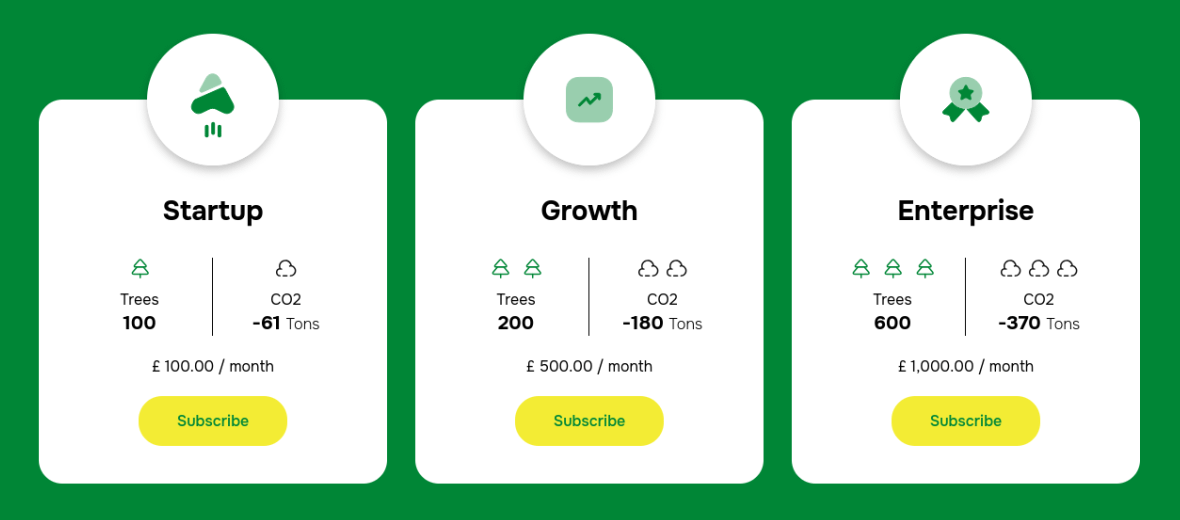
Where did those figures come from?
Evertreen: Pricing.
Our published plans are Startup £150/month for 100 newly planted trees each month, Growth £300 for 200, and Enterprise £900 for 600 — £1.50 per tree at each tier. The same flat per-tree rate is what we offer companies entering larger partnerships. One-off purchases are priced differently: our subscription rate is discounted to reward recurring support. Prices also differ by currency, and negotiated corporate pricing will not always match a published figure.
Our earlier reply said the £100/£500/£1,000 figures were “not our prices”. We withdraw that statement: it was meant to convey that we do not operate a single price list, and it was too absolute as written. Your screenshot shows what our page displayed on 18 December 2025. Our pricing is held in our platform database rather than in versioned files, so we cannot reconstruct that page from records.
REDD-Monitor: When I wrote the post about Evertreen in December 2025, Evertreen’s General Terms and Conditions of Service included the statement that “The Client irrevocably waives the right to refunds, chargebacks, or payment disputes once a transaction (initial or renewal) is processed.” Here's an archived copy of the terms and conditions.
When and why did Evertreen amend section 7 of the terms and conditions, “Cancellation and Refunds”?
Evertreen: The refund clause.
Our website terms, including section 7, were replaced with a new version on 9 June 2026, following our regular internal review of our terms. The new section 7 sets out the cancellation and refund position in full. Refunds were issued through Stripe while the earlier wording was in our terms, as they still are.
Our subscription agreement, the document each subscriber signs, had its own renewal paragraphs containing a similar waiver. In September 2026 those paragraphs were replaced with wording consistent with section 7, including that nothing in the agreement removes the subscriber’s right to raise a dispute with their bank or card provider. We will not rely on the earlier wording for any subscription.
REDD-Monitor: In December 2025, Evertreen was selling carbon credits from projects that had been suspended from Verra’s registry. I note that Evertreen has removed its webpage about Colombia. However, the webpage about Brazil still includes the Evergreen REDD project, which is listed as “On hold” on Verra’s registry. The Rio Anapu-Pacajá REDD Project is also listed as “On hold” on Verra’s registry. That’s two examples of projects that Evertreen has not removed despite them being under review. Why have these not been removed from Evertreen’s website?
Evertreen: Projects under review.
Our Brazil page named the Evergreen REDD+ Project (VCS 2539) and the Rio Anapu-Pacajá REDD Project (VCS 2252), both “On Hold” on the Verra registry, along with Fortaleza Ituxi (1654) and Unitor (2508). None was offered as a product in its own right. Rio Anapu-Pacajá was also among the projects described in a broader “Restoration in Brazil” product, which is closed to new customers (see answer 9). Each page now carries its registry status and the date it was checked.
Our Zimbabwe page described the Kariba REDD+ Project (VCS 902) as certified under Verra; Kariba’s registry status is Withdrawn, and that page now carries the correct status. Kariba was also described in a “Restoration in Zimbabwe” product, likewise closed to new customers.
On process: we review registry status with our legal team, through contact with the standards bodies, and by manual registry checks. That process was looking for suspension and withdrawal, and was checking pages that take payment. It was not catching “On Hold” or “Under Review” states on pages that are editorial rather than transactional. It now covers every registry state and every page.
We also re-checked everything we currently list, on 16 September 2026. Vida Manglar (VCS 2290) is “Late to Verify”; Tambopata (1067), Matavén (1566) and Conservation Coast (1622) show “Verification approval requested”. Those states are now shown on the pages rather than left for a reader to discover. Chestnut Carbon, which is at Gold Standard Certified Design stage and has never issued a credit, has been removed from sale and from our Gold Standard listing.
REDD-Monitor: Evertreen’s new webpage titled “Transparency” states that “planting is delivered by farmers and local partners engaged through non-profit implementing organisations”. But the webpage does not explain which non-profit implementing organisations these are. As far as I can tell, these non-profit implementing organisations are not listed anywhere on Evertreen’s website. Could you please provide a complete list of all the non-profit implementing organisations that Evertreen works with. Please organise the list by country and by tree-planting site in each country.
Evertreen: Implementing partners.
We contract with partner organisations, who deliver planting with local implementers and farmers. Each country’s project page names its implementing partner, the region, and whether the country is still included in our plans:
Madagascar — evertreen.com/projects/reforestation-in-madagascar
Italy — evertreen.com/projects/reforestation-in-italy
United Kingdom — evertreen.com/projects/reforestation-in-england
United States — evertreen.com/projects/restoration-in-the-usa
India — evertreen.com/projects/reforestation-in-india
Australia — evertreen.com/projects/reforestation-in-australia
Indonesia — evertreen.com/projects/mangroves-in-indonesia
Spain — evertreen.com/projects/seaforestation-in-spain
Mexico — evertreen.com/projects/reforestation-in-mexico
Brazil — evertreen.com/projects/reforestation-in-brazil
Nepal — evertreen.com/projects/reforestation-in-nepal
Honduras — evertreen.com/projects/reforestation-in-honduras
Kenya — evertreen.com/projects/reforestation-in-kenya
Where a partner changed, the page says so: in Mexico, for example, it records the previous partner and when that partnership ended.
To be precise about how the three parts of our work differ: in Madagascar, the trees we fund are planted by local farmers managed by our partner, in a planting programme run for Evertreen and financed by Evertreen; in our other planting countries we fund planting carried out by the independent local organisations named on each page; and certified carbon credits are purchased from third-party projects and resold, with Evertreen acting as an intermediary and not as the project developer.
Clause 2.1 of our terms sets out the same structure.
REDD-Monitor: You write that “every site is GPS-boundary-mapped, with drone mapping, permanent photo points, forest-inventory survivorship plots and community surveys”. Could you please show me one example of one of Evertreen’s tree planting sites with all of this data, along with information about how this data was collected and by whom.
Evertreen: Monitoring evidence.
To state it precisely: monitoring varies by site and by partner. Drone mapping is not available in every country we work in, as our About page notes, and our transparency page now says the same.
Rather than restate a general claim, here is the full record for one site — the Vohidahy Forest Project in Madagascar:
evertreen.com/projects/vohidahy-forest-madagascar
evertreen.com/trees/trees-in-madagascar-vohidahy
Implementing partner and its wider local network: named on the project page above
Field photography: 87 published photographs from our Madagascar planting sites, including Vohidahy and Kimony, taken by our partner’s team and by our own photographers on visits, at evertreen.com/gallery
Satellite monitoring: EOS Data Analytics, contracted since 2023
Our planting in Madagascar is not limited to Vohidahy: our partner plants in several areas of the country, and the project page sets out who planted where, including the sites planted before 2022. At Kimony, in western Madagascar, the planting is mangroves. For that site we hold drone footage, filmed in April 2026, showing the nursery, established planting and new planting under way: youtube.com/watch?v=Er8di4FE92g. In July 2026 a corporate client that financed planting there visited the site with our field team and our partner; photographs from that visit are in our gallery.
We would rather state a limit than imply there is none: that page says plainly that there is no registry, no carbon methodology and no third-party verifier attached to Vohidahy. What we sell there is tree planting; the project page also describes our partner’s work protecting the forest that is still standing, and we do not present either as a certified carbon credit.
You asked to see a site rather than read about one, which is a fair request, so here is the more useful answer: you are welcome to visit Vohidahy or Kimony. We will arrange it, you can walk the planting areas, and you can put your questions to our partner directly rather than through us. The offer is open and it does not expire with this exchange.
REDD-Monitor: Evertreen has slightly amended paragraph 2.3 of its General Terms and Conditions of Service. Paragraph 2.4 (as it is now labelled) reads as follows:
“Evertreen funds Projects that are either internally monitored by the Company or externally verified under recognised carbon standards, which may include Verra, Gold Standard or the Core CBL market. The mix of internally and externally verified Projects used for a given contribution is determined by Evertreen, and Evertreen will identify on request the standard applicable to a specific contribution.”
I note that you did not respond to this part of my post about Evertreen.
My concern is that Evertreen’s clients are buying carbon credits with no way of knowing in advance whether they will receive Verra or Gold Standard certified carbon credits, credits on the CBL market (which covers a wide range of registries), or credits that are “internally monitored” by Evertreen. The company appears to be making “internally monitored” equivalent to certified carbon credits.
This is further illustrated in the form at the bottom of every page on Evertreen’s website:
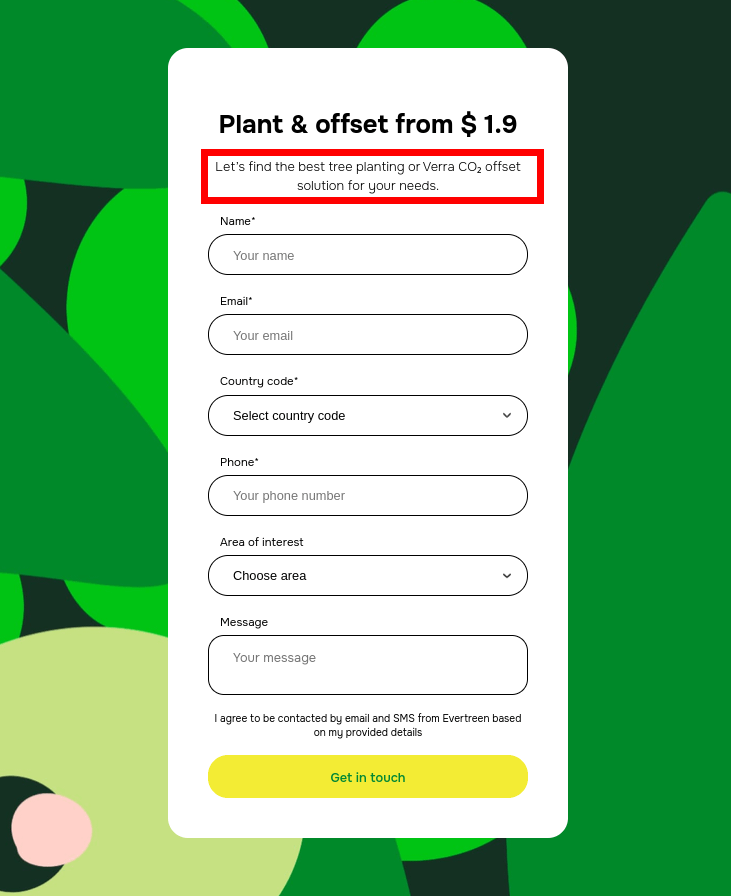
However, the tree planting credits that Evertreen offers are not third-party validated, verified, or certified. They are therefore not equivalent to Verra or Gold Standard carbon credits, or credits traded on the CBL market. Please explain what is going on here.
Evertreen: Certified credits and tree planting.
Our platform sells two distinct products. Certified carbon credits are sourced from third-party projects and retired on their registries. Tree planting is funded through our local partners and is not a certified credit.
Fifteen certified-credit projects had been classified under the tree section of our shop — Conservation Coast, Katingan Mentaya, Double Bar, Matavén, GreenTrees, TIST, Humbo, Vida Manglar, Mikoko Pamoja, EcoMakala, NicaForest, WithOneSeed, Vichada, Biodiverse Forests and Chestnut Carbon. That was a classification issue in how the catalogue was organised, not a difference in what was delivered: those purchases funded certified credits, and the applicable standard was named on each project page. Those still offered now carry their project name, standard and registry ID in the product name itself, and sit in the certified-credits section. Biodiverse Forests, whose crediting period has ended, and Chestnut Carbon have been withdrawn from sale.
The same applied to seven older products sold under names such as “Restoration in Brazil” or “Trees in Cambodia”, which funded credits from REDD+, forest-management and land-use projects in Brazil, Peru, Zimbabwe (Kariba), China, Cambodia (Keo Seima), DR Congo (Mai-Ndombe) and the United States. They are closed to new customers; allocations to existing clients have been drawn from credits we had already bought.
Tree products state that they are a contribution to tree planting and not a certified carbon credit. Credit products state that a credit is retired on the project’s registry, and that the registry’s own retirement confirmation and certificate can be issued in the client’s name on request — we need the retirement reason and an email address, and the document comes from the registry, not from us.
On clause 2.4: the wording provided for the applicable standard to be identified on request. It is now stated on the product page before purchase.
Our homepage shows trees funded and credits retired as two separate figures.
On the form at the foot of our pages: it names only Verra — it carries no Gold Standard or CBL option.
REDD-Monitor: I have been informed that following my post about Evertreen on REDD-Monitor, Luca Giordaniello, one of the co-founders of Evertreen, claimed that REDD-Monitor’s business model involves writing negative defamation then asking for money to have the post removed.
Needless to say, this is absolutely not true. I have never asked anyone for payment to remove a post. (On the other hand, I have been offered money to take down a post on REDD-Monitor. I posted the offer on REDD-Monitor, received no payment, and the original post is still available on REDD-Monitor.) I would be grateful for an acknowledgement that I have not asked Giordaniello for money — and an apology from him for making things up about me.
Evertreen: The remark about REDD-Monitor.
We would be interested to know what was reported to you, and by whom, though we appreciate you may not wish to say.
For context: the article appeared without any prior contact between us — as you have since confirmed, we had never worked together — and there was internal speculation among our team about why it had been written.
To be unambiguous: REDD-Monitor has not requested payment from us, and we are not suggesting that it has.
REDD-Monitor states openly that it is opposed to carbon trading. We have engaged with these questions on their merits regardless.
These answers are published in full at https://www.evertreen.com/transparency/redd-monitor-questions and we have made the changes described. We will not be providing running commentary beyond this, but this page will be kept accurate and corrected if anything in it turns out to be wrong. Anyone wanting registry serials, coordinates or certificates can write to partnerships(a)evertreen.com.
Interesting. What I gather from this is that Evertreen have reorganised the way they talk about their projects thanks to your thorough research! Noting that they appear to be engaging with your questions in a reasonable way and that most of their responses make sense. Also noting that you have made no comment on their responses. Did you draw any specific conclusions?