

“We live a social injustice because we have been dispossessed”
A new briefing documents how Indigenous Peoples in Peru lost their rights with the creation of the Cordillera Azul REDD project and the the Cordillera Escalera Regional Conservation Area.

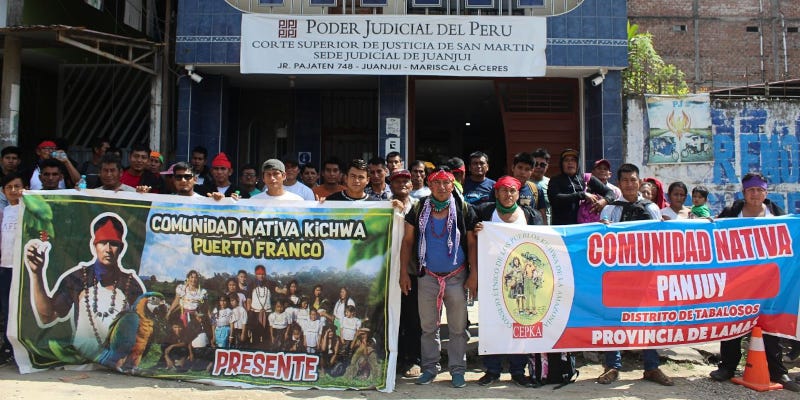
When the Peruvian government created the Cordillera Azul National Park in 2001, it did so without the free, prior and informed consent of the Kichwa Indigenous People living in and around the park.
When the Peruvian government created the Cordillera Escalera Regional Conservation Area in 2005, it did so without the free, prior and informed consent of the Kichwa people.
And when the Centre for Conservation, Research and Management of Natural Areas (CIMA), the organisation managing the park, created the Cordillera Azul REDD project, it did so without the free, prior and informed consent of the Kichwa people.
A new briefing summarises the resistance of the Kichwa people to the Cordillera Azul National Park and the Cordillera Escalera Regional Conservation Area. The briefing coincides with the IUCN World Conservation Congress which is taking place in Abu Dhabi from 9-15 October 2025.
The briefing is written by Matías Pérez Ojeda del Arco, Olga Cristina Gavancho León, Tom Younger, Marco Sangama, and Lara Domínguez Rush with contributions from Angela Mera Mejía, Nelsith Sangama, Helen Newing. It is published by the Federación de Pueblos Indígenas Kechua Chazuta Amazonas (FEPIKECHA), Instituto de Defensa Legal (IDL), Federación de Pueblos Indígenas Kechwas del Bajo Huallaga San Martín (FEPIKBHSAM), Consejo Étnico de los Pueblos Kichwa de la Amazonia (CEPKA), and Forest Peoples Programme (FPP).
The briefing includes the following five key points:
The situation of the Kichwa people of San Martin exemplifies how state-run protected areas can affect indigenous peoples’ use of and access to land, as well as their cultural practices. The Kichwa have been severely impacted by the creation of the PNCAZ [Cordillera Azul National Park] and ACR-CE [Cordillera Escalera Regional Conservation Area] on their traditional territories.
However, the Kichwa communities and their representative organisations have created agreements and proposals that promote rights-based conservation in Peru, transforming the traditional exclusionary model into a more intercultural and just one.
Faced with the Peruvian state’s failure to comply with indigenous rights and the lack of a willingness to engage in dialogue, the Kichwa people have chosen to strengthen their governance and control of their territories through autonomy and self-determination, including the self-demarcation of their ancestral territories within the protected areas.
Thus, the Kichwa struggle aims to transcend outdated paradigms of exclusionary conservation. Instead, their approach values the opportunities that conservation with a true rights-based approach will offer in the face of the state’s climate and biodiversity commitments.
In the face of the rollback of indigenous rights in Peru, international organisations and donors must strengthen their due diligence so as not to facilitate the violation of the human rights of the Kichwa and other indigenous peoples affected by the imposition of protected areas. It is therefore urgent to revolutionise the Peruvian protected areas authority’s concept of co-management towards one of restitution and respect for rights.
“We live a social injustice because we have been dispossessed”
In the briefing, Marisol García, the president of FEPIKECHA, writes,
We are tired of proving that we are a living culture . . . Indigenous peoples do not need to deforest to demonstrate ancestral possession. We live a social injustice because we have been dispossessed . . . there are wooden poles from old houses within the protected areas, the names of sites within the protected areas are Kichwa. Ankash yaku, Kuriyacu — what else? The fact that we were not recognised as communities at the time is not our fault. How many more years must we prove ourselves? We are not begging for justice.
In 2018, despite the violation of Kichwa territorial rights, IUCN included the Cordillera Azul National Park in its Green List, which IUCN describes as “a global standard for recognizing and promoting effective and equitable management of protected and conserved areas”.
The decision to include Cordillera Azul in IUCN’s Green List was reach without any discussion with the Kichwa or their representative organisations.
The briefing states,
Far from the PNCAZ’s [Cordillera Azul National Park] self-promotion and the glossy “natural climate solutions“ portfolios touted by the buyers of its carbon credit, in Kichwa territories, communities and organisations joined forces to reject dispossession and emphasise that environmental justice requires territorial justice.
In early 2025, IUCN confirmed that the Green List certification of the Cordillera Azul National Park had expired in October 2023. This followed an evaluation of the Kichwa’s complaint and an interim review of park by the Expert Assessment Group for the Green List.
In January 2017, IUCN bought 10,172 carbon credits from the Cordillera Azul REDD project to offset the emissions from the World Conservation Congress 2016. But IUCN has not made any public statements about the problems created by the Cordillera Azul National Park and REDD project.
Most of the carbon credits from the Cordillera Azul REDD project have been sold to Shell and TotalEnergies. “The Kichwa continue to reject a funding model for conservation that relies on financing from polluting companies,” the briefing notes.
Lawsuits and self-demarcation
The Kichwa have taken out a series of lawsuits to defend their collective rights. In September 2022, the Peruvian government created a Technical Committee to address the conflict with the Cordillera Azul National Park. but the Technical Committee was suspended in January 2023. The Committee ultimately failed because the Peruvian protected areas authority (SERNANP) and CIMA were not willing to address the Kichwa’s demands.
The Kichwa have developed new strategies including self-demarcation of their territories. The briefing states that,
Several communities in San Martín have already defined their polygons on areas that overlap with the PNCAZ [Cordillera Azul National Park] and the ACR-CE [Cordillera Escalera Regional Conservation Area], thus contributing to their presence in perpetuity.