


A new report published by Carbon Market Watch investigates the role that auditors play in the voluntary carbon market. In theory, third party audits are supposed to ensure so-called “high integrity credits”. But the report’s conclusions are damning:
We found that there are many gaps in the requirements of Verra’s auditors. Even more fundamentally, the details of Verra’s requirements for auditors de facto direct it not to assess project integrity or the quality of climate claims. All 15 of the analysed projects had been audited by two to four auditors. This totals 88 audits, in which auditors noted over 450 issues of highest severity and still greenlit all projects.
The report is written and researched by Rachel Rose Jackson and Adrien Tofighi-Niaki and is titled, “Verified but not trusted: Do audits ensure carbon credit quality?”
Jackson and Tofighi-Niaki used the Allied Offsets Database to select the three largest projects by volume of credits retired from the top five most used auditors between 15 July 2023 and 15 July 2026. All of the projects were on Verra’s registry.
Jackson and Tofighi-Niaki assessed the project performance of the 15 projects based on ratings by three carbon credit rating agencies: BeZero; Sylvera; and Calyx Global. They checked the projects against the Carbon Credit Quality Initiative (CCQI). They also conducted literature reviews into each of the projects and interviewed five independent experts on the voluntary carbon market or auditing.
93.4 million dodgy carbon credits
They found that 13 out of the 15 projects were “highly risky” based on the fact that they had two or three agency ratings that indicated a moderate to very low likelihood of delivering one tonne of carbon dioxide avoidance or removal for each carbon credit issued.
The remaining two projects of the 15 were “somewhat risky” because one ratings agency indicated a moderate risk of not delivering.
Jackson and Tofighi-Niaki write that,
Every project failed our methodological rigour assessment across various dimensions (additionality, permanence, etc.), indicating they were unfit to deliver the promised emissions reductions. Furthermore, all but three projects were run by project developers with notable and publicly known claims of harm or wrongdoing in relation to their business practices or the carbon credit projects they run, including claims related to land conflicts, human rights or sexual abuse.
In total, 94.3 million carbon credits were retired from these 15 project during the three year period covered by the report. “All 94.3 million carbon credits come from projects that lacked integrity,” Jackson and Tofighi-Niaki write.
The report presents a series of recommendations for standard setting organisations, auditors, policymakers, courts, regulators, and carbon credit buyers. “Boost transparency through complete and reliable audit documentation, and stop treating third-party verification as a quality check”, Carbon Market Watch summarises. “An auditors rubber stamp is not proof of good project performance,” Carbon Market Watch adds. “And it definitely is not a shield against greenwashing.”
The report points out that while these recommendations would help ensure that audits focus more on integrity, the voluntary market market faces vast and systemic structural issues.
These structural issues “are much bigger than how audits are conducted, and fundamental questions about the role of the VCM in climate action need to be further scrutinised given the evidence”, Jackson and Tofighi-Niaki write.
Ten dodgy REDD projects
Ten REDD projects are included in the 15 projects selected for investigation in the report. These include the two largest projects in the world for the three year period — Katingan and Mai Ndombe.
The Katingan Peatland Restoration and Conservation project in Indonesia, received an AA rating from BeZero and Sylvera but Tier 2 from Calyx. Jackson and Tofighi-Niaki describe it as a “somewhat risky project”. Between 2016 and 2026, the project was validated and verified nine times by three different auditors. The auditors raised 94 findings under Verra’s standards. On CCQI, the project scored “very low” on additionality/vulnerability, non-permanence, and quantification. Between 15 June 2023 and 15 June 2026, more than 22.8 million carbon credits were retired from this project. The independent expert review found that the project fails on inflated baselines and overcrediting. The project has also faced issues of land conflicts and dispossession as well as fires.
The Mai Ndombe REDD project in the Democratic Republic of Congo “failed every integrity assessment in this study despite being validated and verified six times by four different auditors between 2012-2025” the report states.
The auditors raised 81 findings under Verra’s standards. Between 15 June 2023 and 15 June 2026, more than 19.7 million carbon credits were retired from this project. All three agencies indicated that the project had a low likelihood of delivering one tonne of CO₂e avoidance or removal. On CCQI, the project scored “very low” on additionality/vulnerability, non-permanence, and quantification. The project has resulted in land conflicts, evictions, and human rights abuse.
The Keo Seima REDD project in Cambodia received BBB ratings from BeZero and Sylvera and Tier 3 from Calyx. On CCQI, the project scored “very low” on additionality/vulnerability, non-permanence, and quantification. Between 2014 and 2023, the project has been validated and verified five times by two different auditors. The auditors raised 173 findings under Verra’s standards. Between 15 June 2023 and 15 June 2026, more than 6.8 million carbon credits were retired from this project. The independent export review found that the project fails on inflated baselines and overcrediting.
The project faces on-going deforestation and a failure to respect the rights of the Bunong Indigenous People who live in the project area.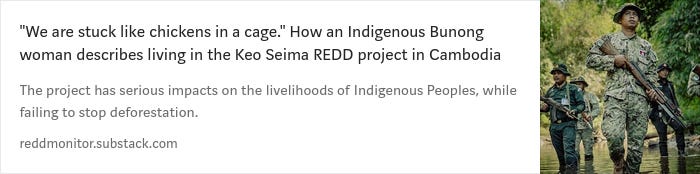
The Envira Amazonia project in Brazil received a BBB rating from BeZero, a BB rating from Sylvera, and a Tier 3 rating from Calyx. On CCQI, the project scored “very low” on additionality/vulnerability, non-permanence, and quantification. Between 2015 and 2022 the project has been validated and verified five times by three different auditors. The auditors raised 114 findings under Verra’s standards. Between 15 June 2023 and 15 June 2026, more than 5.6 million carbon credits were retired from this project.
The independent expert review found that the project fails on inflated baselines and overcrediting. The project has resulted in community exclusion and evictions.
The Cordillera Azul REDD project in Peru “failed every every integrity assessment in this study despite being validated and verified six times by three different auditors between 2013-2023”. The auditors raised 53 findings under Verra’s standards. Between 15 June 2023 and 15 June 2026, more than 5 million carbon credits were retired from this project. On CCQI, the project scored “very low” on additionality/vulnerability, non-permanence, and quantification. The independent expert review found that the project fails on inflated baselines and overcrediting.
The project resulted in displacement and community threats, grievances and court cases, as well as involving controversial financial practices.
The Kuamat Rainforest Conservation project, Malaysia received an A rating from BeZero and Sylvera, but a Tier 2 rating from Calyx. Between 2023 and 2025, the project has been validated and verified three times by two different auditors. The auditors raised 94 findings under Verra’s standards. Between 15 June 2023 and 15 June 2026, almost 5 million carbon credits were retired from this project. On CCQI the project scores “very low” on quantification and “low” on additionality/vulnerability, and non-permanence.
The independent expert review found that the project fails on inflated baselines and overcrediting. The project has resulted in land conflicts and dispossession.The Kariba REDD project in Zimbabwe “failed every integrity assessment in this study despite being validated and verified seven times by three different auditors between 2012-2022”. The auditors raised 424 findings under Verra’s standards. Between 15 June 2023 and 15 June 2026, more than 4 million carbon credits were retired from this project.
On CCQI the project scored “very low” on additionality/vulnerability, non-permanence, and quantification. The independent review found that the project fails on inflated baselines and overcrediting. The project has faced community exclusion, land conflict, and low transparency.
Following a series of investigative reports exposing serious problems, Verra suspended the project. Verra conducted a review that lasted two years that found the project issued 15.2 million fake carbon credits.
Eight months later, another Verra review concluded that the auditors, “could not identify evidence of a breach of Verra’s rules in the three areas they examined for that time period: trophy hunting, benefit sharing, and financial compliance”. Jackson and Tofighi-Niaki note that, “This indicates that auditors followed the established procedures, which were insufficient to the extent that they enabled the repeated validation and verification of what is very likely one of the worst-performing carbon credit projects in the VCM.”
The Pacajai / ADPML Portel-Pará project in Brazil received a D rating from Bezero, a B rating from Sylvera, and a Tier 3 rating from Calyx. Between 2013 and 2020 the project was validated and verified three times by two different auditors. The auditors raised 93 findings under Verra’s standards.
On CCQI, the project scored “very low” on additionality/vulnerability, non-permanence and quantification. The independent expert review found that the project fails on inflated baselines and overcrediting.
The project has resulted in land conflicts, lack of free, prior and informed consent, and controversial financial practices. Between 15 June 2023 and 15 June 2026, more than 2.9 million carbon credits were retired from this project. For most of this period, the project was suspended by Verra.
(There’s also the fact — not mentioned in the Carbon Market Watch report — that the company running the project was set up by the sons of Kenneth Noye, infamous for his role in the 1983 Brink’s-Mat gold heist in London.)
The Kulera Landscape REDD project in Malawi received a BB rating from BeZero, and AA rating from Sylvera, and a Tier 3 rating from Calyx. Between 2014 and 2020, the project has been validated and verified three times by two different auditors. The auditors raised 67 findings under Verra’s standards. Between 15 June 2023 and 15 June 2026, more than 1.8 million carbon credits were retired from this project.
On CCQI, the project scored “very low” on additionality/vulnerability, non-permanence, and quantification. The independent expert review found that the project fails on inflated baselines and overcraediting.The Ntakata Mountains REDD project in Tanzania has a BBB rating from BeZero and Sylvera, but a Tier 3 rating from Calyx. Between 2020 and 2026, the project has been validated and verified five times by two different auditors. The auditors raised 193 findings under Verra’s standards. Between 15 June 2023 and 15 June 2026, more than 1.7 million carbon credits were retired from this project.
One auditor of the project approved a zero fire risk rating for the project despite having actually seen a fire during the site visit.
On CCQI, the project scored “very low” on additionality/vulnerability, non-permanence, and quantification. The independent expert review found that the project fails on inflated baselines and overcrediting. The project faces problems of community exclusion and low transparency on benefits.


Verra's response to Carbon Market Watch's report is available here: https://verra.org/verra-views/integrity-requires-scrutiny-and-careful-consideration-verras-response-to-carbon-market-watch/
Surprise, surprise! Verra dismisses the criticism:
"The report’s sample is limited in scope. It sampled only 15 of 2,889 registered VCS projects, so really just 0.5% of these projects.
"It highlights cases that may warrant closer examination, but it cannot establish with statistical certainty how often auditors have underperformed across Verra’s programs or the wider market."