

Why the Ngorongoro Conservation Area in Tanzania “cannot be a World Heritage Site and an eviction zone”
Open letter from the Oakland Institute to the World Heritage Committee.

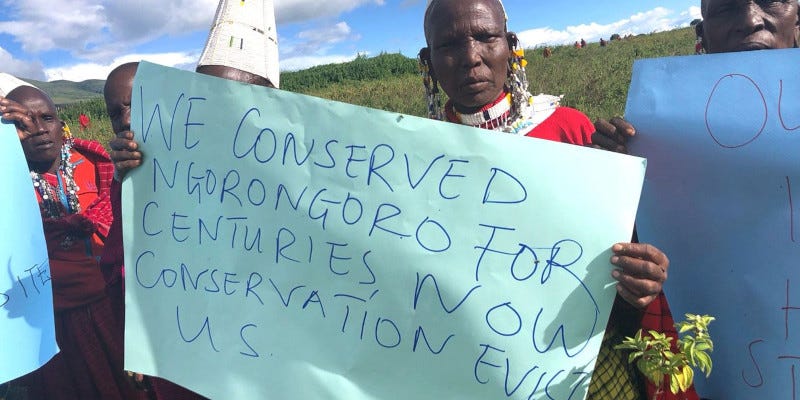
Last week, REDD-Monitor wrote about a decision the World Heritage Committee will take at this year’s meeting in South Korea regarding the Ngorongoro Conservation Area in Tanzania. Ngorongoro is a UNESCO World Heritage Site, but the Maasai Indigenous People living there are facing mass evictions.
Last week’s post featured a petition from Survival International with the message to the World Heritage Committee that,
Ngorongoro is Maasai land and they have protected it for generations. No place where such abuse occurs deserves the title of World Heritage Site. Delist NCA now. Stand with the Maasai.
The post also featured a letter from the Maasai International Solidarity Alliance to the World Heritage Committee, calling on them to respect Indigenous Peoples’ rights and international law.
On 19 July 2026, the Oakland Institute published an open letter to the World Heritage Committee. The Oakland Institute points out that Ngorongoro cannot be a World Heritage Site and an eviction zone.
The letter is posted here in full:
Open Letter to the UNESCO World Heritage Committee Ahead of its 48th Session in Busan, Republic of Korea | July 19–29, 2026
The Oakland Institute, 19 July 2026
Dear Members of the UNESCO World Heritage Committee,
Ahead of the 48th Session of the World Heritage Committee, the Oakland Institute calls upon the Committee to confront the ongoing human rights violations against the Maasai in the Ngorongoro Conservation Area (NCA).
The NCA continues to enjoy World Heritage status while the Indigenous Maasai people – whose stewardship preserves this globally celebrated landscape – face dispossession, coercive relocation, and systematic violations of their rights. If UNESCO cannot ensure that the World Heritage designation protects the rights of its Indigenous custodians, then the Committee must remove the Ngorongoro Conservation Area from the World Heritage List.
The Oakland Institute has extensively documented how the Tanzanian government has used “conservation” as a cover to restrict Maasai livelihoods and deny access to essential services, to force Indigenous residents from their ancestral lands, turning their heritage into a playground for safari tourists.
UNESCO maintains that “forced evictions are unacceptable and incompatible with international human rights law and related international obligations,” in Ngorongoro. Yet, the Committee’s draft decision for its upcoming 48th Session once again falls far short of upholding Indigenous land rights. While it calls for “full and effective consultation” before moving away from the Multiple Land Use Model, it does not require the Free, Prior and Informed Consent (FPIC) of the Maasai. By failing to reject relocation and treating consultation as sufficient, the draft decision effectively legitimizes the continued forced displacement of the Maasai.
For years, Committee decisions have portrayed the presence of Indigenous pastoralists as a threat to conservation, endorsing measures to reduce the resident population while allowing the construction of luxury lodges and the increase of safari trucks and tourists entering the area by millions. In doing so, the Committee has lent international legitimacy to policies that have steadily stripped the Maasai of their rights. The Tanzanian government has publicly stated that its campaign against the Maasai in Ngorongoro results from UNESCO recommendations. UNESCO cannot continue to oversee a World Heritage Site while ignoring violations against the Indigenous custodians.
Despite mounting international criticism, the Tanzanian government continues to pursue mass relocation. This year, two Presidential commissions – established after widespread Maasai protests in 2024 – purported to investigate the crisis. Instead, they endorsed the government’s relocation policy, relied on demonstrably false claims that Indigenous pastoralism drives environmental degradation, and ignored evidence that expanding tourism infrastructure – including luxury lodges, roads, and commercial development – poses far greater ecological pressures. The Oakland Institute has exposed that these land commissions were neither independent nor impartial; they rubber-stamped continued displacement while ignoring coercion and intimidation tactics, restrictions on essential services, and the denial of meaningful community participation. The Tanzanian government’s latest goal of total displacement – under the excuse of World Heritage Site – is a profound indictment of UNESCO’s approach against Maasai people in Ngorongoro.
The Maasai have made their position unmistakably clear. As their representatives have stated:
“If respect for human rights and coexistence cannot be ensured, the continued existence of Ngorongoro as a World Heritage Site should be conditional upon respecting Indigenous communities in Ngorongoro as the legitimate and primary rights holders of Ngorongoro.”
The Oakland Institute fully endorses this position. For years, the Committee has failed to use its influence to prevent escalating human rights violations. Any heritage status that requires the removal of Maasai Peoples from their ancestral lands to preserve a landscape they helped create and sustain stands in direct contradiction to the principles of human dignity, equality, and justice.
The continued pursuit of the mass displacement of more than one hundred thousand members of a protected population constitutes a violation of international human rights law. UNESCO is bound by its obligations under international law to ensure that such violations are neither enabled nor perpetuated in its name.
Allowing Ngorongoro to retain its World Heritage status despite the ongoing dispossession of its Indigenous custodians lends legitimacy to the Tanzanian government’s actions. The World Heritage status of Ngorongoro must be grounded in the inherent dignity, human rights, and continued existence of the Maasai in Ngorongoro. Unless these rights are fully respected and protected, the Committee should remove the Ngorongoro Conservation Area from the World Heritage List.
The Committee's draft decision is still leaning on a framing that rangeland science abandoned decades ago. Moringe ole Parkipuny was making this exact case to the UN back in 1989 — that the Maasai were being blamed for "degrading" land they'd managed sustainably for generations while conservation revenue bypassed them entirely. Since Sandford (1983) and Ellis & Swift (1988), the non-equilibrium ecology literature has shown that in semi-arid rangelands like Ngorongoro, rainfall variability — not grazing pressure — drives vegetation dynamics, and drought keeps herds well below any theoretical "carrying capacity." Overgrazing-driven degradation is the exception, localized around wells and boreholes, not the rule. "Consultation" without FPIC isn't a compromise — it's the same relocation logic with better PR. Delist or hold the line on FPIC; there's no third option that respects both the science and the people who've been managing this landscape the longest.