

Crooked Carbon Business: Ecomapuá Amazon REDD Project, Pará, Brazil
Ecomapuá Conservação is selling carbon credits from land that overlaps two Extractive Reserves, which are protected and publicly-owned.

This week’s briefing by Simon Counsell and Jutta Kill looks at the Ecomapuá Amazon REDD Project in the state of Pará, Brazil.1 The briefing can be downloaded here:
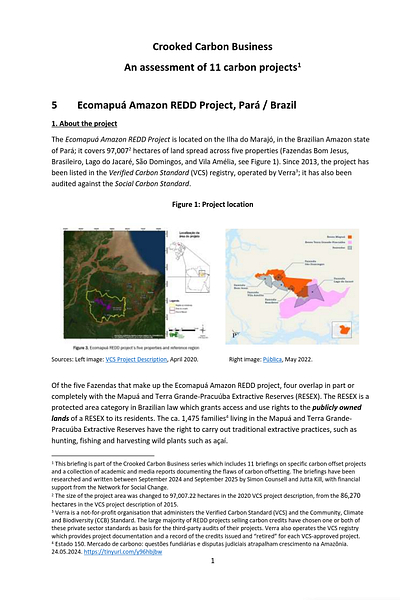
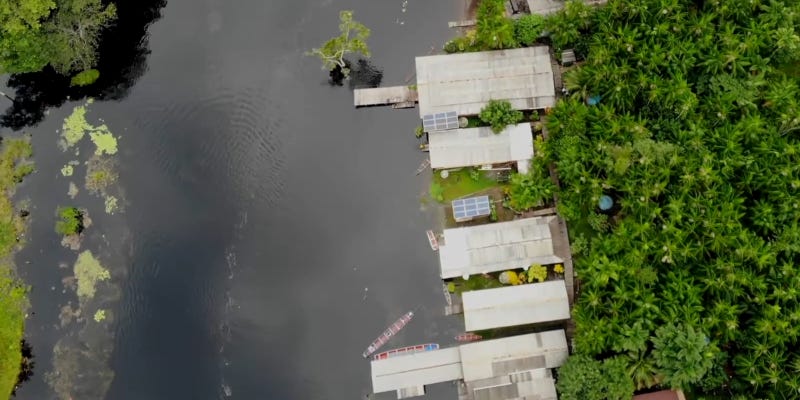
The project covers an area of almost 100,000 hectares on the Ilha do Marajó in the state of Pará. The project is about 150 kilometres from Belem, where COP30 is currently taking place.
Five properties make up the project, Fazendas Bom Jesus, Brasileiro, Lago do Jacaré, São Domingos, and Vila Amélia. The project started in 2002. In February 2013, a company called Sustainable Carbon produced the Project Description Document. The project has been listed on the registry of the Washington DC-based carbon certifying company Verra since 2013. The current status of the project is “Late to verify.”
The project has generated more than 2 million carbon credits. Buyers include Banco Santander do Brasil, Instituto Unibanco, the Brazilian branch of Deloitte, the maritime service provider Swire Pacific Offshore, Air France, the Inter-American Development Bank, Nespresso, Rabo Bank, British Gas owner Centrica, and the International Air Transport Association (IATA).
Extractive Reserves (RESEX)
The project area overlaps with two Extractive Reserves (Reserva Extrativista in Portuguese or RESEX): RESEX Mapuá and the RESEX Terra Grande-Prachuúba. Extractive Reserves are type of protected area in Brazilian law. The land is publicly owned but the people who live there have the right to carry out traditional extractive practices, such as hunting, fishing, and harvesting wild plants.
In December 2021 and again in May 2022, Anna Beatriz Anjos, a journalist with the Brazilian investigative journalism agency Pública, wrote about the Ecomapuá REDD project. REDD-Monitor wrote about the project in May 2022, based on the Pública articles:

Pública calculated that 65% of the REDD project overlaps with the Extractive Reserves. None of the project documents prepared by project proponents mention the overlap with the Extractive Reserves. The first mention of the overlap in documents submitted to Verra comes in 2020, 17 years after the project started.
In its audit report, Carbon Check (India) Private Ltd writes that,
The total overlapping area between the project area and both Federal Conservation Units is of 64,187ha, approximately 74% of the Project area.
On the same page of the audit report Carbon Check states that 60% of the project area overlaps with the Extractive Reserves.
Pública produced a map to illustrate the overlap:

The Rural Environment Registry (Cadastro Ambiental Rural, CAR) lists the Fazendas Lago Jacaré and Brasileiro as “suspended”:
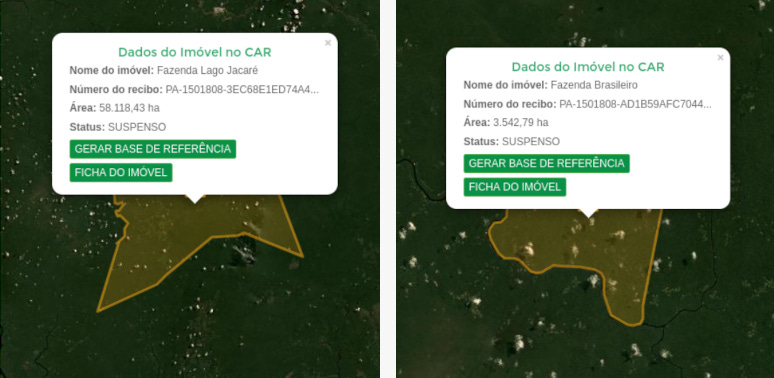
Pública reports that two of the other Fazendas (São Domingo and Vila Amélia) were cancelled in September 2010.
In February 2022, the real estate notary office of the municipality of Breves, the 1º Ofício de Breves, issued a statement confirming that the registrations of all five Fazendas had been, or were in the process of being, cancelled.
Overcrediting
Project documents argue that in the absence of the project subsistence agriculture would be a “driving force of deforestation in the project area”. The main reason for the focus on subsistence agriculture as the driver of deforestation is that logging operations had been banned in the project area — before the REDD project started.
Until July 2001, Ecomapuá Conservação Ltda, the company running the REDD project was called Santana Madeiras Ltda. As the name suggests, it was a logging company. When the company changed to a conservation company, the owner, Chan Lap Tak, banned logging.
The reference area does not include any Extractive Reserves. Counsell and Kill write that,
[D]eclaration of public lands as protected areas with RESEX status affects how the land inside the RESEX can be used. This would render deforestation dynamics in a reference area that is not a RESEX a poor baseline for the deforestation supposedly avoided by the Ecomapuá Amazon REDD project.
The Carbon Check auditors, in their 2020 report, question the “suitability of the baseline deforestation model adapted”.
The annual deforestation rate predicted for the monitored period in the reference region is 3.35%. This is much higher than the observed in the monitored period (0.47%) and suggests a significant overestimation of the baseline.
The deforestation in the project area was 0.43%, which is very similar to the 0.47% rate of deforestation in the reference area. Deforestation in the leakage area was also similar, at 0.45%.
BeZero, a carbon credit rating company, has given the Ecomapuá project a “C” rating, indicating a “a very low likelihood of achieving 1 tonne of CO₂e avoided or removed”. Renoster rated the project’s emission reduction claims as “suspect” and stated that the “project scores poorly across a wide range of critical review criteria”.
A timeline: the legal case and a complaint to Verra
In April 2023, the Association of Residents of the Mapuá Extractive Reserve (Amorema) took legal action against the proponents of the Ecomapuá Amazon REDD project. Amorema alleged that the companies were profiting from sales of carbon credits generated on land that is publicly owned.
The companies also made false claims about using the money from carbon credits to the benefit of the communities in the project area. Amorema pointed out that the project documents were not even available in Portuguese.
Amorema called for the carbon credits to be cancelled.
In September 2023, Carbon Market Watch submitted a complaint to Verra about several REDD projects, including Ecomapuá. Carbon Market Watch wrote that the auditors, “did not ensure that ‘discrepancies with regard to land ownership’ were resolved prior to verification, as the policy requires. Moreover, the auditor did not assess the implications of this overlap in relation to the risks for affected communities.”
In May 2024, Amorema’s case was dismissed because of a dispute between courts about the mandate to hear the case.
In October 2025, Amorema called on federal authorities to investigate their allegations against Ecomapuá and ensure the safety of community members and leaders.
This is the fifth in a new collection of posts on REDD-Monitor under the headline “Crooked Carbon Business”. The posts are based on a series of briefings about carbon offset projects written by Simon Counsell and Jutta Kill.