

Crooked Carbon Business: Livelihoods’ Mangrove Restoration project in Senegal
Substandard wages for villagers. Carbon credits for corporations.

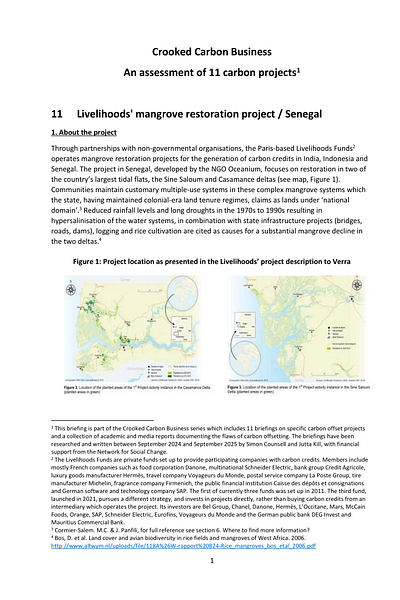
This week’s briefing by Simon Counsell and Jutta Kill looks at the Livelihoods’ Mangrove Restoration project in Senegal.1 The briefing can be downloaded here:
The Paris-based Livelihoods Fund was created the French multinational food-products corporation Danone with the Ramsar Convention on Wetlands and IUCN in 2008. It was then called the Danone Fund for Nature. One of its first projects was a mangrove restoration project in Senegal.
In 2011, the Fund was rebranded as the Livelihoods Carbon Fund and several other corporations joined the fund, including Schneider Electric, Crédit Agricole, Michelin, Hermès, SAP, CDC Climat, La Poste, Firmenich, Voyageurs du Monde, and Eurofins.
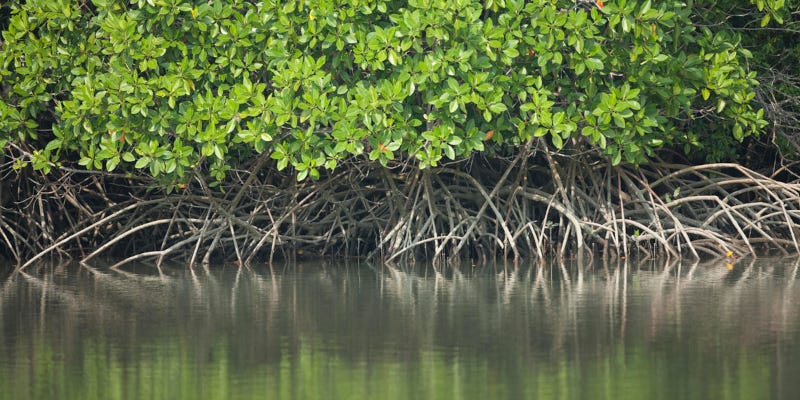
The mangrove project in Senegal is carried out by an NGO called Océanium de Dakar. The project focuses on mangrove planting in the Sine Saloum and Casamance deltas.
Counsell and Kill write that,
Communities maintain customary multiple-use systems in these complex mangrove systems which the state, having maintained colonial-era land tenure regimes, claims as lands under ‘national domain’. Reduced rainfall levels and long droughts in the 1970s to 1990s resulting in hypersalinisation of the water systems, in combination with state infrastructure projects (bridges, roads, dams), logging and rice cultivation are cited as causes for a substantial mangrove decline in the two deltas.
Reforestation under the Livelihoods’ Mangrove Restoration project took place from 2009 to 2012 on an area of 10,415 hectares. The project was initially registered as a Clean Development Mechanism project and subsequently under Verra’s carbon certification system. Almost 500,000 carbon credits have been issued by the project.
Corporate members of the Livelihoods Fund use the carbon credits from the Fund’s projects to “offset” their emissions. Some carbon credits have been sold to other companies.
BeZero, the carbon offset rating agency, rated the Senegal project as “BBB”, indicating “a moderate likelihood of avoiding or removing 1 tonne of CO₂e”. BeZero explains that, “the project faces significant risk of non-permanence, driven by high salinity and other natural and anthropogenic hazards; and notable over-crediting risk, due to potential over-estimation of soil carbon.”
The impact of the project
Océanium describes the mangrove restoration project as a success in brochures and monitoring reports to Verra. Océanium claims that more than 300,000 villagers from 340 villages have been involved in planting mangroves under the project.
In 2024, investigative journalist Jack Thompson travelled to Senegal and interviewed villagers in the project area. In an article for Hakai Magazine, Thompson wrote that,
International companies and NGOs pay local workers substandard wages, obscure their own finances, and rarely involve communities in project designs. Local communities also receive no share of the revenue generated by the projects they contribute to, aside from meager wages for planting mangroves.
While villagers mentioned an increase in oysters and shellfish in the mangroves and higher yields from their beehives, they feel exploited by the project. “We know it’s the NGOs and their partners who are earning millions, not use,” one woman told Thompson.

Planting mangroves is hard work. Women told Thompson that they started the planting work at 5 am. They often cut themselves on sharp shells and roots. They were unaware that the project was funded by European companies with large annual profits.
The project budget was US$4.4 million, paid to Océanium. Communities were paid US$22 per hectare restored. The total amount paid to communities amounts to only 5.2% of the project budget.
Colonial conservation
Counsell and Kill write that,
The Livelihoods Funds mangrove restoration project in Senegal also bears hallmarks of a troubling characteristic of land-based and mangrove carbon projects: They perpetuate colonial patterns of domination by describing customary users of the land as incapable of restoring the mangrove systems without the support of (white) outsiders. This is no coincidence because carbon projects must present a story that without the intervention of the project proponent (which is almost never a local organisation / company, or the community itself), the mangroves would not have been restored.
For the mangrove restoration project to generate carbon, Océanium has to tell a story of a deforestation threat or of degraded mangroves — that the community cannot address without the NGO’s help.
Océanium did not restore a mangrove forest. Villagers told Thompson that the mangroves are a plantation. “There’s nothing natural about it,” one of the villagers said.
Marie Christine Cormier-Salem is a senior researcher at the French National Research Institute for Sustainable Development and has studied Senegal’s mangroves for several decades. In a 2016 paper written with her colleague Jacques Panfili, she argues that,
[T]he extensive planting of a single mangrove species, Rhizophora mangle, is a means of green grabbing. The buying of carbon offsets by industrial conglomerates has disempowered local communities . . .
In addition the planting of Rhizophora monocultures is slowing the natural regeneration of other mangrove species in the Saloum delta. Cormier-Salem told Thompson that the monocultures are less resilient to disease and extreme weather that natural, more biodiverse mangrove forests.
A 2014 verification report of the project found almost total loss of tree cover in one-quarter of the sample plots measured. The reason was the choice of Rhizophora instead of the more resilient species, Avicennia. The auditor recommended planting with Avicennia. But Avicennia is considerably more expensive because it has to be grown in a nursery before it can be planted out. The next audit, carried out in 2021, found that no such replanting had happened.
This is the eleventh in a collection of posts on REDD-Monitor under the headline “Crooked Carbon Business”. The posts are based on a series of briefings about carbon offset projects written by Simon Counsell and Jutta Kill.
Is there something structural in the market that could be done to prevent this? It seems having some centralized global governance could go along way (assuming low corruption) as otherwise this seems all dependent on local authorities.