

“Economists have had more influence on climate policy than atmospheric scientists. I think that should cause everyone to pause and consider whether that’s for the best.” Interview with Nat Dyer

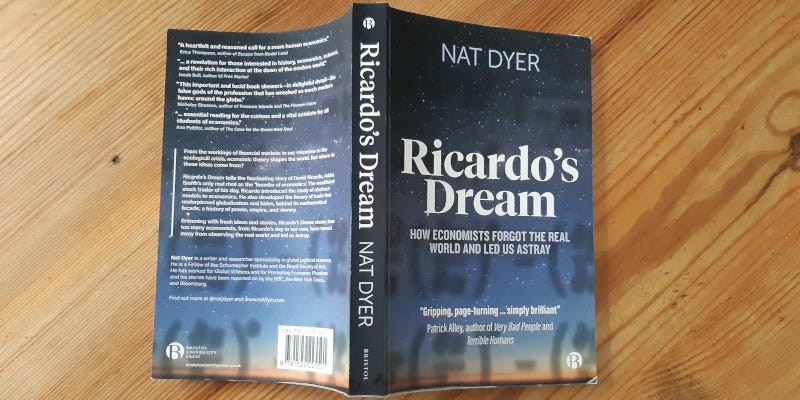
Interview with Nat Dyer, author of the book “Ricardo’s Dream: How economists forgot the real world and led us astray”. The interview was conducted online on 4 August 2025.
REDD-Monitor: First of all, congratulations on the book. I really enjoyed reading it. And it’s not often I can say that about a book about economics!
Can you start by explaining who you are, a bit about your previous work, and why you decided to write a book about David Ricardo.
Nat Dyer: Thanks, Chris. I’m an author based in Southwest England. I’ve worked for various NGOs on issues such as deforestation and forest people’s rights, including working on REDD for a few years. I’ve worked on corruption in mining and oil, including the role of offshore tax havens. And then more recently on breaking apart the dominance of one strain of economics teaching.
My interest in economics stemmed from what I saw working in these other areas. A lot of the justifications for the ecological and corporate abuses that I worked on ultimately stemmed from bad economics. And so I decided to write the book.
For those who haven’t necessarily studied economics, it’s a subject, that intimidates or bores quite a lot of people. So I was attempting to write about it in a fresh and vivid way.
I wrote a book about David Ricardo first, because he was quite a fascinating character, but second, I argue that he’s the originator of very bold, sweeping, influential theories about the world that are actually wildly detached from reality. And that is, I think, a good story in itself, but also a good analogy for how bad economics has made smart people unable to see the reality of the ecological situation, and led us astray in areas such as finance, trade and corporate power.
REDD-Monitor: Comparative advantage is one of the main things that Ricardo is famous for. Can you briefly run through Ricardo’s explanation of the trade in Portuguese wine and English cloth, which is the model that Ricardo used to explain comparative advantage? And can you explain what’s missing from what appears to be a very simple model?
Nat Dyer: Comparative advantage is the model and theory often used to defend why international trade, indeed all trade, is win-win and beneficial. It’s often known as the crown jewel of the profession, one of the deepest truths, or the most beautiful theories of economics. I think in recent decades, it’s almost been the essence of an economist to subscribe to comparative advantage and to agree — in public, at least — that international trade is always positive.
David Ricardo demonstrated this theory through a classic explanation of two countries trading two commodities. The countries were England and Portugal, and the commodities were cloth and wine. He produces a very simple model that shows how efficient each country was at producing each commodity. Even though in his theoretical model England is worse at producing both things, if you crunch the numbers in the way that he tells you to, England can still benefit through trading with Portugal.
The moral of the story is that each country should focus on what they are least bad at, or what they’re best at, and the uptick is that it doesn’t matter what you focus on. A country could specialise in exporting computer chips, or they could specialise in exporting potato chips, but ultimately it doesn’t really matter.
Now, the actual history and reality of trade is vastly different to this and I wanted to show that through looking at the very example that Ricardo used with England and Portugal. There was a trade in these two commodities between England and Portugal backed by one of the earliest trade deals.
Exports of both commodities did increase, but the trade was actually massively reliant on English naval power. Portugal was pulled by France in one direction and England in another direction and the fact that England had a powerful navy attracted Portugal to the English camp. The trade deal only came after a series of military treaties.
And then more importantly, England valued Portugal, not just for its own market, but for its colonial markets, because Portugal was one of the first European countries to have an empire outside Europe.
Portugal never exported enough wine to make up for the English cloth it imported. It made up that trade deficit with huge quantities of gold from its Brazilian colony. A lot of that Brazilian gold ended up in London for decades and decades.
In some ways that’s why the global regulation of gold is still controlled by London through the London Bullion Market Association’s Good Delivery standard. That is a consequence of this deep, deep history.
There’s one more element that’s excluded from Ricardo’s textbook model as the Brazilian gold was largely dug by enslaved Africans, taken from the West Coast of Africa. And a lot of the cloth that came down to Portugal was exported again to the West African coast.
Instead of seeing the England Portugal trade as this very positive story of win-win international trade, I ended up seeing it as an appendix to the transatlantic trade in enslaved Africans. Ricardo was writing only 10 years after Britain had outlawed the slave trade while still maintaining slavery itself, but he decides to completely ignore that.
I think it tells an interesting story about British economic development and also the selective vision of economists.
REDD-Monitor: You have a chapter in the book about economics and climate change, titled “Life: An Externality”. Why did you choose this title? Please explain what “externality” means in economics and what your take is on this.
Nat Dyer: I argue that economics has been incredibly influential in the way that we have responded to the ecological and climate crisis. This is potentially a surprise because economics has generally ignored the natural world for most of its existence. In the face of criticism that economics ignores the natural world, the answer has been to say that ecological problems can be dealt with by putting a price on them. This is the theory of externalities.
When two parties strike an economic deal, the basic theory is that neither party would do that unless it was in their own interest. Therefore that deal is win-win. They will both benefit. There are many problems with that theory, but that’s the basic idea.
But what about other people who are not part of that deal and either benefit or lose out? For example, if a new train station is built near your home, you might not have been involved in that decision, but the price of your house or flat, if you’re lucky enough to own it, might increase. That’s a positive externality. On the other side, you might have a negative externality. For example, an oil company decides to start drilling in the North Sea, and that very well might impact your life quality now or in the future. So that’s a negative externality.
The whole idea of an externality is the basis for cap and trade schemes and also for REDD. The idea is that if you get the price right, everything else will sort itself out. I am highly critical of that view, partly, I think, because it relies on a fantasy that markets work perfectly and that humans are these calculating machines, neither of which is true.
I called the chapter “Life: An Externality” because I wanted to point out how ridiculous it was to class the entirety of the natural world as an externality, as if it’s some sort of secondary importance. Whereas in reality, the entirety of the economy is nested within the biosphere of the earth and would cease to be if that biosphere couldn’t exist.
You might want to describe the idea of externalities in some ways as “elite common sense” now, but it hasn’t always been the way. There’s a book by Elizabeth Popp Berman called “Thinking Like an Economist”, which essentially looks at Washington DC from the 1970s to the 1990s. She talks about how when landmark environmental regulation was passed in the US, such as the Clean Air Act, economists were basically ignored and they went for a system that was about rules and regulations. But by the 1990s, they updated the Clean Air Act to bring in this economic style of reasoning, based on these externalities.
Her point is that people had to be taught to think in this way. Now it might seem natural to people in the World Bank and others, but it wasn’t that long ago that this was a completely alien idea.
So that history makes me think that people can be taught to think otherwise.
REDD-Monitor: The Rio conference took place in 1992, and you described the UNFCCC document that came out of that conference as a “radical document”. But, as you point out, there are no enforcement mechanisms. “And rules without consequences are just good advice,” you write, which I think is a very good way of putting it. One example of this from almost 30 years later, is the Glasgow Declaration on Forests. It’s yet another in a long line of UN declarations, which I would say are pretty much meaningless. So do you see any hope for the COP process to address the climate crisis?
Nat Dyer: Great question. I would say, if you go back and read some of the language in Rio around intergenerational equity or around the precautionary principle, then it sets out fairly clearly some of the problems and some of the ways to deal with them. But if you then compare that with the way that the World Trade Organization was set up just three years later in 1995, that was backed by a supranational court able to fine countries billions of dollars for breaking the rules.
And nothing like that has ever existed or even really ever been seriously considered, I don’t think, within the ecological and climate area. So there’s this massive disconnect between an apparent will, but actually not giving the organisations the tools they need to enforce it.
I attended the COP meetings for a few years starting in Copenhagen in 2009. And I do think that they have been in some ways a useful forum for discussion and attracting media attention. But it’s become, I think, undeniable, especially in the last few years, that they have just failed to do what is needed.
Especially looking at the figures about the rising number of fossil fuel lobbyists at the COPs, it’s clear that it has not worked and that we need a different approach to try and preserve the beauty and diversity of the world.
I’ve read your post on the Glasgow Declaration on Forests, and I think you do an excellent job of saying this is not unprecedented, we’ve been around this a few times. The caveat to that is I would like to have hope that we can find a way to halt the disruption of the beauty and diversity of the world.
One way to do that ultimately is with new stories and new understanding of humans’ relationship and intertwining with the natural world but that is much more difficult and maybe too abstract for some.
REDD-Monitor: The first COP I went to was in Argentina in 2004. I remember that it was very much like visiting a trade fair, with one stall after another of companies selling their so-called solutions. Very often they were the direct opposite of genuine solutions. I sat in on some of the negotiations and the trivial level of debate was astonishing. After the conference I wrote a piece titled “Climate change negotiations: Time for a change”.
If anything it’s got worse since then. I would agree with you that there are solutions to the crises we’re facing, but whether they’re going to come through the COP process, unless the COP process is dramatically reformed, I just can’t see it.
Nat Dyer: I agree. It just seems like an annual jamboree.
REDD-Monitor: Let’s get into some of the detail of the economics that you write about. In his 1920 book, “The Economics of Welfare,” Arthur Pigou argued that we should put a price on externalities. In the context of the climate crisis, this means putting a price on carbon, which is supposed to send a signal to reduce the amount of fossil fuels that we burn. Everyone, from the World Bank to the World Economic Forum to ExxonMobil, pretty much agrees that this is what we should do.
I have two questions for you about this. First, if this idea is so popular, why don’t we have a global price on carbon? And second, what’s your view on carbon pricing?
Nat Dyer: There are many different regional and national and even some international attempts at a carbon price, but as you say we don’t have a global market for carbon. One of the reasons why it’s not happened is that it’s a much easier idea to grasp in theory than it is to create in reality.
There’s a somewhat ignored economic theorist called Karl Polanyi, who argued that free markets are not spontaneous but need to be created and built. I think that’s what you saw with REDD and with carbon trading. The idea behind REDD is that you would have this slick market mechanism of one price and it would be vastly efficient, but actually it was a massive bureaucratic process to try and create a world in which the market could work, and that has been more tricky and complicated than the economic theory suggested.
You can see that for example it’s often worked poorly in the EU. There’s been massive inefficient carbon emissions through some of the EU trading mechanisms, often related to the over allocation of credits for political reasons.
I also think that you can’t write off the fact that carbon pricing has not been popular with the public.
My view on carbon pricing is ultimately that it was a costly narrowing of vision and it was a decades long unsuccessful policy detour that was actually a diversion from real solutions. As I said before, I think it relies on a fantasy version of the world with humans as perfect calculators and a market that works perfectly. Neither of which is true in reality.
It’s much better to look at ecological problems in the round rather than just pretending that one price can sort them all out.
REDD-Monitor: The Stern Review was one of the key reports that helped introduce REDD to the world. It was written by Nicholas Stern, who was the chief economist at the World Bank. REDD is basically an economists’ solution. It’s easy to see the appeal. Rich countries and big polluters can continue business as usual. And in theory, at least, it provides some money to conserve forests. Can you outline some of the things that have gone wrong with REDD that you discuss in the book, including the role of McKinsey?
Nat Dyer: You can see the appeal of REDD, especially if you are convinced that the economic theories are a useful guide to policy, because in theory, it’s almost a cliché of the low hanging fruit. It should allow you the most efficient way to reduce emissions. It’s seen as smart, whereas regulation is seen as top down and unresponsive to what people are doing.
I also agree with you that REDD is completely downstream from the economists’ vision of how the world should work. I’d be tempted to put in a word for Nicholas Stern as not as bad as some other climate economists. In some areas, he has been more realistic than others, such as William Nordhaus, who we might come on to discuss.
I haven’t worked on REDD itself for over 10 years and you are much more aware of some of the downsides than I am. But what was very interesting for me is that working on REDD was kind of a microcosm of the problems with this economic vision.
In the book I write about how when people believe in theory too much and don’t pay attention to reality, it leads to what Daniel Kahneman called “theory-induced blindness”.
Specifically with REDD, one problem is property rights. I focused on Central Africa and at the time 99% of the land was formally owned by governments. I don’t think it’s changed hugely. This was a hangover from colonial times and almost none of the forest was owned by local communities and Indigenous Peoples who live in the forest. If you are going to start having a system whereby the carbon in that forest generates money, how is that going to be shared?
And these forest communities, especially indigenous Bayaka communities are extremely politically marginalised. The idea that without making major political and land reforms, suddenly these communities are going to actually receive this money and benefit from it is complete pie in the sky thinking.
A second problem is related to the fact that, these reductions in deforestation and therefore emissions are being traded as offsets. This leads to the question: how can you tell that they are actually reductions? How can you tell that they’re not trading “hot air”? Ultimately, that is, I would say, a theoretical construct of comparing two hypothetical futures against each other. You have one hypothetical future with a REDD project and another hypothetical future with with no REDD project. Because they’re hypothetical futures, it’s quite easy through tweaking the assumptions to change those lines and then draw a ruler between the two and say, “Oh look, we’ve saved X tonnes of carbon.”
But there’s an incentive both for the people buying the credits and for the people creating the credits to have as many credits as possible. So you have a situation whereby rich countries or businesses in the North are able to continue polluting because apparently it’s being offset, but the offsets are fake, they’re not real.
There was a study that came out in 2023 that said 90% of voluntary carbon credits were actually phantom credits. They didn’t really exist.
You asked about McKinsey. That was a piece of work that goes back to 2010. The headline in Le Monde was “The evil geniuses of the forest.”
It was a piece of work we did looking at how McKinsey sold their very expensive consultancy services to a lot of developing countries, Papua New Guinea, DR Congo, Guyana, among others. They helped to create these REDD plans, or at least the basis for REDD, plans that was then used by these countries to lobby for REDD money.
A lot of the problems I’ve been discussing, including inflated baselines, were born out of the methodology and in the assumptions that McKinsey used.
For example, in Congo, McKinsey’s study said that they were going to decrease the logging density from 15 cubic metres per hectare to 10 cubic metres, but did not say that currently the legal harvest was between three to five cubic metres per hectare. So actually you’d be doubling the logging rate but apparently you’d be paid for reducing it.
And then, an even more well known example of inflated baselines — you covered this back in the day — as Guyana pretended that deforestation was going to massively increase so that the country could be paid to reduce it. Actually the reduction was going to be larger than the current baseline of deforestation.
These are a few of the many problems of REDD, which REDD-Monitor has done an excellent job of highlighting over the years.
REDD-Monitor: It’s interesting to me that one of the things that REDD proponents often say is that, “You’re talking about something that happened 10 years ago. It’s all changed since then.” But there was an editorial in Science Magazine just a few weeks ago about the conflict of interest that auditors face. Of course, Verra denies that this is a problem but the auditors are paid by the REDD project developers.
Nat Dyer: The global financial crisis is a good example of this type of conflict of interest. The ratings agencies were paid by the Wall Street companies and others to give a rating to their products. If they didn’t give them the AAA best ratings, it was possible for the Wall Street banks to take their business elsewhere. So they had a perverse incentive. In that situation, pension funds looked to these ratings as apparently independent guidance, but they were being hoodwinked.
The people ultimately buying the carbon credits are looking to these auditors for assurance but it’s not independent guidance.
REDD-Monitor: You write that “Despite the good intentions of many, the promise of a forest carbon market has failed.” I’d like you to expand a little bit on that, because I’ve heard a few times that “REDD is dead.” In 2013, Conservation International put out an SOS call to bail out REDD. REDD seemed to be basically finished. But more than 10 years later, REDD is still with us.
I agree with you that the forest carbon market has failed, but it’s not gone away. Particularly with Article 6, which is the carbon trading part of the Paris Agreement, and COP30 coming up, which is described as the “rainforest COP”, I still see a big drive for REDD.
Nat Dyer: I think you make a really good point about how ideas don’t necessarily die, they morph and they change. When I compare the situation now to when I first started working on REDD back in 2009, there were so many claims that this was this was going to revolutionise the way that we did forest conservation. The World Bank and rich nations were lining up to pledge billions of dollars. I think large portions of the forest conservation world shifted their attention to REDD.
From my perspective, although I haven’t followed it for the last 10 years, it’s undeniable that those claims and promises have not come to fruition. And that, as I understand it, the focus has moved from government backed schemes to the voluntary carbon markets. Although that too has got a battering in recent years.
My sense is that the ideological support for REDD has waned quite considerably and that REDD and carbon trading comes out of a high point in the 1990s and 2000s of the post cold war belief in the magic of the marketplace. Now both on the right and left in the western world we are no longer completely fixated by this idea. We no longer believe in the magic of the marketplace.
Ultimately, although REDD may be chugging along, I think that it has lost some of its ideological backing. Not completely, but I think it’s waned.
What I would say, related to the “rainforest COP”, I looked at the new scheme called the Tropical Forest Forever Facility. Based on a brief reading of it, it looks crazy to me that you would put a huge amount of money into financial markets in order to generate some profit, which would then be paid to countries to stop them deforesting. I would be surprised if it didn’t generate much more deforestation through the investments in financial markets than it saved with the smaller direct payments.
I’m not saying that carbon trading is necessarily going away or that Indigenous Peoples and forest communities can relax that their land is not going to be stolen. What I was trying to say is that REDD has failed to live up to its promises and that the solutions to climate change are morphing.
REDD-Monitor: You mentioned William Nordhaus in passing earlier on. In his speech accepting the Nobel Prize, Nordhaus talked about a 4°C global increase in temperature by 2140 as being optimal. Incidentally, it was also Nordhaus who came up with the two degree target in something he wrote in the mid 1970s. It’s interesting that an economist came up with the 2°C target rather than a climate scientist. Can you talk a bit about William Nordhaus, his influence on climate policy, and what’s missing from his model.
Nat Dyer: I have a quotation in the book from Larry Summers, another prominent American economist, who says that economists have had more influence on climate policy than atmospheric scientists. I think that should cause everyone to pause and consider whether that’s for the best.
William Nordhaus is an extremely influential Yale economist who won the Nobel Memorial Prize, which was not one of the original Nobel Prizes, in 2018. Nordhaus has been writing about this stuff since the 1970s. He is someone who is concerned about climate change, and he has consistently pushed governments to have a higher carbon price. So he definitely believes that the market mechanism will solve the climate crisis.
He went on record, actually, after he won the Nobel Prize, saying the market is the only thing that will solve the ecological and climate crisis. But I think the real scandal with Nordhaus, is when you start digging into his numbers. He and his supporters will say that what he’s doing is based on fundamental scientific theories. He has estimated the costs and benefits of climate change, which helps him produce this idea that 4°C is optimal. It’s the balance he believes between responding to climate change or not, balancing the economic and the ecological costs.
But when I started digging into how those numbers are created, I was completely shocked. The political economist Steve Keen has done work on this and called it appallingly bad economics. Essentially, Nordhaus used two different methods. The first method is to arbitrarily divide the economy, or gross domestic product, by which sectors he thought were going to be impacted by climate change. He put nine tenths of the economy into the category of negligible impacts of climate change. Basically he assumes that anything that happens indoors is not going to be impacted by climate change.
Farming and fishing as a percentage of US GDP declined from the 1970s to the 1990s, from something like 3% to 1%. That was the sector that he thought was most going to be impacted because it happens outdoors and it’s directly related to the natural world.
On the basis of this in his 2013 book “The Climate Casino,” he said that the economy is becoming less vulnerable to climate change and that this was good news in the long term. To say this is out of sync with what climate scientists are telling us is a massive understatement.
Later, he ditched that methodology and started using a new one, which is based on a statistical relationship between GDP and temperature. But the data shows how GDP increases related to current temperatures. For example, that the GDP of Central African Republic, which is hotter, is lower than the GDP of France, which is cooler. And then they use this statistical average to say that there is some relationship high temperatures and lower GDP.
But they use this statistical relationship to then estimate the impact of climate change in the future.
I think this is completely inappropriate, and it leaves so much out of the model. In a technical manual, Nordhaus even admitted that biodiversity, ocean acidification, extreme events such as sea level rise, accelerated climate change, catastrophic events and very long-term warning, sharp thresholds and tipping points are all excluded from this model. But he didn’t mention that during his Nobel Prize speech.
This is another case of theory-induced blindness. It has produced a narrative that was helpful for those who didn’t want to reduce carbon emissions sharply.
My subheading for the section on Nordhaus is “Illusionary Precision”. The model produces wonderful answers but it only does so by massively changing the actual question. It produces really nice looking answers based on a world that doesn’t exist. This is known as substitution.
My view is that he shouldn’t have won the Nobel Prize and that his work has been a bad influence on climate policy.
REDD-Monitor: You write about the economic consulting firm, Charles River Associates, and how it was hired by the American Petroleum Institute to produce a report in 1991. How has the oil industry has used economic models to weaken, delay, and oppose climate policy?
Nat Dyer: A lot of my response draws on a really good article by someone called Benjamin Franta, who’s an environmental lawyer at Oxford University. In 2021, he wrote an article titled “Weaponizing Economics” that talks about these stories.
You’re right, way back in the 1990s, but also right up to Trump pulling out of the Paris Agreement, economic models and modelling has been used to justify going slow or doing nothing about ecological issues.
Particularly related to that 1991 report, Franta shows that Charles River Associates were paid by the American Petroleum Institute to produce a study that warned that there would be huge economic damage from trying to reduce climate emissions. And the API executives then trumpeted the study in the New York Times, but failed to mention that they had paid for it. That’s the crucial part of the story.
It’s not just the creation of the study, it’s then holding this up as some sort of independent creation. Right through the fights in the 1990s and 2000s related to the Kyoto Protocol and also to cap and trade, there was a constant drumbeat of bad economic projections of what would happen if there was serious ecological climate action.
One of the things that I really loved from Benjamin Franta piece is that he manages to interview one of the modelers who was responsible for these models, who now admits that they were structured completely to produce one sided results.
One of the main points I try to make in the book is that we need to pay much more attention to the assumptions that go into producing the conclusions. There is a dogma within economics that unrealistic assumptions are OK, which stems back to an argument Milton Friedman made in the 1950s.
But, if you share Friedman’s point of view that the economist has complete free reign about what assumptions go into their model, they can produce any answer they want.
These highly motivated economic modellers with Charles River Associates and other firms have been able to produce these numbers through unrealistic assumptions. And one of the reasons why they’ve been powerful is because ordinary people don’t know much about modeling. It’s often written not in English, but in mathematical notation and technical language. It can make people feel intimidated.
If someone complains, the response is often: “Experts have looked at this and, you don’t understand the terms of the debate”. It’s easy to throw a few fancy words in there and throw sand in people’s eyes.
So, the impact of bad economic modeling has been twofold. One, in order to feed politicians, who probably didn’t believe in the ecological crisis anyway, a rationale and excuse based on what look like solid numbers. And two, to diminish public understanding and access to these debates with very technical language.
REDD-Monitor: You write about an advert appearing in the Wall Street Journal, just before the Green New Deal, titled “The Economists’ Statement on Carbon Dividends”. This statement argued for a carbon tax, as “the most cost-effective lever to reduce carbon emissions at the scale and speed that is necessary”. This letter was organised by the Climate Leadership Council, members of which include Conservation International, World Resources Institute, Goldman Sachs, ExxonMobil, Shell, Total Energies and BP. Why were economists opposed to the Green New Deal and why were they siding with the oil industry?
Nat Dyer: There’s a book that came out about a year before mine, “How Economics Can Save the World,” by Erik Angner. There’s a chapter in there that basically argues that we have an ecological and climate crisis because we haven’t listened to the economists enough. And that they have a solution. Angner holds this Economists’ Statement on Carbon Dividends up as the reason why orthodox economic theory can solve the problem and save the world.
But he completely neglects to note that it was organised, as you say, by the Climate Leadership Council that was massively bankrolled by some of the largest oil companies in the world.
And it’s also important to note that Greenpeace did an expose a few years ago where they spoke to an executive lobbyist for Exxon, who said that they only support a carbon price because they need a talking point and they know it’s never going to happen.
So it’s something they can easily say, “Oh, yeah, this is our solution,” without actually fearing that there will be any real change. And since then, as we’ve seen, large swathes of corporate America have further distanced themselves from progressive social and ecological issues.
This Carbon Dividends statement was signed by over 3,000 economists in the US. It is described as possibly the largest sign on statement by economists ever.
The main reason why they’re opposed to the Green New Deal, is because it cuts against what has been the orthodoxy for the last few decades. What I try and do in my book is break this open and say there’s so many different schools of economic thought, but often alternatives have been pushed to the margins, and there’s been one dominant orthodoxy.
The orthodoxy very much lines up with the idea, as I’ve already said in this interview, of putting a price on what you value in nature as the way to save it. The Green New Deal comes from a different place, a much more developmental state, a much more whole of government approach. It’s intended to not just use the stick of carbon pricing but also to use the carrots of incentives.
For example, it’s much more structural, helping to create some of the infrastructure that you need to have higher take up of solar panels, or heat pumps, or whatever.
I think a lot of economists probably signed up because Janet Yellen, who is a very prominent economist, asked them to. And I would also put it down to being mesmerised by basic economic theory and the overconfidence in that basic economic theory.
I was surprised to find out how very clearly this statement was designed to undercut the Green New Deal and just how conservative apparently progressive economists can be.
REDD-Monitor: We now have Donald Trump dismantling US climate policy, which it’s been estimated is going to add 7 billion tons of emissions to the atmosphere in the next five years. Trump has pulled out of the Paris Agreement. Could you say something about Trump and his brand of economics?
Nat Dyer: I wrote the book before the 2024 election, but after Trump’s first term, and also after Biden’s which was quite a break from the more neoliberal approach under Clinton and Obama. To take the point that’s implicit in your question, I think there’s a real possibility that whatever comes next after neoliberalism might be worse. But that doesn’t necessarily mean neoliberalism was a good idea!
I would argue that it has contributed to the oligarchic corporate capture that we see in America and also to the anger and rage related to massive inequality, that has energised the far right and the Trump phenomenon.
Although it’s not a particularly original point, what I’d say is that Trump has very effectively focused on some genuine economic grievances and problems and then provided completely false solutions to those problems.
It feels to me that the terms of the debate have shifted and major political parties are no longer arguing that system is working well, instead they’re fighting over who has the better alternative to it. Obviously at the moment it looks like the far right is winning that fight.
For 30 or 40 years the opposition to globalisation was marginalised on the left. The anti-globalisation protests, or what I prefer to call the alter-globalisation protests, in the 1990s, most famously in Seattle, were looking for different sorts of globalisation.
But often, the US president, even when they were Democrats, managed to ignore the pesky people on the left who were worried about globalisation. The US economist Greg Mankiw describes these pro-free trade presidents approvingly as the “adults in the room”.
What we’ve seen more recently is some of the opposition to globalisation switch sides ideologically to the right, obviously in a different form. If you look at the way that Trump was talking about trade deals in 2016 and the way Bernie Sanders was talking about them, there are actually quite a lot of parallels between the two. Although obviously both had a different solution. The way Trump is using tariffs has actually got very little to do with trade policy or economic theory and has everything to do with trying to extract concessions from countries.
In some ways, Trump is exposing the power imbalances that have always been behind trade and trade talks. While these were often denied, he’s making them explicit.
But Trump’s is obviously an extremely regressive environmental policy. It’s under emphasised just how much the US in recent decades has shifted to being the largest fossil fuel producer in the world now, which is really interesting.
It’s a really interesting dynamic where China has captured large portions of the solar and battery market and then you have the US doubling down on fossil fuels. That doesn’t seem like a smart bet to me.
REDD-Monitor: Your last chapter is titled “New Hope”. Can you explain what this chapter is about and what gives you hope?
Nat Dyer: My hope is in the transformation of economics itself and the potential impact this could have on public policy. Obviously, my book is very critical of mainstream economics and there are plenty of economists who will dismiss me and others by saying, “Oh, that might have been true in the 1990s or the 1980s, but things have completely changed now and economics is different.” I think in large part that that’s not true.
You can see that still with the massive influence of people like Nordhaus, who won the Nobel Prize just a few years ago.
But it is undoubtedly true that the neoliberal turn in economics did peak somewhere in the 1990s or the 2000s and has since declined.
The things that give me new hope are different narratives and different stories coming back into economics, which is widening our vision and putting issues back on the table that had been excluded by this very narrow vision of mainstream economics.
To cite two examples, there’s the famous work of Thomas Piketty, the French economist, who through his detailed empirical work showed that Western societies were far more unequal than they had been previously, and that they were reaching levels not seen since the 1920s and back to the Gilded Age. That has, I think, undeniably shifted discussion about how to deal with inequality.
The second example that I would give is, at least in the US, there’s a strong antitrust or an anti-monopoly movement. For many years, as I describe in the book, there was a certain type of economic approach called law and economics, which said that corporations are only ever too big if they charge the customer too much. That’s the only metric you need to look at.
This new movement, which is called the New Brandeis movement, came through and said, “This very narrow vision ignores all sorts of ways in which corporations can be too large.” For example, how they can mistreat their employees, or how they can squeeze their suppliers, or the political impact of corporations. That gained a lot of traction, especially in the last Biden administration.
But there’s some signs that it’s bipartisan. Those are only two examples. But my hope lies in a better economics driving better policy, but obviously that’s not something that happens overnight.
The obvious question is will it be too late? We’ve seen the real emergence of an American oligarchy. The hopeful side of me says that this, the sort of Musk and Trump thing, is a last ditch attempt to hold back the democratising influence of the internet and to maintain these old power hierarchies.
So in my hopeful days, I think that there’s a real possibility that we could have a positive economic transition just as we have had previously. The more pessimistic side of me says, “Well, will that actually apply to the natural world as well?”
Also major changes have often only happened after massive disasters or wars, which is obviously not something I’d wish to see. So yes, there is some new hope in there, but I think also some realism.
This is the first time I’ve contemplated (with excitement) buying a book on economics. Thanks for bringing it to my attention.