

Greenwashing destruction: APRIL’s Kampar Peninsula REDD project in Indonesia
Will Verra approve millions more fake carbon credits?

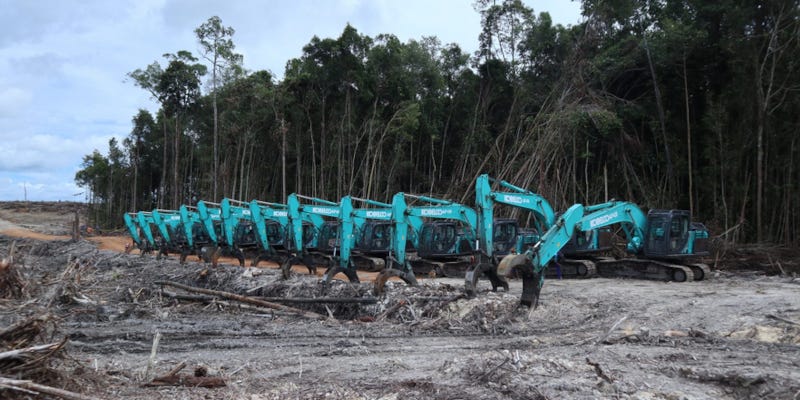
The Kampar Peninsula REDD project has always been controversial. In 2008, Fred Pearce mentioned the project in an article about REDD in New Scientist. Here’s how Pearce described the project:
Meanwhile, some huge forest destroyers are drawing up plans to get compensation. On the Indonesian island of Sumatra, for instance, giant pulp mills are responsible for vast amounts of carbon being released into the air as they log rainforests and drain peat bogs to plant new trees. One of them, Asia Pacific Resources International (APRIL), wants to set up a REDD pilot project under which it will block the canals that now drain the Kampar swamp. APRIL could receive tens of millions of dollars a year in compensation for protecting the forest and not releasing the peat carbon. The project is genuine and is based on sound science, but the reductions are only possible because the company has been so destructive in the past.
In 2011, Bill Laurance, a forest scientist with James Cook University in Australia, described APRIL’s destruction in Sumatra as “an ecological Armageddon”:
“Mowing down vast expanses of primary forest and converting it into monocultures of exotic trees which are grown to be four, five years old and then cut down, like you cut the grass and turn into paper pulp, this is not something I define as environmentally sustainable. It’s something different altogether.”
In January 2014, APRIL released a “Sustainable Forest Management Policy”. Greenpeace pointed out that APRIL is the “single largest driver of deforestation for pulp in Indonesia” and that the policy announcement is “essentially a licence to continue forest clearance”.
Analysis by Nusantara Atlas reveals that over the past two decades, PT RAPP, an APRIL subsidiary, has cleared 128,267 hectares of peat swamp forest in Riau.
APRIL’s forest destruction continues today. APRIL is owned by Indonesian businessman Sukanto Tanoto’s Royal Golden Eagle Group. RGE’s pulp mill in China has used wood from companies that have cleared vast tracts of rainforest in Kalimanatan. A massive new pulp mill, the Phoenix pulp mill on the island of Tarakan in North Kalimanatan will put Indonesia’s forests under more pressure, as monoculture pulpwood plantations replace biodiverse rainforests.
A new investigation by Adi Renaldi, published by The Diplomat, reveals that the carbon credits to be generated by APRIL’s Kampar Peninsula REDD project are based on a deforestation threat that is unlikely to have happened.
APRIL’s Riau Ecosystem Restoration (RER) project is listed on Verra’s registry with the status of “Verification approval requested”. The project covers 130,090 hectares of tropical peat swamp forest on the Kampar Peninsula and hopes to generate a total of 373 million carbon credits over the project’s 57-year lifespan.
The project developer
The project developer is a Singapore-based company called Himpanzee. The company was co-founded by Dorjee Sun and Mark Harding, who previously worked for another Singapore-based company, Carbon Conservation.
Carbon Conservation was the company that developed the failed Ulu Masen REDD project in Aceh province, Indonesia.
In 2011, East Asia Minerals Corporation, a Canadian mining company, signed an agreement to buy 50% of Carbon Conservation. Here’s how Dorjee Sun attempted to justify getting into bed with such a destructive company:
“I kind of feel like I’m being tempted by the dark side. You know, like, the force, you know? You try to do the good shit, right, working with cool people like this, like-minded, you know, good souls. But then you walk into a board room and you get your arse handed to you, you know by bankers who say like where’s my return, where’s my money, where’s my security? So now we’re starting to work with mining companies.”
No, I wasn’t convinced either.
But it does perhaps explain how Sun’s company Himpanzee could see nothing wrong with developing a REDD project for APRIL, one of the most destructive pulp and paper corporations on the planet.
Himpanzee did not respond to The Diplomat’s questions about the RER project. REDD-Monitor had the same experience with Carbon Conservation when I sent the company some questions about the Ulu Masen project.
Renaldi’s months-long investigation used satellite datasets, Verra documents, interviews, scientific research, and government and publicly available data.
“RER may have overstated the deforestation threat to its forests, which are already under regulatory constraints, in order to generate carbon credits,” Renaldi writes. “This has been enabled by methodological loopholes and lenient monitoring, reporting, and review processes under Verra’s voluntary carbon standards.”
The counterfactual baseline
Like all REDD projects, the RER project relies on a story about how forest would be destroyed if the carbon project did not go ahead. In its project description document, RER argues that without the project the entire concession area would be cleared for industrial tree plantations.
The project area consists of 78,000 hectares of forest. Four former logging concessions make up the project area. All four concessions belonged to companies linked to Royal Golden Eagle, APRIL’s parent company.
RER argues that by buying Ecosystem Restoration licenses for each concession the forest has been “saved from the risk of conversion to industrial tree plantations”.
But Renaldi’s investigation found “no evidence of any new peatland conservation plans approved by the government in the years leading up to the project’s commencement”.
RER calculates that without the carbon project, the forest would be completely cleared in seven to 10 years, with a deforestation rate of up to 10,000 hectares per year.
Renaldi writes that “historical deforestation data observed through satellite and government records in the Kampar Peninsula do not show the constant pattern of deforestation assumed in that baseline”.
Government data show that deforestation in the project area peaked in the early 2000s. After 2014, it declined sharply, partly as a result of new conversion regulations for peatlands.
From 2011 to 2019, annual deforestation on the Kampar Peninsula averaged between 2,000 and 3,000 hectares. In 2020, it dropped to 249 hectares.
Juma Maulana, a peatland researcher who works with the NGO Pantau Gambut, told The Diplomat that the deep peat on the Kampar Peninsula had high acidity and low nutrient content. This makes it unsuitable for industrial tree plantations. Clearing deep peatland is also expensive.
“Draining peat can create a domino effect,” Juma told The Diplomat. “Once dried, peat is no longer able to absorb water and eventually triggers recurring floods and fires. The risk is immense. It is economically unviable and far too dangerous.”
Juma’s comments echo a report published in 2015 by independent science institute Deltares, commissioned by Wetlands International. The report assessed the impacts of peatland drainage for plantations in the Kampar Peninsula. In its press release about the report, Wetlands International states that,
By 2014, 31% of the existing plantation area (including 5% of the existing pulp plantations) on the Kampar Peninsula already suffered from regular flooding and drainage problems. It is projected that within 25, 50 and 100 years, this will increase to 71%, 83% and 98% respectively, making nearly all plantations (pulp and oil palm) on the Kampar Peninsula peatland economically unviable in the middle to long term.
The additionality claims
The next problem with APRIL’s Riau Ecosystem Restoration project is additionality. The RER project has to prove that the reduced emissions from deforestation, and in this case from draining peatlands, are a result of APRIL’s actions under the project and not because of government policies or legal obligations.
“In the case of RER,” Renaldi writes, “layers of protection policies and regulations were already in place long before the carbon project commenced.”
Renaldi lists the regulations affecting peatlands in Indonesia — specifically relating to the concessions in the Kampar Peninsular:
In August 2009, the Ministry of Forestry issued a new regulation that required logging and plantation companies to carry out ecosystem restoration as part of their operations.
Between 2010 and 2011, before RER had bought the Ecosystem Restoration license, a pulp wood company called PT Surya Alam Perkasa, applied for a permit to clear peat swamp forests and establish industrial tree plantations on one of the four concessions. The Indonesian government rejected the application, because of the moratorium on new forest concessions, signed in May 2011 by then-President Susilo Bambang Yudhoyono.
In 2017, under a new peat restoration policy, the government ordered the protection of peatlands with a depth of more than three metres. Companies had to exclude deep peat from conversion operations. The government offered a land swap scheme that offered replacement concessions outside peatland areas.
In 2022, Agus Justianto, who at the time was director general of sustainable forest management at the Ministry of Environment and Forestry, told Media Indonesia, that the former logging concessions that make up the RER project area were never approved for conversion into industrial tree plantations. They were included in the moratorium map for the termination of new permits (known by the abbreviation PIPPIB).
”After becoming ex-HPH [Forest Concession Right] areas, these four restoration concessions were included in the PIPPIB and reserved for ecosystem restoration permits,” Justianto told Media Indonesia.
“The narrative that only the RER project successfully prevented the conversion of peatlands in the Kampar Peninsula is not supported by the evidence,” Renaldi writes.
The auditors
APRIL’s RER project was validated by an Indian company called Earthood Services. In 2023, Verra raised 24 issues in a Project Review Report. But the issues raised by Verra led only to revisions, recalculations, and editorial corrections, “without any fundamental changes to its baseline emission claims”, Renaldi writes.
During the validation process, Earthood was supposed to review relevant national policies and regulations as they relate to the carbon project.
“However, the available project documents do not display a regulatory analysis that responds to policy shifts in the forestry sector,” Renaldi notes.
Predictably enough, Verra decided that the RER project met its standards. Renaldi describes the auditing process as “lenient”.
The greenwash
Made Ali is an environmental activist and independent researcher based in Riau. He pointed out that the narrative behind the RER project is that APRIL is saving the forest that APRIL itself is threatening. Ali told The Diplomat that,
“This also demonstrates a classic greenwashing tactic. They may protect one area, but the company continues to drive deforestation in Riau and elsewhere. Turning that protection into tradable carbon credits raises serious ethical questions.”
Refki Saputra, a forest campaigner with Greenpeace, told The Diplomat that the RER project is simply a new part of APRIL’s business portfolio. The aim is to greenwash the company’s continuing forest destruction.
“This does not reflect a genuine ambition to truly reduce emissions and prevent deforestation,” Refki told The Diplomat.