


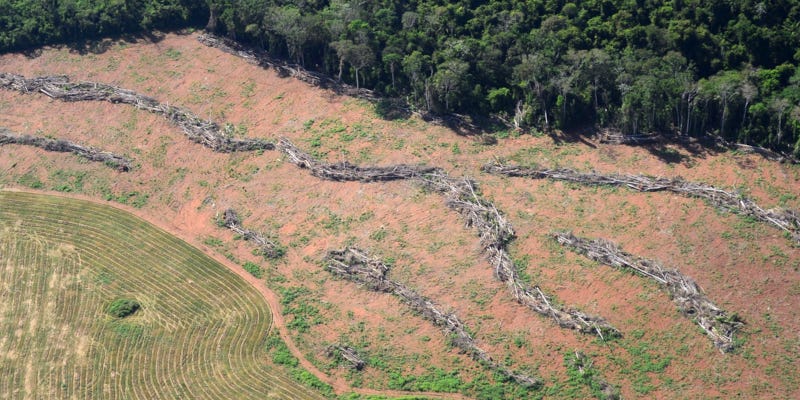
The Amazon rainforest faces unprecedented pressure from climate heating and from deforestation. A new study published in Nature finds that these pressures could lead to “system-wide changes across major parts of Amazonian ecosystems”. If deforestation continues in the Amazon basin, a tipping point could be reached at global heating of 1.5 to 1.9°C resulting in two-thirds of the Amazon rainforest shifting to degraded forest or a savanna ecosystem.
The authors conclude that,
Overall, our results reinforce the need to keep global warming levels below 1.5 °C and halt deforestation, as well as ecologically restore degraded forests to avoid high transition risks across the Amazon forest system.
We are currently at 1.4°C of global heating and about 17 or 18% of the Amazon rainforest has been deforested. A tipping point could be reached with global heating of 1.5 to 1.9°C and deforestation of 22 to 28%.
Nico Wunderling, a scientist at the Potsdam Institute for Climate Impact Research and lead author of the study explains that,
“One implication is that we would lose the most biodiverse area on the planet, also economic impacts from agricultural yields would decrease, but also a third point is that the global carbon sink of the Amazon rainforest would completely disappear once it would transition over to a savanna-type vegetation.”
The study is titled, “Deforestation-induced drying lowers Amazon climate threshold,” and is written by Nico Wunderling, Boris Sakschewski, Johan Rockström (all of the Potsdam Institute for Climate Impact Research, Germany), Bernado M. Flores (Instituto Juruá, Brazil), Marina Hirota (Federal University of Santa Catarina, Brazil), and Arie Staal (Copernicus Institute of Sustainable Development, The Netherlands).
The study notes that the Amazon rainforest is “transitioning from one of the largest terrestrial carbon sinks to a carbon source”.
Rainfall feedbacks
In a statement, Arie Staal, a co-author of the study, says that,
“Global warming and deforestation affect rainfall feedbacks across the Amazon system. When deforestation interrupts moisture transport in one area of the Amazon, entire regions hundreds or even thousands of kilometres away can also lose resilience through cascading drought effects.”
The Amazon rainforest generates part of its own rainfall with up to half of the rainfall in the Amazon coming from water recycled by the rainforest. Trees in the Amazon release water vapour into the atmosphere producing rainfall across the basin. When the forest is destroyed, this water recycling is reduced leading to increased drought stress. Other forest regions therefore become more vulnerable to degradation.
“If you lose forests, then you lose rainfall,” one of the co-authors of the study, Bernardo M. Flores, tells the New York Times. “This interaction between rain and forests is at the heart of the Amazon’s resilience.”
Johan Rockström is the director of the Potsdam Institute for Climate Impact Research and a co-author of the study. In a statement, he emphasises the importance of the Amazon rainforest:
“Until now, the Amazon rainforest has played a vital role in stabilising the Earth system as a carbon sink, regulator of moisture recycling and host of Earth's richest biodiversity on land. Continued deforestation is undermining this stability, pushing the forest closer to a tipping point. This would not only be devastating for the region, but could have far-reaching consequences for the entire planet.”
“However,” Rockström adds, “these changes are not inevitable. Stopping deforestation, together with ecologically restoring degraded forests and rapid emission cuts can still reduce the risks.”
Stopping deforestation
Unfortunately, the record so far on stopping deforestation is not great.
In 2025, the loss of tropical rainforests globally fell by 36%. But this was from a record high in 2024. Brazil’s deforestation fell by 41% from the previous year. Even so, 1.94 million hectares of forest in the Amazon basin was lost.

Elizabeth Goldman, the co-director of Global Forest Watch describes the drop in deforestation in 2025 as “encouraging”. But she points out that,
“[P]art of the decline reflects a lull after an extreme fire year. Fires and climate change are feeding off each other, and with El Niño on the horizon for 2026, investments in prevention and response will be critical as extreme fire conditions become the norm.”
In 2021, at COP26 in Glasgow, Brazil was one of more than 100 countries that signed the Glasgow Leaders’ Declaration on Forest and Land Use with a commitment to “working collectively to halt and reverse forest loss and land degradation by 2030”.
We are now half way to that target date. World Resources Institute calculates that current levels of deforestation are about 70% too high to meet the target of stopping deforestation by 2030:

“Generally speaking, a good year is a good year,” Matthew Hansen, a professor at the University of Maryland told the New York Times. “But you need good years forever if you’re going to conserve the tropical rainforest.”
If deforestation in the Amazon increases again, the Amazon could cross a tipping point as soon as 2031.
Stop carbon trading!
In 2025, Rockström was one of the scientists that signed a statement published during COP30 in Belém on the urgency of both phasing out fossil fuels and stopping deforestation.

The statement made clear that trading the carbon stored in rainforests against continued emissions from burning fossil fuels is simply not an option:
The only reason we can have an orderly phase out of fossil fuels is because we assume forests will continue to be a major carbon sink. Unfortunately we have increasing evidence that forests are turning from carbon sinks to carbon sources. This happens because forests are vulnerable to climate change causing more frequent and intense droughts, fires, heatwaves and land use conversion. The main cause of climate change is burning fossil fuels, thus without a fossil phase out, forests might not have the ability to survive and thrive. This is why it’s equally urgent to have a roadmap to concurrently phase out fossil fuels and end deforestation.
Most intact tropical forests are in developing countries. The Roadmap on ending deforestation must include financial support, capacity building and robust monitoring. Forest protection cannot be used as offsets. Standing forests cannot be an excuse to keep burning fossil fuels.
The new study in Nature reinforces the urgency to stop burning fossil fuels, stop deforestation, and stop carbon trading.