

Protest at appointment of ex-President Bharrat Jagdeo of Guyana as IUCN high level envoy for sustainable development in forest countries

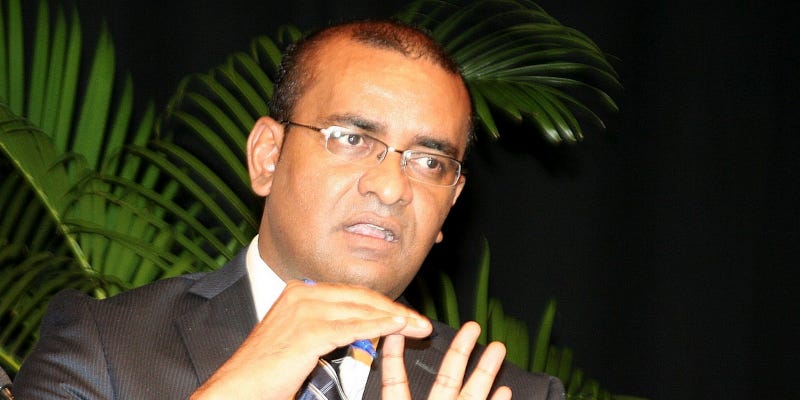
Last week, the International Union for Conservation of Nature (IUCN) announced the appointment of former President of Guyana, Bharrat Jagdeo, as IUCN High Level Envoy for Sustainable Development in Forest Countries and Patron of Nature.
Yes, you read that correctly. The world’s largest and oldest global environmental organisation has decided to hire the man whose “avoided threatened deforestation” and “payments for increased deforestation” versions of REDD have completely failed to address the structural problems underlying the forest sector in Guyana. It’s difficult to know what IUCN was thinking when it decided to appoint Jagdeo.
Yesterday, John Palmer, Senior Associate, Forest Management Trust sent the following letter to Stewart Maginnis, head of the IUCN Forest Conservation Programme, to protest at the appointment. Copies were also sent to Julia Marton-Lefevre, the Director General of IUCN, and the acting director of IUCN South America regional office (based in Quito).
From: John Palmer
Sent: 21 March 2012 09:57
To: Stewart Maginnis
Subject: protest at appointment of ex-President Bharrat Jagdeo of Guyana as IUCN high level envoy for sustainable development in forest countries.Dear Stewart,
I wish to place on record my protest at IUCN’s appointment of ex-President Bharrat Jagdeo of Guyana as IUCN high level envoy for sustainable development in forest countries. During his 12 years as President of Guyana, the national forest policy 1997 and national forest plan 2001 have been comprehensively ignored, exports to Asia of unprocessed logs from natural tropical rainforest in Guyana have increased greatly (against all national policies), illegal logging has increased and so has gold mining in forested areas, and illegal trade in those logs has been facilitated by the prevalence of corruption originating at the apex of government. A small number of Jagdeo’s crony capitalists and an increasing number of Chinese national log traders have become wealthy while prime commercial timbers are being overcut by 30 times the natural rate of regeneration. All this information is in the local Press in Guyana and could easily have been checked by IUCN.
Perhaps IUCN was swayed by the presence of Jagdeo at international meetings, calling for fast disbursement of donor funds for avoided deforestation? But in Guyana there is no credible threat of increased deforestation because the hinterland soils are among the most infertile in the world, not having been subject to rejuvenation by volcanism or marine transgression; the Guiana Shield landscape has been stable for millions of years and leaching has left impoverished soils. A proposal by McKinsey & Company in 2008 to Jagdeo based on the notorious McKinsey carbon cost abatement calculations utterly ignores the infertility of the soils and the associated absence of any agronomic trials to support the 90 per cent forest clearance and crop replacement suggested by McKinsey as the default proposition. Based on this 2008 study, Jagdeo called for international donors to provide him with around USD 580 million per year for avoided deforestation. Only Norway responded, apparently in furtherance of its commitment towards carbon neutrality by 2030 while continuing to pump oil and gas from its massive reserves. Although Norway has transferred USD 70 million to a World Bank trust fund, no money has yet been disbursed from that fund, at least in part because the Office of the President in Guyana has been incapable of putting together project proposals which are rational in terms of national development or which comply with WB environmental and social safeguards. Also, Jagdeo assured local gold miners and loggers several times that it would be ‘business as usual’ even while he was making international statements about forest conservation, PES and REDD.
Under ex-President Jagdeo, Guyana has made no explicit commitment to reduce emissions of carbon from deforestation or forest degradation, in spite of being one of the earliest countries to submit an R-PIN (mostly written by Conservation International HQ), R-PLAN and R-PP (revised up to mid-2010). No FCPF money has been released to Guyana, which wanted the InterAmerican Development Bank (IDB) to handle the transactions. Both IDB and World Bank have been ‘cussed down’, as they say in Guyana, because Jagdeo left his presidential office in December 2012 without receiving the FCPF and Norwegian money.
There is a mass of allegations in the local Press about the corrupt diversion of national budget and donor moneys on instruction from the apex of government. So far, the new President, who appears to be still under Jagdeo’s direction, has cancelled only the most challenged of the disreputable contracts arranged by Jagdeo. My guess is that this will be the ‘sacrificial lamb’ to divert attention from much larger scams. The executive President of Guyana constitutionally appoints the senior judiciary, so a flood of prosecutions for corruption is most unlikely, and Jagdeo has constitutional immunity from criminal prosecution even after leaving office.
The IUCN appointment is very handy to Jagdeo, allowing him to travel at IUCN expense, but you might check his travel arrangements/routes very carefully. I should also say that although only 47 years old Jagdeo draws a post-presidential pension which is essentially unlimited in amount and is much more generous than that of the US President.
And please ask IUCN to be more careful in future.
ENDSWith best wishes
John Palmer
Senior Associate, Forest Management Trust, Gainesville, Florida, USA
Comments following the original post on REDD-Monitor.org are archived here: https://archive.ph/TK0Ha#selection-921.4-921.15