

Tanzania must respect the rights of Maasai Indigenous People living in the Ngorongoro Conservation Area
The Oakland Institute calls on the Tanzanian government to recognise Maasai human rights and land rights.

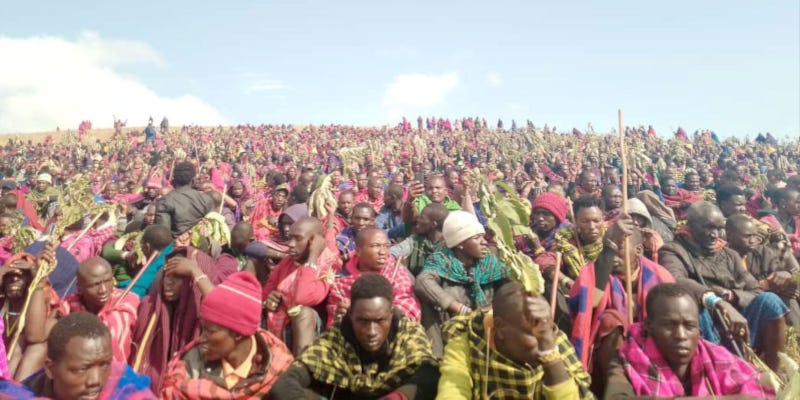
In August 2024, thousands of Maasai Indigenous People protested in the Ngorongoro Conservation Area in Tanzania. The protest raised awareness about the human rights abuses that the Maasai communities in Ngorongoro are facing, including the threat of eviction from their homes.
The protest challenged the government’s attempt to drive the Maasai out of the Ngorongoro Conservation Area by denying Maasai pastoralists the right to vote and the right to land. The government had also cut healthcare and education services.

Two Presidential Commissions
Following an international outcry, in February 2025, the Tanzanian government launched the “Presidential Commission on Land in Ngorongoro” and the “Presidential Commission on Relocation from Ngorongoro”. The commissions were supposed to take three months and release their findings at regular intervals. But the government has shared no information and published no reports.
The Oakland Institute recently issued a statement calling on the Presidential Commissions to respect and ensure the rights of the Maasai living in the Ngorongoro Conservation Area.
In May 2025, the Indigenous Peoples law and Policy Program at the University of Arizona submitted a report to the Presidential Commissions titled, “Global Insights on Conservation, Pastoralism and Sustainable Land Stewardship”.
The report makes a series of recommendations to the Tanzanian government, including the formal recognition of the Maasai as Indigenous Peoples, the full implementation Maasai’s right to free, prior and informed consent, the provision of effective remedies and reparations, and the adoption of a rights-based approach to conservation.
Both commissions have very limited Maasai representation. The Oakland Institute writes that, “It is believed that the commissions have already submitted reports, recommending further relocations to the President, who intends to release them after the October general elections.”
As the Maasai International Solidarity Alliance reports, in June 2025 president Samia Suluhu gave an extremely worrying speech in which she complained about the livestock and local communities in Ngorongoro. She said that tourists should be greeted by giraffes, zebras, and elephants, not by cows, sheep, or people.
“I want to make Ngorongoro the way it should be,” she said. Suluhu wants to encourage business and conservation. “Ngorongoro is very lucrative,” she said.
Suluhu called activists who oppose the government’s plans for Ngorongoro “thorns”. She added that she would “help remove them”.
Days later, Ngorongoro game wardens arrested and detained people, and demolished settlements and a church.
The government is attempting to pressure people living in the Ngorongoro Conservation Area to “volunteer” to resettle in Msomera, 600 kilometres away from Ngorongoro. The Oakland Institute has documented that the proposed resettlement site lacks adequate water resources and grazing land. The government has not met its promises of improved social and health services.
A history of evictions in the name of conservation
In 1940, the British colonial government created the Serengeti National Park. Initially, the Maasai were allowed to remain in the national park. But in 1957, a “community of enquiry” proposed splitting the Serengeti National Park into two areas. The first area became the present day Serengeti National Park. The second area is the Ngorongoro Conservation Area covering 829,000 hectares.
The Oakland Institute writes that “The NCA was proposed as a multiple land-use area: conserving natural resources, protecting the interests of indigenous groups, and promoting tourism.”
The colonial government persuaded the Maasai to move from the Serengeti which had been their home for centuries. In return, they were allowed to live in the Ngorongoro Conservation Area. They were promised better water resources and participation in the management of the conservation area.
The 1959 Ngorongoro Conservation Area Ordnance specifically gave the Maasai settlement rights in Ngorongoro. However, the Ngorongoro Conservation Area Authority had the power to prohibit, restrict, or control land cultivation, cattle grazing, collecting forest products and honey, and building settlements and homes.
In 1975, the Ngorongoro Conservation Area Ordnance Amendment banned all cultivation inside the conservation area. Grazing and movement of livestock was restricted. These laws had a devastating impact on the Maasai.
These impacts were so severe that in 1992, prime minister John William Malecela overturned the ban on cultivation in Ngorongoro.
Since then, a series of land laws and conservation laws have imposed restrictions on the Maasai’s livelihoods. In 2011, after three years of drought in Ngorongoro, a measles outbreak combined with malnutrition and food insecurity led to the deaths of 200 Maasai children.
“This history has had a devastating effect on the Maasai,” the Oakland Institute writes, “not just leading to displacement and dispossession, but eroding their traditional ways of life and threatening their very survival.”
Recommendations to the Presidential Commissions
The Oakland Institute has a series of recommendations for the Presidential Commissions.
As the environmental stewards of the area, it is imperative that the land rights of the Maasai are restored in compliance with national and international law. The Oakland Institute reiterates the calls made by international law experts to the Presidential Commissions:
Recognize and protect Maasai land rights, in line with international standards.
Affirm the role of Indigenous knowledge in conservation, with a focus on Indigenous women and girls.
Guarantee Free, Prior, and Informed Consent (FPIC) before any conservation initiatives are launched.
Support sustainable livelihoods rooted in Maasai knowledge, culture, and environmental stewardship.
Establish ongoing, transparent dialogue between Maasai communities and authorities.
Promote community-led education and knowledge sharing on conservation.
Implement U.N. recommendations on halting forced relocations and upholding human rights.