

“The potential for natural climate solutions related to ecosystem restoration is close to zero”
A new paper in Nature Geoscience challenges whether ecosystem restoration can really help address the climate crisis.

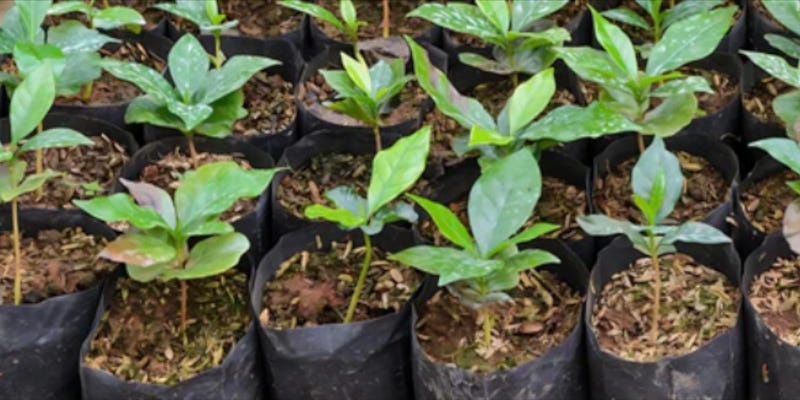
There are plenty good reasons to plant trees, restore forests, and protect remaining forests. About 70 million people including Indigenous Peoples live in forests. 1.6 billion people depend on forests for food or fuel. Forests prevent soil erosion and protect from landslides and floods. Protecting forests is crucially important for protecting biodiversity.
And trees store carbon. Many governments, corporations, environmental organisations, and the carbon trading industry promote nature-based climate solutions as an important means of addressing the climate crisis.
But a recent paper in Nature Geoscience estimates the carbon capture potential of restoring forest, shrubland, grassland, and wetland ecosystems until 2100. The scientists found that “ecosystem restoration has limited potential for climate change mitigation even if orchestrated with a pervasive shift towards sustainable, low-emissions economies globally”.
The scientists add that,
[I]f we plan restoration targets to match future climatic conditions and consider state transitions of currently natural ecosystems due to climate change, the potential for natural climate solutions related to ecosystem restoration is close to zero.1
They recommend that ecosystem restoration should be carried out anyway to restore biodiversity, support livelihoods and the resilience of ecosystem services.
To address the climate crisis we need to stop burning fossil fuels.
Limited carbon sequestration potential
The paper is titled, “Limited carbon sequestration potential from global ecosystem restoration,” and is written by Csaba Tölgyesi (University of Szeged, Hungary), Nándor Csikós (University of Szeged), Vicky Temperton (Leuphana University Lüneburg, Germany), Elise Buisson (Avignon University, France), Fernando Silveira (Federal University of Minas Gerais, Brazil), Caroline Lehmann (University of Edinburgh, UK), Péter Török (University of Debrecen, Hungary), Zoltán Bátori (University of Szeged), and Ákos Bede-Fazekas (Eötvös Loránd University, Hungary).
The paper highlights the problems with proposals for massive tree-planting schemes, such as the 2019 paper published in Science titled “The global tree restoration potential”. Grasslands and savannas sequester large amounts of carbon, mainly below ground out of reach of fire and drought.

The authors of the Nature Geoscience paper write that planting trees in open ecosystems such as grasslands and savannas “increases water scarcity, alters fire regimes, reduces biodiversity and albedo, which can offset or outweigh climate benefits”.
The scientists developed a global ecosystem restoration model and assessed the potential restorable area for each ecosystem. They then calculated the expected carbon gain up to 2100.
The model came up with an area of 28.76 million square kilometres available for ecosystem restoration. Of this, 11.6 million km² is potential forest, 4.91 million km² shrubland, 9.37 million km² grassland, and 2.83 million km² wetlands suitable for ecosystem restoration.
The scientists adjusted the numbers to look at the period from 2061-2080. The areas were adjusted to allow for factors such as tree encroachment in the tundra, or expansion of grasslands due to fires in dry tropical forests, for example.
Their model found that restoration of available land using current climate predictions would result in carbon capture of 1.92 billion tons per year, giving a total of 136.2 billion tons between 2030 and 2100. “However,” they write, “reclaiming all this land by 2030 and initiating target ecosystem restoration are extremely unlikely.”
“Supporting climate justice”
A more realistic scenario suggests sequestration of 85.2 billion tons by 2100. They argue that this number could be increased to 96.9 billion tons by “prioritizing regions with the highest potential carbon benefit”. These priority regions include temperate areas, such as American prairies and central Asian steppes and “not only formerly prioritized tropical rainforest regions”.
They write that,
On reflection, we probably received this nuanced pattern over previous studies via our ecosystem-inclusive approach, the use of rates over final carbon stocks and that we did not ignore the carbon sequestration of the ecosystem type before restoration. As a result, there is a more even biogeographic distribution of priority regions, with greater opportunities for both high- and low-income countries to contribute to large-scale restoration, supporting climate justice, ameliorating an increasing pressure on historically low-emitting countries to meet ambitious restoration targets.
The authors are critical of tree planting schemes to generate carbon credits. They note that,
Such campaigns driven by carbon credits may eventually have little climate change mitigation and rather have detrimental impacts on biodiversity and livelihoods of local people, for example, by displacing people for afforestation, which in turn can lead to deforestation elsewhere.
The figure of 96.9 billion tons of potential carbon sequestration is considerably lower than previous estimates of the benefits of nature-based climate solutions. The authors look at the various climate change scenarios projected by the IPCC in 2021. They write that their model provides “alarming results, as we predict a continuous loss of ecosystem-locked carbon, particularly in tropical forest regions, although carbon gains are also expected at higher latitudes”.
The authors are not opposed to ecosystem restoration and point out that it is crucial for the livelihoods of local communities. Intact ecosystems reduce the impact of heatwaves, prevent soil erosion, and increase the resilience of pollinator populations which are threatened by climate change.
The authors conclude that,
Due to the limited likelihood of any notable mitigation of climate change through global ecosystem restoration in the short or medium term, future policies should (1) prioritize adaptation and optimize restoration activities in favour of vulnerable peoples, (2) streamline mitigation plans by rigorous mechanisms to cut emissions instead of investing in offsetting with uncertain results and (3) support the original goal of ecosystem restoration to combat the biodiversity crisis and thereby increase the resilience of ecosystem services, rather than solely carbon sequestration.
Several of the quotations from the paper in this post include references — please refer to the paper in Nature Geoscience for these references.
Phenomenal.
Truly remarkable work.