

The REDD+ Global Summit failed to address the problems with REDD
Kwami Kpondzo recently reported on the meeting for Global Forest Coalition.

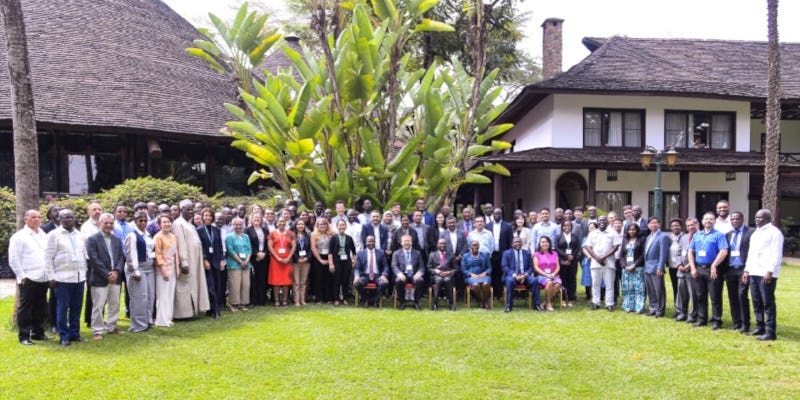
In May 2026, a REDD+ Global Summit took place at the Safari Park Hotel in Nairobi. Organised by the UNFCCC secretariat, the meeting was intended,
“to provide a space for discussion on opportunities and challenges with accessing different sources of REDD+ results-based finance, and with combining them with other forest-related funds.”
Almost 100 people took part in the meeting, from 59 countries involved in developing REDD projects or programmes. Representatives from four donor countries, 13 international organisations working on implementing REDD, and three civil society organisations also took part.
A summary report produced by the UNFCCC secretariat reports that the meeting closed with a “forward-looking sentiment”:
the task of halting and reversing deforestation and forest degradation by 2030 is demanding, but practical cooperation can accelerate progress. Building on the political momentum around the COP30 Presidency Forest Roadmap, participants expressed interest in sustaining peer learning and in continuing to refine how REDD+ delivers credible, inclusive and scalable outcomes across an evolving set of finance pathways.
This sort of sounds nice, except that it’s focused on hoped for future improvements to a mechanism that has failed to address deforestation, over a period of several decades.
The rate of destruction of primary tropical forests remains stubbornly high and is way off the target of stopping deforestation by 2030. In 2025, 4.3 million hectares of tropical primary forest were lost.

Predictably enough, the summary report of the meeting in Nairobi makes no mention of fossil fuels. Neither does it mention the climate crisis (or even climate change). Of course, there is no mention of the fact that Big Polluters are buying REDD carbon credits and using them to legitimise continued pollution.
And the fact that we simply cannot address the climate crisis by trading the carbon stored in forests against continued emissions from burning fossil fuels is nowhere to be found in the summary report.
“Time is running out”
Kwami Kpondzo, Extractive Industries, Tourism and Infrastructure Campaign Coordinator at Global Forest Coalition, recently reported on the REDD+ Global Summit.
“Time is running out,” Kpondzo writes, “yet countries continue to pursue solutions that ultimately fuel the climate crisis by allowing polluters to carry on with business as usual. These so-called solutions include, among others, REDD+ and carbon markets.”
The three-day REDD+ Global Summit held in Nairobi from 19 to 21 May 2026 made it clear that REDD+ initiatives are primarily projects that facilitate the financialisation of nature. Countries are seeking opportunities to generate funding rather than addressing the root causes of the climate crisis.
Presentations at the REDD+ Global Summit came from the World Bank, Verra, Emergent, and Conservation International. Their approach, Kpondzo notes, was to draw countries’ attention to the supposed benefits of REDD, rather than focusing on the safeguards under the Warsaw framework. “Traditional and local knowledge were not at the centre of the discussion, even though it is a crucial issue in REDD+ projects,” Kpondzo writes.
The Warsaw Framework for REDD+
“The Warsaw Framework for REDD+, adopted at COP19 in 2013 and expanded at COP21 in 2015, includes measures on social and environmental safeguards,” Kpondzo writes.
The Warsaw Framework for REDD+ included seven decisions on REDD. One of these decisions was about how and when countries report on how safeguards are being addressed and respected. The safeguards, as Kpondzo notes, were agreed at COP16 that took place in Cancun in 2010.
Shortly after COP19 finished, I wrote a line-by-line explanation and critique of the COP19 decision on reporting on safeguards. I concluded that,
The Warsaw decision on summary of information on safeguards is staggeringly weak. Governments “should” provide a summary report every two years. Least developed countries don’t even have to do that if they don’t feel like it.

Before the Warsaw Framework, several REDD projects were implemented that resulted in “negative consequences” Kpondzo writes. He highlights two of these projects, the Mai Ndombe REDD project in the Democratic Republic of Congo and the Guaraqueçaba Climate Action Project in Brazil.
The Mai Ndombe REDD project was set up by Ecosystem Restoration Associates and Wildlife Works Carbon subsequently took over the project. The project failed to carry out a meaningful process of free, prior and informed consent. “Communities were not adequately informed about REDD+,” Kpondzo writes, “and the project failed to consider customary land rights, preventing communities from claiming their rights to carbon.”
The project also failed to stop deforestation — deforestation increased quite dramatically two years after the project started.
When journalist Jonas Gerding visited the project in 2022, he found that communities living in the project area have seen few benefits.

The Nature Conservancy started the Guaraqueçaba Climate Action Project in 2001. The project is funded by three Big Polluters: American Electric Power, Chevron, and General Motors.
In 2009, investigative journalist Mark Schapiro reported from Guaraqueçaba. He found that many people that had previously lived in the project area had been forced to move. The Nature Conservancy’s local partner, Society for Wildlife Research and Environmental Education (SPVS), had forced villagers to stop using the forest and planting food crops.
In 2012, Fern carried out a series of interviews with people affected by the project. “There’s no more freedom here”, one man said. “They buy this, buy that, till there’s nowhere for us to go.”
REDD problems have continued since the Warsaw Framework
Many REDD projects implemented since the Warsaw Framework for REDD+ have faced similar problems, Kpondzo notes. He refers to a 2018 report by CIFOR titled, “Transforming REDD+: Lessons and new directions”. The report found a series of ongoing problems with REDD. “We point to critical issues and suggest how to move forward to make forest-based mitigation effective, efficient and equitable,” the report states.
Among the problems that CIFOR highlights are the following:
A global carbon market – of which REDD+ was to be an integral part – never
materialised. Finance for REDD+ has been provided by only a small group of
countries and multilateral institutions, and readiness funding is drying up.
Results-based payment has not been the driving force it was expected to be, due to a lack of finance and other challenges, including questions of what to pay for, whom to pay and how to set reference levels.
Coordination, often cited as the solution to many challenges, is in reality hampered by the conflicting interests attached to land and forest use.
Land tenure and the rights of indigenous peoples and local communities have been prominent on the REDD+ agenda since its early days. Implementation has resulted in some progress on tenure, but not enough to ensure a proper functioning of REDD+.
A review of the available evidence on policy impacts finds that national and
subnational policies contribute to forest conservation, but their effectiveness is low on average, especially in the tropics.
Since the CIFOR report, a number of critical reports about carbon trading and REDD have been published. Recently Simon Counsell and Jutta Kill wrote a series of articles titled, “Crooked Carbon Business” which highlights 11 problematic forest carbon projects. Counsell and Kill also produced an overview of documentation of “inherent contradictions of carbon offsetting and how these consistently generate conflicts and ‘phantom’ credits”.

Kpondzo concludes his report on the REDD+ Global Summit as follows:
The first UNFCCC REDD+ summit held in Nairobi in May 2026 highlighted diminishing possibilities for accessing funding to continue forest conservation and carbon offsetting projects in the future. This raises an important question: Why invest existing funds in projects that fail to solve the climate crisis, destroy the livelihoods of forest-dependent communities, and distract countries from taking real climate action?
Instead of halting deforestation and forest degradation, REDD+ has commodified forests and forest life as carbon, rather than recognising their intrinsic value. These projects even count monoculture tree plantations as forests, misleadingly presenting reduced deforestation figures while ignoring the destruction of primary forests and biodiversity. In reality, monoculture plantations are harmful, are not true forests, and do not store carbon as primary forests do. Where do the carbon credits to be sequestered, sold, and turned into profit actually come from?
It is clear that polluters want to continue emitting CO₂, which is why they support REDD+ processes and carbon trading schemes. Is REDD+ truly a solution to climate change? We are losing forests at an alarming rate despite the proliferation of REDD+ projects. Now is the time to consider alternative approaches.