

Tomorrow’s Tropical Forests Forever Facility meeting is shrouded in secrecy
“Which version is being marketed in Rotterdam?”

Tomorrow, 26 May 2026, will see the latest meeting in the development of the Tropical Forests Forever Facility. The meeting will take place in Rotterdam and is titled, “Inside the TFFF: An Exclusive Investor Convening.” It is billed as “An exclusive convening for investors and policymakers offering a deep dive into the Tropical Forests Forever Facility (TFFF).”
The meeting is hosted by the Netherlands government, Finance for Biodiversity Foundation, Robeco, and WWF Netherlands. Robeco is an asset management firm. Finance for Biodiversity Foundation was launched by 26 financial institutions in 2020 with the Finance for Biodiversity Pledge. More than 200 institutions have now signed on.
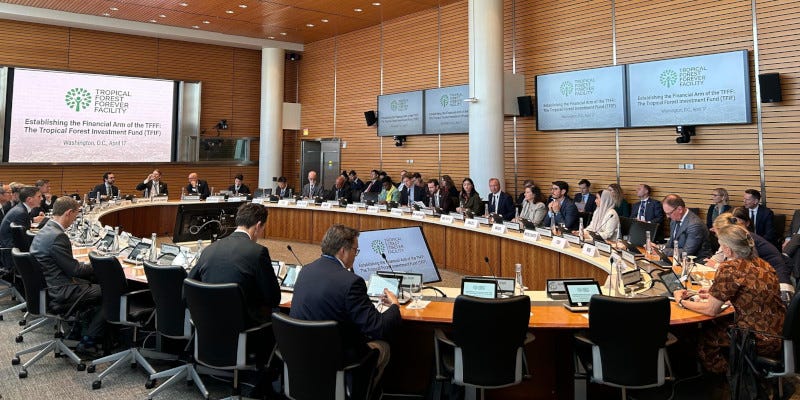
In April 2026, the TFFF held a meeting as part of the IMF and World Bank Spring Meetings. Brazil and Norway agreed to co-chair both the Tropical Forest Investment Fund Transition Committee and the TFFF Interim Board.
In May 2026, the TFFF held a dialogue during the UN Forum on Forests in New York. In a press release about the meeting, TFFF states that, “Since COP30, the Facility has made fast progress toward implementation.”
“Fast progress” is something of an exaggeration, to put it mildly.
TFFF aims to raise US$25 billion from countries and philanthropic organisations. So far, Brazil and Indonesia have committed US$1 billion each. France has pledged US$578 million, Norway US$3 billion, and Germany US$1.17 billion.

“Risky and unnecessarily complex”
Neither Germany nor Norway appear particularly convinced about their pledges.
A recent parliamentary question from Germany’s Green Party reveals that the government cannot say where the money will come from, or over what period the money will be paid out. The German Development Minister Alabali Radovan previously stated that the German money would be provided in the form of equity. But this no longer appears certain, according to reporting by RiffReporter.
In Norway, Development Today reports that one of the conditions attached when prime minister Jonas Gahr Støre pledged US$3 billion to the TFFF in Belém in November 2025, was that the pledge needs parliamentary approval.
Nikolai Astrup is a member of parliament with Norway’s Conservative Party and was previously Development Minister. Commenting on Norway’s TFFF pledge, he told Development Today that,
“This appears to be a risky and unnecessarily complex transaction, which in the worst case will cause Norway great losses without any funding for the conservation of the rainforest.”
Norway’s climate minister, Andreas Bjelland Eriksen declined Development Today’s request for an interview.
Støre is now asking Parliament to authorise the loan which would be paid over the next ten years, only if the remaining conditions are met. These conditions require that the TFFF raises US$10 billion by the end of this year; that Norway’s contribution is less than 20%; and that the funding model is sustainable and maintains “an acceptable level of risk”.
None of these conditions has, so far, been met, as Development Today points out.
Development Today also reports that the Norwegian Climate Ministry has hired Knut N. Kjær and Dag Løtveit to “assist with reviewing and improving the TFFF concept”.
In 1998, Kjær was hired as the first manager of the Norwegian Government Pension Fund Global, which is now the world’s largest sovereign wealth fund. It is commonly called the Oil Fund — because that’s where the money originally came from. Kjær then hired Løtveit to lead the Oil Fund’s investment in bonds.
When Development Today asked the Climate Ministry for Kjær and Løtveit’s terms of reference, a spokesperson replied that, “This is on-going work related to the Norwegian conditions for the loan contribution. It is too early to share anything beyond that.”
And Kjær told Development Today “It is not possible for me to comment on this matter now.”
Can the TFIF outperform the Oil Fund?
Several economists have argued that the TFFF is extremely risky and market volatility, or a collapse, would leave no money left for tropical forest countries.
Bjørn H. Amland of Development Today argues that to succeed, TFFF would have to raise almost four-times the bond earnings of the Oil Fund over the past decade.
The TFIF will borrow most of the US$125 billion that it plans to invest in bonds issued by governments or corporations, mainly in emerging markets. TFIF relies on earning between 2.47% and 3.25% more than the interest the US Treasury pay to buyers of US bonds.
The TFFF has to cover a series of expenses before it can start payments to tropical rainforest countries for protecting their forests. Development Today summarises these payments as follows:
pay interest on almost all the money it raises;
cover its administrative costs;
allocate funds for reserves for risk reduction;
build up equity capital; and
repay the US$25 billion it hopes to raise from governments.
Tropical rainforest countries receive whatever is left over. If the returns on the TFIF are too low, the amount paid per hectare of forest will be reduced.
The Oil Fund has low management costs. It does not borrow the money that it invests, so there are no interest payments. Only 5% of the Oil Fund’s money can be invested in emerging economies. The TFFF will invest in both emerging and OECD countries. But, according to the most recent TFFF concept note, it hopes to “Act as a significant new investor in debt issued by Emerging Markets and Developing Economies.”
Investing in emerging economy bonds can give higher returns but it is considerably riskier.
Development Today has compared the TFIF’s hoped for earnings with the performance of the Oil Fund in the bond market. Amland writes that, “According to latest public version of the TFFF concept note, the fund will need an annual gross yield on its bond portfolio in the range of 7.0 to 8.25 per cent.”
Since the Oil Fund was established in 1998, the average annual return on bond investments has been 3.85%. Over the past decade, the Oil Fund had a return of 2.04% per annum.
That is significantly less than the TFFF’s hoped for returns.
The TFFF’s Missing Billions
In the week before the TFFF’s meeting in Rotterdam, German economist Max Alexander Matthey has written a series of articles pointing out ongoing problems with the TFFF.
Matthey notes that the legal incorporation of the TFIF is not yet in place. There is no published rating analysis, or a public risk analysis. And the Concept Note has not been updated to incorporate various design revisions that have been announced since October 2025: Concept Note 3.1. (This version is still only available in English.)
Matthey lists the following missing documentation:
❌ The Funding Path: A clear, written trajectory from the roughly $5.7 billion currently pledged to Norway’s $10 billion launch threshold.
❌ The Market Rationale: A transparent financial theory explaining how a multilateral fund can reliably earn hundreds of basis points after cost on a carry trade that commercial markets have left unexploited for decades.
❌ The Rating Analysis: The published rating-agency assessment that the TFFF’s own Financial Q&A confirms has already been performed privately.
❌ The Term Sheet: A precise description, in writing, of how the senior tranche is actually structured and protected.
According to Concept Note 3.1 the return of 2.47% to 3.25% over US Treasuries will fund a US$2 billion annual pay out to tropical forest countries.
Matthey points out that the previous Concept Note (3.0 dated August 2025) gave an example based on a 3% gross spread on investments in BB+ emerging market bonds. This, according to Concept Note 3.0, would give a return of US$3.4 billion for payments to tropical forest countries.
“The near-term forest payout fell 41% between drafts,” Matthey writes. “This retreat was never acknowledged.”
Matthey notes that even US$2 billion is optimistic. He writes that, “the honest case for annual forest payments on a $125 billion fund lies between $213 million and $738 million”. That gives a midpoint of US$475 million, about one-quarter of the US$2 billion in Concept Note 3.1.

The TFFF was designed to give US$4 per hectare of protected forest to tropical forest countries. “The honest case is $0.50 / hectare,” Matthey writes.
And that is the favourable estimate: it assumes the post-GFC [global financial crisis] EM [emerging markets] credit rally extends another forty years, the senior tranche secures its AAA rating, operating costs come in at the Concept Note’s promised floor rather than the comparator-implied ceiling, and the full $25 billion sponsor base is raised — against confirmed pledges of under $7 billion as of May 2026. Strip any one and there is no forest payment to make.
João Paulo de Resende, under-secretary for economic and fiscal affairs at Brazil’s Ministry of Finance argues that the TFFF’s financial structure has been subjected to extensive testing and modelling. In October 2025, he told the Financial Times that,
“We’ve run this through four different financial advisers, the World Bank Treasury, credit rating agencies . . . and they’ve all confirmed that at least one version of this can work.”
Matthey asks, “Which version is being marketed in Rotterdam?” It’s a good question.
For anyone outside the inner workings of the TFFF and TFIF, there is currently no way of knowing.
Tomorrow’s meeting is for investors and policymakers only and it remains to be seen how much information will be released about the discussions after the meeting.
Good article. Thanks.