

Verra suspended the Pacajai REDD project in September 2023. Companies have retired more than 2 million carbon credits from the project since then
Including Mastercard, BlackRock, and Philip Morris.

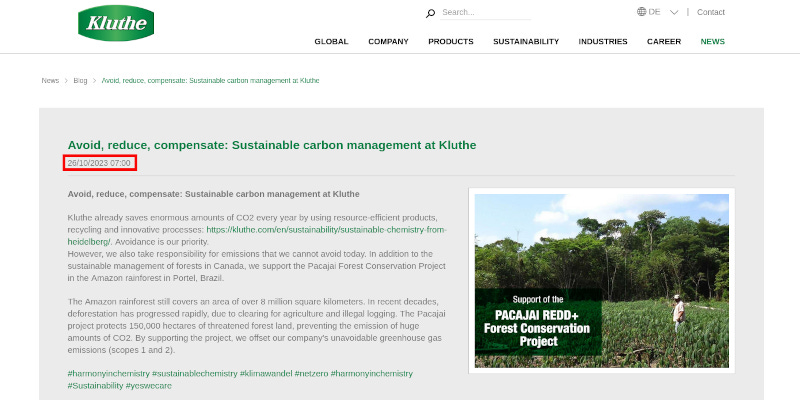
Verra suspended the Pacajai REDD project in Brazil in September 2023, pending an investigation into the project’s validity. That didn’t stop Mastercard, BlackRock, Philip Morris International from retiring carbon credits from the project to offset their greenhouse gas emissions.
An investigation published this week by journalist Yusuf Khan in the Wall Street Journal reveals that more than 140 corporations retired carbon offsets from the Pacajai project after Verra suspended the project. Verra’s investigation is still ongoing. The Wall Street Journal reports that “Verra didn’t provide a timeline of when its review would be completed.”
“The Pacajai REDD+ project was placed on hold following stakeholder concerns that it was being implemented on public land,” Verra told the Wall Street Journal. In its suspension notice, Verra explains that reports from the state of Pará “indicate that certain private-sector carbon projects may overlap with public land, specifically state forest areas, where local authorities have not issued the required permits”.
This is a project with a bizarre backstory. The director of the company running the project is the son of Brink’s-Mat gangster, Kenneth Noye. His other son, Brett, is also involved — and he has something of a history with UK scam companies.

The local Public Defender’s Office is suing four REDD projects, including Pacajai. It is seeking US$4 million in damages for local communities in the area of the four projects. The buyers of carbon credits are not involved in the lawsuit.
The Wall Street Journal reporting is based in part on research carried out by the NGO Corporate Accountability looking at problematic carbon credits in Brazil. This post focuses on the Pacajai project. I’ll look at Corporate Accountability’s report in a future post.
Between January 2024 and July 2025, more than 2 million carbon credits from the Pacajai project were retired. In 2024, the project was the seventh-largest offset project in the world in terms of credits retired. In addition to the 140 companies named in Verra’s registry as having retired carbon credits from the Pacajai project, many other companies chose to retire carbon credits anonymously.
After Verra suspended the project, Philip Morris retired 25,000 credits, Mastercard retired more than 11,000, and BlackRock retired 5,000.
In total 10.06 million carbon credits have been issued from the Pacajai project of which 7.3 million have been retired. The Wall Street Journal reports that “companies bought Pacajai credits that were sold for less than $2 a ton”.
In its assessment of the project, carbon credit ratings agency BeZero stated that the project has a “significant” risk of over-crediting and leakage. It also has “notable” risk of non-permanence and “weak” additionality.
The Wall Street Journal reports that “BeZero and Sylvera both said the Pacajai project was unlikely to have any positive impact in reducing net carbon emissions”.
Mastercard
In its 2024 Impact Report, Mastercard states that since 2020 the company’s global operations have been “carbon neutral”. This is in part achieved by buying carbon credits. Mastercard states that,
We employ high-integrity carbon credits, verified to recognized standards, and only in conjunction with real reductions in carbon emissions. We strive to select credits that have characteristics of performance and source them from a range of geographic regions. Project types include forestry, clean cookstoves, renewable energy and destruction of refrigerants.
Mastercard told the Wall Street Journal that its carbon credits were retired by 3degrees, a company that claims to sell “high-integrity carbon credits that drive meaningful climate impact”. 3degrees bought the Pacajai credits in 2021 and sold them to Mastercard in October 2023, the month after Verra suspended the project. 3degrees retired the credits for Mastercard in December 2024.
3degrees told the Wall Street Journal that it wasn’t aware that the project had been suspended when it sold the credits to Mastercard.
BlackRock
In its 2024 Climate Report, BlackRock states the following:
As part of BlackRock’s efforts to address emissions outside of its value chain, BlackRock purchases what it considers to be high-quality carbon removal credits to invest in projects with greater climate impact, advance deployment of carbon removal technologies, and to address the emissions from its operations that cannot currently be avoided or reduced. Building upon the selection criteria and due diligence process BlackRock established in 2023, the firm enhanced its carbon credit portfolio in 2024 by investing in all technology vectors of nature-based, hybrid-based, and engineered-based removal credits with higher durability.
BlackRock told the Wall Street Journal that the Pacajai carbon credits were bought by a pension fund that BlackRock took over in May 2021. BlackRock didn’t choose to buy the Pacajai credits itself. The credits were supposed to “offset” the emissions of an industrial project that the pension fund was funding. And the credits were bought and retired by a company that was managing the credits for the pension fund.
Philip Morris
Philip Morris writes in its Integrated Report 2024 that,
Our PCI [Portfolio of Climate Investments] investments provide a standardized, technically robust approach to compensation, ensuring a pool of high-quality carbon credits that deliver both environmental and social impacts.
The company applies a due diligence process developed with Clarmondial, its carbon finance adviser, to “assess investment quality and impact”
Philip Morris told the Wall Street Journal that the credits were used as part of the company’s “carbon neutrality” programme. Retiring carbon credits was “simply the expected completion of the offsetting process — not an indication of any issue” Philip Morris said. It bought the credits before the project was suspended.
Evertreen
Evertreen is another company that bought carbon credits from the Pacajai project. REDD-Monitor wrote about the company in December 2025. Evertreen sells carbon credits which it claims are from its tree planting operations. But the company is not transparent about where its tree planting actually takes place, or exactly how it calculates how much carbon is stored in the trees.
Evertreen also buys carbon credits from from several other REDD projects that Verra has suspended.

In May 2025, Evertreen retired one carbon credit from the Pacajai project for “employee travel”. In November 2025, Evertreen retired 3,192 Pacajai credits for “Evertreen end users”. In December 2025, Evertreen retired 1,000 Pacajai credits. And in January 2026, Evertreen retired a further 500 Pacajai credits.
A “deep structural flaw” in Verra’s system
The Wall Street Journal points out that, “Mastercard, BlackRock and Philip Morris haven’t been accused of breaking any rules.” Under Verra’s rules, the carbon credits that were issued before the project was suspended are still valid. No new carbon credits will be issued, but the project can still sell carbon credits that were issued before the suspension.
But the Pacajai REDD project highlights what CarbonPlan calls a “deep structural flaw” which is that Verra doesn’t know how to deal with projects on its registry that have massively exaggerated the number of carbon credits the project generated.
In October 2025, Verra completed a review of the Kariba REDD project and found that it had issued 15.2 million “excess credits” to the project. Verra requested compensation from the project developer, Carbon Green Investments.
But the chances of Carbon Green Investments paying up are extremely slim. Carbon Green Investments has withdrawn the project from the Verra registry. Carbon Green Investments “ran up its tab and skipped town”, CarbonPlan writes.
By coincidence, the project developer of the Pacajai project, was initially registered at the same address as Carbon Green Investments in the secrecy and tax haven of Guernsey. When the project started, the project developer was Avoided Deforestation Project (Manaus) Limited and the project was called the ADPML Portel Pará REDD project. In August 2020, a company called Amazon Forest People Ltd was incorporated in the UK — with the same director, Kevin Tremain, Kenneth Noye’s son.
In October 2023, The Mirror reported that Noye was living in Amazon Forest People’s head office in Sevenoaks.
Both Carbon Green Investments and Avoided Deforestation Project (Manaus) Limited were registered at the offices of Oak Directors Limited, part of the Oak Group:


A Portuguese version of this post is available here:
https://blogdopedlowski.com/2026/03/11/verra-suspendeu-o-projeto-redd-pacajai-em-setembro-de-2023-desde-entao-as-empresas-retiraram-mais-de-2-milhoes-de-creditos-de-carbono-do-projeto/